

Executive Overview
Artificial intelligence has crossed the threshold from experimental novelty to standard enterprise utility. Yet, product teams across industries face a recurring, paradoxical phenomenon: an AI feature is deployed to save users time on a specific task, only to result in those same users spending that saved time checking, correcting, and verifying the AI’s output.
When digital products introduce generative or analytical models without rigorous upfront evaluation, they risk shifting labor rather than reducing it. Users are quietly transformed from active problem-solvers into anxious, fatigued checkers.
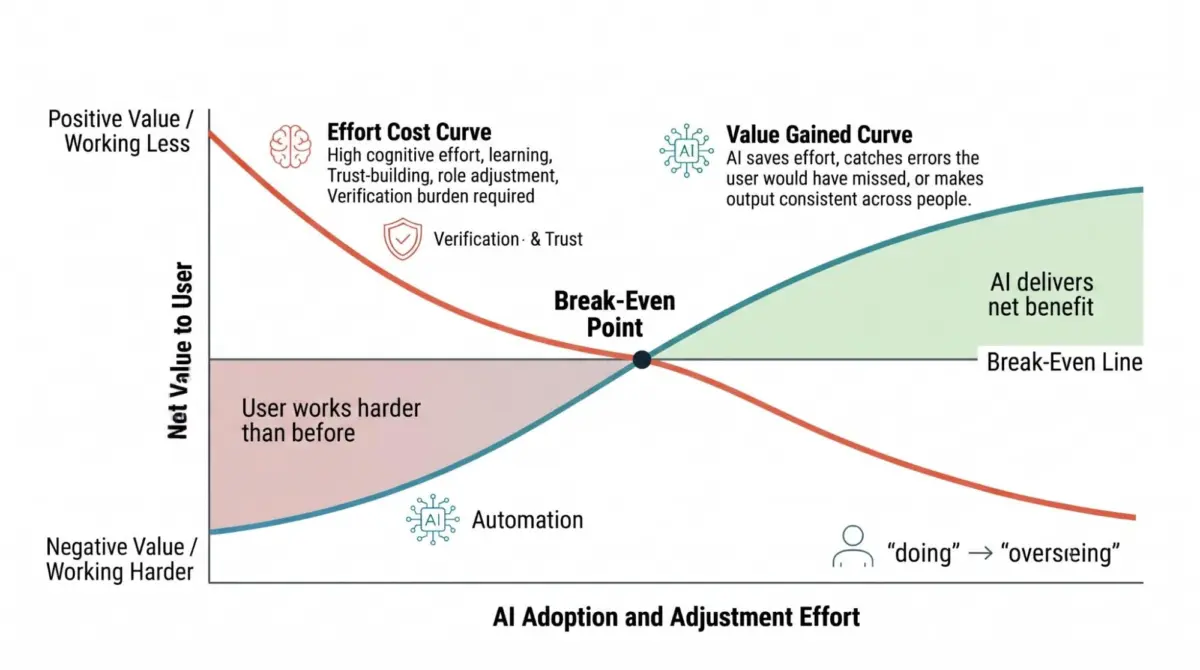
To address this friction, product organizations must adopt a systematic evaluation framework. By focusing on the break-even line—the precise threshold where the value returned by an AI feature definitively outweighs the cognitive cost of learning, adjusting, and verifying it—teams can prevent costly development missteps. This article explores a practical four-question audit designed for product teams, illuminates the hidden psychological and operational costs of enterprise AI integration, and demonstrates how strategic rescoping can transform a failed feature into an indispensable tool.
Detailed Chronology: The Anatomy of an Enterprise AI Failure and Pivot
The real-world consequences of misapplied artificial intelligence are best illustrated through case studies in high-stakes environments. Consider a product team at a major health insurer tasked with integrating generative AI into the daily workflow of benefits appeals specialists.
Phase 1: The Initial Misstep
The team’s initial objective was clear: automate the generation of written determinations for benefits appeals. Technologically, the feature functioned flawlessly. The model ingested complex medical policies, patient histories, and clinical rationales, outputting fully drafted determination letters within seconds.
However, user adoption flatlined almost immediately. Specialists actively avoided the feature. Those who attempted to use it discovered a disheartening reality: reviewing an AI-generated determination letter carefully enough to sign off on it took just as long as writing it from scratch. Worse, specialists had to hunt for nuanced, subtle mistakes—errors of context or medical policy interpretation that they would never have made themselves.
Rather than lightening the cognitive load, the AI feature added a heavy layer of editorial oversight to a task these professionals had already mastered. The automation penalty outweighed the automation benefit.
Phase 2: The Diagnostic Evaluation
Recognizing the adoption failure, the product team conducted a rapid qualitative evaluation with the specialists. The feedback was unequivocal. Reading fluent, confident AI prose required intense concentration to catch hallucinations or misapplied policy clauses. The interface forced specialists into a passive verification loop that drained their mental reserves.
Phase 3: The Strategic Pivot
Armed with this insight, the product team rescoped the release. Instead of tasking the AI with writing the final determination, they shifted its responsibility upstream.
In the second version of the software, the AI was programmed to instantly surface the specific policy provisions, regulatory guidelines, and relevant prior decisions pertinent to each specific appeal. The actual writing of the determination was left entirely in the hands of the human specialist.
The transformation was immediate:
- The arduous manual search step vanished from the workflow.
- Review and completion times dropped significantly.
- The core professional competency—synthesizing medical judgment and drafting the final ruling—remained firmly with the human expert.
Crucially, the underlying technology in both versions was identical. The dramatic difference in user adoption and efficiency came down to which part of the workflow the AI handled.
Supporting Context & Metrics: The Human Cost of Automation
Every interface modification imposes a toll on the user before it yields any operational dividend. Users must mentally reconstruct how the tool operates, locate new interface elements, and establish a baseline calibration of trust in the AI’s outputs.
Cognitive psychology underscores the fragility of this process. Research into working memory capacity—such as Nelson Cowan’s foundational 2001 reviews—indicates that human working memory holds a severely limited number of items simultaneously (approximately four chunks of information). Enterprise AI features draw heavily on this finite cognitive reservoir.
Professional Identity and Cognitive Friction
When an AI feature is introduced into a complex workflow, it fundamentally alters the user’s daily reality. Delegating synthesis turns the user into a checker. Delegating recommendations reduces their job to a rubber-stamp signature.
For knowledge workers whose professional standing is tied to their expertise, these shifts can feel like a professional demotion. Research by Sophia Ackerhans and colleagues (2025) exploring clinician interactions with AI-assisted decisions revealed that physicians asked to sign off on machine-generated choices reported severe threats to their professional identity. Intriguingly, explanations detailing how the AI reached its conclusions simultaneously increased user trust and heightened feelings of professional threat.
The Break-Even Equation
An AI feature earns its permanent place in a product roadmap when its tangible returns exceed the adjustment and verification costs incurred by the user. These returns generally manifest in three ways:
- Errors Caught: Identifying critical edge cases or anomalies that a human reviewer would likely miss (e.g., advanced fraud-screening algorithms).
- Speed and Scale: Processing vast datasets or complex variables at a velocity unachievable manually.
- Synthesis of Ambiguity: Providing a coherent starting point when exploring open-ended options or cross-referencing disparate data streams.
The Four-Question Audit Framework
To locate the break-even line before engineering resources are committed, product teams should evaluate every proposed AI feature against four critical questions. These should be answered in collaboration with frontline users—such as loan officers, data analysts, or benefits specialists—whose daily reality is shaped by the software.
Question 1: Does this reduce the total effort the task takes for this user?
Product teams must calculate the comprehensive effort demanded of the user, including thinking, clicking, and downstream verification. Fewer clicks do not automatically equal less effort; a feature can reduce manual data entry while drastically increasing cognitive load.
- Design Condition: Clearly define the user segment served by the feature, and build intentional exit paths or alternative modes for other user segments who derive no net benefit.
Question 2: Does this beat the way the user does the task now?
Compare the proposed AI workflow against existing user workarounds, custom spreadsheets, and established habits. If a user already possesses a practiced, reliable, and fast route to an answer, introducing AI often layers unnecessary friction onto an already optimized process.

- Design Condition: Remove AI intervention points from workflows where current manual methods already reach accurate conclusions quickly and reliably.
Question 3: Can the user catch the errors?
All AI systems produce errors. Product teams must evaluate the visibility of potential mistakes, the consequences of uncaught errors, and whether users retain the necessary domain expertise to spot them. Automation bias—well-documented by human factors researchers Raja Parasuraman and Dietrich Manzey (2010)—shows that humans routinely defer to automated outputs even when those outputs are factually incorrect.
- Design Condition: Any feature with a high-consequence, low-visibility error surface must ship with transparent provenance displays and explicit verification prompts—or not ship at all.
Question 4: After a year of using this, can the user still tell when the AI is wrong?
While offloading routine tasks is beneficial, core human judgment must remain active. Relying entirely on automation causes human verification skills to atrophy over time. Radiological studies by Thomas Dratsch and colleagues (2023) demonstrate that continuous reliance on automated diagnostic suggestions degrades human accuracy over time, regardless of baseline experience levels.
- Design Condition: Embed active verification mechanisms directly into the workflow—such as periodic blind reviews or randomized manual audits—to ensure core evaluation skills do not wither through disuse.
Official Statements & Industry Perspectives
Industry leaders and product strategists increasingly emphasize that the success of artificial intelligence in enterprise environments relies less on raw model parameters and more on interface ergonomics and workflow integration.
“The race to inject generative AI into every software category has created a blind spot,” notes leading human-computer interaction researcher Dr. Elena Vance. “Product organizations frequently measure success by output generation speed rather than task completion integrity. When an interface forces a skilled professional to spend more time debugging synthetic text than it would take to author it natively, the technology ceases to be an accelerator and becomes an administrative tax.”
Enterprise UX directors echo this sentiment, arguing that the integration of AI models demands a cultural shift away from "pro-innovation bias"—the widespread assumption that deploying emerging technology is inherently progressive. By anchoring product roadmaps to empirical workflow audits, teams can shift conversations from speculative model capabilities to verifiable human productivity.
Future Outlook: Operationalizing the Audit in Roadmap Planning
As enterprise software matures, the competitive differentiator will not be whether a platform utilizes AI, but how thoughtfully that AI is integrated into the human experience.
Product teams that institutionalize the break-even audit will avoid the trap of feature bloat. By embedding the four core design conditions directly into project briefs, requirements documents, and sprint planning sessions, organizations can ensure that AI enhancements are treated not as superficial polish, but as structural architectural components.
Ultimately, human attention remains a finite and precious resource. No matter how advanced language models or predictive analytics become, the cognitive capacity of the user remains constant. By designing systems that honor this limitation, product teams can build AI features that genuinely elevate human potential, protecting professional expertise while delivering measurable, sustainable value.
