

Executive Overview
For generations, humanity has looked up at the cosmos and wondered about the true provenance of the oceans that define our pale blue dot. The conventional scientific narrative has long pointed outward, heavily reliant on the idea that Earth was born bone-dry—a scorched, volatile amalgamation of rock and dust that only grew its life-sustaining hydrosphere through a cosmic game of billiards. In this classic paradigm, icy comets, distant meteorites, and water-rich asteroids bombarded the young planet over hundreds of millions of years, slowly pooling together to form our vast seas.
However, a radical new study published in Nature Geoscience is turning this celestial narrative on its head. Researchers at The University of New Mexico have uncovered compelling evidence suggesting that Earth may have been an active participant in its own hydration. Rather than waiting passively for water to be delivered from the outer reaches of the solar system, our planet may have manufactured a substantial portion of its own water internally.
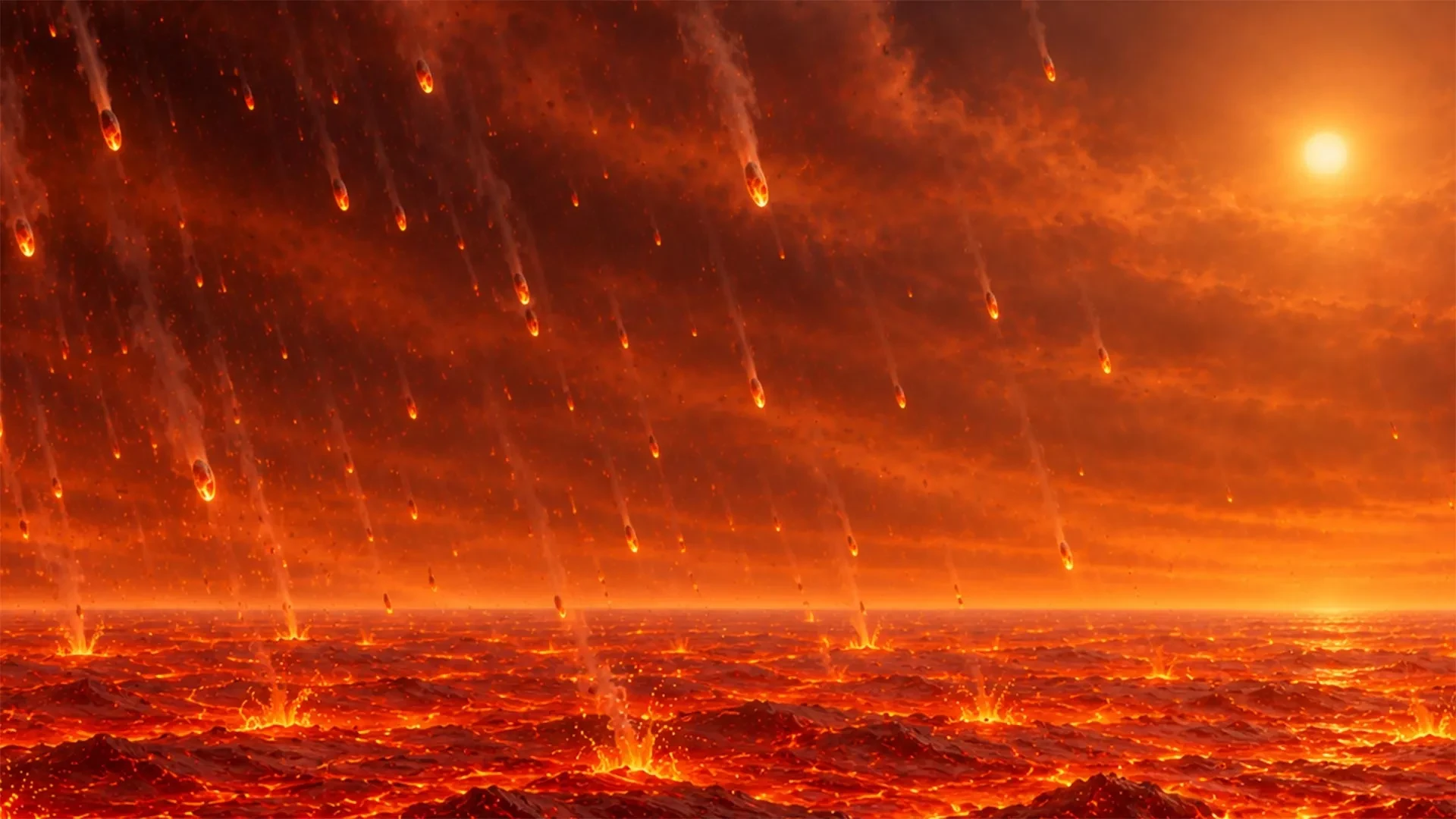
Led by graduate student Susmita Garai, alongside Professor and Director of Earth and Planetary Sciences Zachary Sharp and researcher Peter Olson, the team investigated a transformative chemical pathway. Their findings indicate that when iron-bearing rocky pebbles plummeted through the dense, hydrogen-rich atmosphere of the primordial Earth, intense heat triggered rapid, high-yield chemical reactions. This atmospheric alchemy transformed iron oxide into metallic iron, releasing massive plumes of water vapor in the process.
The implications of this discovery stretch far beyond our own geological history. If Earth-sized rocky planets naturally generate water through atmospheric-rock interactions during their formative stages, water may be an intrinsic, standard feature of terrestrial planet formation rather than a stroke of cosmic luck. This paradigm-shifting realization suggests that habitable worlds could be vastly more common across the galaxy than previously dared to imagine.
Detailed Chronology: Unraveling the Genesis of a Water-Rich World
To appreciate the gravity of the University of New Mexico team’s findings, one must trace the timeline of planetary science and the evolving theories surrounding Earth’s earliest epoch—the Hadean eon.
The Reign of the Extraterrestrial Delivery Theory
For decades, planetologists faced a profound geochemical puzzle. As the solar system coalesced approximately 4.5 billion years ago, the inner regions were simply too hot for volatile compounds like water to condense into solid ice. Consequently, the material that accreted to form the terrestrial planets—Mercury, Venus, Earth, and Mars—should have been overwhelmingly dry.
To solve this conundrum, scientists embraced the external delivery model. This hypothesis posited that icy planetesimals, comets, and carbonaceous chondrites originating from the cold outer solar system migrated inward, peppering the inner planets and depositing vast reserves of water. While this theory successfully accounted for the presence of water, it struggled with structural inconsistencies. Researchers found it difficult to model how a sufficient volume of icy material could traverse such vast interplanetary distances without evaporating entirely, nor could it fully reconcile the subtle isotopic signatures—such as the ratio of deuterium to hydrogen—found in Earth’s oceans compared to known cometary samples.
The Advent of Pebble Accretion
Over the past decade, a new framework known as "pebble accretion" has gained significant traction within the astrophysical community. Instead of viewing planet formation solely as the slow, violent collision of massive asteroid-sized bodies, pebble accretion suggests that planets grew rapidly by sweeping up millimeter- to centimeter-sized drifting pebbles.
This model revolutionized how scientists understood the timeline of planetary growth, solving several longstanding mathematical and physical paradoxes in planetology. Yet, until now, the chemical consequences of these rocky pebbles interacting with planetary atmospheres during the chaotic accretion phase remained largely unexplored.
Recreating the Fires of Creation
Recognizing a critical gap in the literature, the New Mexico research team designed a series of high-temperature experiments to simulate the hellish conditions of the early Earth. Approximately 4.5 billion years ago, as Earth swept up countless rocky pebbles, its accumulating mass allowed it to capture a dense, primordial atmosphere packed with hydrogen gas.
Dr. Susmita Garai spearheaded the experimental phase, subjecting silicate rock samples containing iron oxide to extreme thermal stress. Operating within a temperature range of 1,200 to 1,400 degrees Celsius—temperatures mirroring the hellish lower layers of a proto-planetary atmosphere—the researchers introduced flowing hydrogen gas to
the reaction chambers.
The results were instantaneous and astonishing. Within minutes, the hydrogen gas reacted violently with the iron oxide inside the hot silicate rocks. This reduction process systematically stripped oxygen from the iron oxide, converting it into metallic iron while instantly generating water vapor.
Subsequent control tests utilizing inert helium gas—which failed to produce water or reduce the iron oxide—confirmed that hydrogen was the indispensable catalyst. The speed, scale, and efficiency of the reaction caught the research team entirely off guard, proving that Earth’s volatile inventory could have been home-brewed from the very materials used to build its crust.
Supporting Context & Metrics: The Scale of Primordial Alchemy
To understand the profound nature of this discovery, it is essential to examine the specific metrics, chemical pathways, and quantitative estimates derived from the study.
The Chemical Mechanics of Atmospheric Hydration
The core chemical reaction identified by the research team is a classic reduction-oxidation (redox) process, tailored to the extreme physics of a young, forming planet:
- The Ingredients: Silicate rocks rich in iron oxide ($FeO$ or $Fe_2O_3$) interacting with a dense, hydrogen-rich ($H_2$) proto-atmosphere.
- The Catalyst: Extreme thermal energy ranging from 1,200°C to 1,400°C, typical of impact-heated atmospheres and frictional accretion heating.
- The Transformation: Hydrogen gas strips oxygen atoms from the iron oxide within the falling rocky pebbles.
- The Products: Metallic iron ($Fe$), which would eventually sink toward the planet’s core due to its high density, and massive quantities of water vapor ($H_2O$).
Quantitative Findings and Yields
During the laboratory trials, the transformation was remarkably thorough. When exposed to high-temperature hydrogen, nearly 80% of the iron oxide within the silicate rock samples was successfully converted into metallic iron, releasing copious amounts of water vapor in the process.
When the researchers extrapolated these experimental reaction rates to the macro-scale realities of early Earth—factoring in the sheer volume of rocky pebbles accreted during the planet’s formation—the mathematical projections were staggering. The calculations indicate that this mechanism alone could have generated hundreds of oceans’ worth of water.
To put this into perspective:
- Current Ocean Volume: All of Earth’s present-day oceans, seas, and locked-up glacial ice equal roughly 1.33 billion cubic kilometers of water.
- Estimated Primordial Output: The pebble-hydrogen atmospheric reaction could have yielded an internal water supply exponentially larger than our current hydrosphere, suggesting that early Earth actually managed an excess of water that was subsequently lost to space or sequestered deep within the mantle.
Official Statements and Expert Perspectives
The academic community has received the findings with a mixture of awe and enthusiastic re-evaluation. The principal investigators behind the Nature Geoscience paper emphasize that this discovery redefines the fundamental baseline for planetary habitability.
Dr. Zachary Sharp, professor and director of Earth and Planetary Sciences at The University of New Mexico and co-author of the study, reflected on the historical significance of the work:
"Previous ideas about the source of water to Earth rely on an external source, such as comets or meteorites. Here we show that virtually any Earth-sized planet should have water by this newly identified mechanism. In order to evaluate the possibility of ‘pebble rain’ being a source of water, we needed to construct and execute some very challenging high-temperature experiments. Dr. Garai’s efforts paid off mightily, as she found that water is produced in just minutes in the high temperature environment of the Early Earth’s atmosphere."
Discussing the sheer magnitude of the water generated during the experiments, Sharp noted the surreal juxtaposition between the hostile environment of early Earth and the serene nature of our modern oceans:
"We had suspected and hoped that we would produce iron metal and water in our reduction experiments, but we really had no way of knowing how fast and how much. We were quite surprised to find that extrapolation of our work suggests that hundreds of oceans’ worth of water were likely produced in this way. Looking out over a large body of water, it is hard to imagine that that water may have been produced 4.5 billion years ago in a hell-like atmosphere, but it very well may have."
Highlighting how this discovery solves long-standing geological debates while opening new avenues for astrobiology, Sharp added:
"The idea of pebble accretion is still relatively new. It’s only been around for the last decade. But it seems to solve many problems that exist with the existing paradigm for planet formation. And now we see that it also can explain why our planet is habitable. By extension, it is reasonable to expect that other Earth-sized bodies circling other stars would also have water and possibly life."
Future Outlook: Redefining Habitability Across the Cosmos
While the laboratory results provide robust, empirical proof that rocky material can generate water when exposed to hydrogen under Hadean-like conditions, the scientific journey is far from complete. Planetary scientists now face the intricate task of balancing the books on Earth’s total volatile inventory.
Quantifying the Split: Internal vs. External Sources
A primary objective for future research will be determining the exact apportionment of Earth’s water supply. Scientists must now investigate what percentage of our modern oceans originated from this newly discovered atmospheric manufacturing process versus the traditional delivery model involving comets and carbonaceous meteorites. By analyzing isotopic signatures in deep-mantle rocks—which preserve pristine chemical signatures from Earth’s earliest days—geochemists hope to trace the fingerprint of atmospheric reduction reactions in terrestrial history.
Implications for Exoplanetology and the Search for Life
Perhaps the most profound consequence of this research lies in its application to exoplanets. Telescopes such as the James Webb Space Telescope (JWST) and upcoming ground-based mega-observatories are increasingly capable of characterizing the atmospheres and compositions of rocky exoplanets orbiting distant stars.
If the New Mexico team’s model holds true on a universal scale, it implies that the formation of water is not a rare accident of celestial geography, but a deterministic outcome of terrestrial planet assembly. Any rocky planet that grows via pebble accretion and manages to temporarily retain a hydrogen-rich primary atmosphere will inevitably brew water as its surface is forged in fire.
This realization fundamentally alters the Drake Equation and our broader metrics for astrobiological habitability. Worlds that were previously written off as sterile because they lacked an escort of water-rich comets may, in fact, have harbored the raw ingredients for life embedded within their own crusts and skies from the very second they were born. As science continues to bridge the gap between experimental geochemistry and astrophysics, the ancient fires of Earth’s creation emerge not as agents of destruction, but as the primordial crucible that birthed our living world.
