


Executive Overview
For decades, the standard workflow for long-form journalistic writing, enterprise content marketing, and specialized publishing shared a universal bottleneck: the interview transcription phase. A standard twenty-minute conversation with a Subject Matter Expert (SME)—particularly in dense, technical verticals like financial technology, enterprise software, or healthcare—frequently yields over 3,000 words of dialogue. Historically, capturing these insights required either frantic, dual-focus note-taking during the live call or grueling hours of manual playback, pausing, and typing to transform raw audio into usable text.
Enter artificial intelligence-driven transcription platforms like Otter.ai, Fireflies, and Fathom. These tools have fundamentally altered the economics of freelance writing and digital publishing. By leveraging real-time voice recognition and natural language processing, platforms can now generate synchronized, searchable transcripts the exact moment a call concludes.
This comprehensive analysis examines the operational and financial impact of AI transcription on independent creators. Drawing from workflows utilized by seasoned professionals who conduct recurring expert interviews for major digital publications, this report breaks down the return on investment (ROI), operational bottlenecks, software limitations, and structural alternatives that define modern digital content creation.
Detailed Chronology: The Evolution of the Freelance Transcription Workflow
To understand the disruptive impact of modern AI transcription, one must look at how the mechanics of interviewing and reporting have evolved over the past decade.
The Era of Manual Playback (Pre-2018)
Before automated transcription achieved commercial viability, the workflow for a standard 1,000-word article featuring a single SME interview was notoriously linear and time-intensive:
- The Live Call (20–45 minutes): The writer engaged in a delicate balancing act. They attempted to maintain a dynamic, natural conversational flow while simultaneously typing out critical quotes word-for-word in a document. This split focus frequently resulted in superficial questioning and missed narrative opportunities.
- The Audio Review (60–120 minutes): Following the call, the writer loaded the raw MP3 or digital recorder file into media player software. Because human speech outpaces typing speeds by a factor of four, the writer had to constantly press pause, rewind five seconds, type the sentence, and repeat. A twenty-minute call routinely demanded an hour or more of tedious transcription.
- Drafting and Structuring (3–4 hours): Only after the text sat raw on the page could the writer begin the actual cognitive labor of outlining, synthesizing, and drafting the piece.
The Outsourced Human Era (2018–2020)
As the gig economy expanded, freelancers gained access to human transcription marketplaces and dedicated typing services. While this solved the immediate time drain of self-transcription, it introduced new friction:

- Financial Overhead: Human transcription services charged per audio minute, eroding the profit margins of mid-tier freelance assignments.
- Turnaround Latency: Human transcribers typically required anywhere from 24 hours to five full business days to return a polished document. In fast-paced digital journalism—where a reporter might have a tight seven-day window to pitch, source, interview, research, and draft an article—waiting five days for a transcript was structurally prohibitive unless the writer paid steep "rush" fees.
The Autonomous AI Era (2020–Present)
By 2020, real-time machine learning models reached an accuracy threshold that made automated tools genuinely dependable for professional publishing. Integrations with virtual meeting software (Zoom, Microsoft Teams, Google Meet) meant that virtual assistants could automatically join calls, record audio streams, parse speakers, and output structured text files the second a meeting adjourned.
For working writers juggling multiple clients and strict weekly deadlines, this technological shift removed the single largest administrative hurdle in the content creation pipeline.
Supporting Context & Metrics: The ROI Math of AI Transcription
To evaluate whether subscription-based AI tools—which typically cost around $100 annually for professional tiers—are genuinely worth the investment, one must examine the micro-economics of freelance writing.
Calculating the True Cost of Administrative Drag
Consider a standard freelance commission:
- Deliverable: A 1,000-word reported article featuring one SME interview.
- Compensation: $1,200 flat fee.
- Traditional Time Allocation:
- Research & Sourcing: 1 hour
- Live Interview: 30 minutes
- Manual Transcription & Cleanup: 60 to 90 minutes
- Outlining, Writing, & Polishing: 3 hours
- Total Time Invested: ~5.5 hours
- Effective Hourly Rate: ~$218 per hour
By introducing an AI transcription tool that instantly processes the call audio, the manual transcription phase is effectively compressed from 90 minutes down to roughly 10 minutes of light accuracy verification.
- Optimized Time Allocation:
- Research & Sourcing: 1 hour
- Live Interview: 30 minutes
- AI Transcript Generation & Quick Verification: 10 minutes
- Outlining, Writing, & Polishing: 3 hours
- Total Time Invested: ~4.6 hours
- Effective Hourly Rate: ~$260 per hour
When scaled across a monthly output of three to four reported articles, the hours saved translate directly into either additional billable output or reclaimed personal time. At an annual subscription cost of approximately $100, the software frequently pays for itself within the first assignment of the month.
Feature Analysis: Beyond Basic Text Conversion
Modern transcription platforms have evolved past simple speech-to-text algorithms into comprehensive knowledge-management systems. Key operational features include:
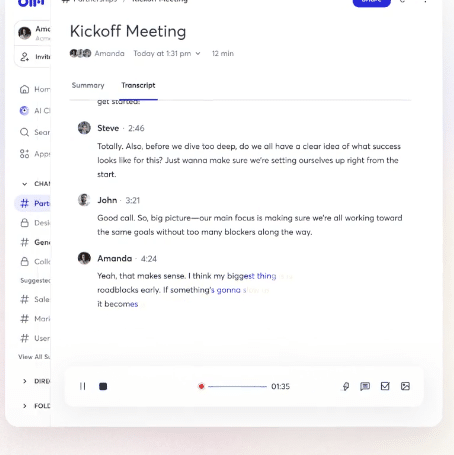
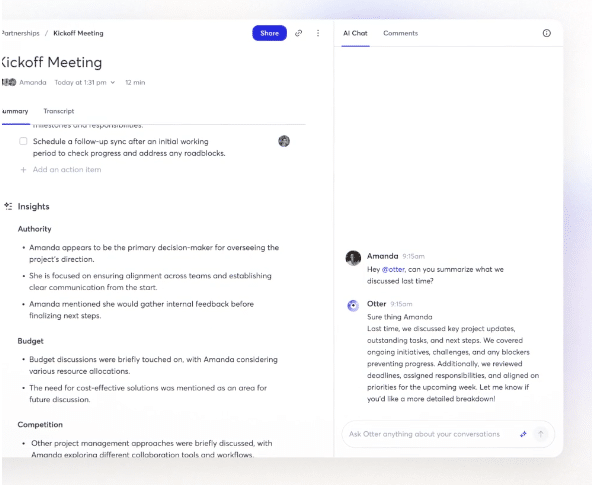
- AI Chat Search: Rather than scrolling through thousands of words of unstructured dialogue, users can query the transcript via integrated conversational AI chatbots. For instance, if an expert touched upon "algorithmic bias" or "cross-border payment friction" twenty minutes into a rambling discussion, a targeted prompt instantly retrieves the relevant excerpt along with an automated contextual summary.
- Synchronized Audio Playback: Text-to-audio anchoring allows users to click any specific sentence within the generated transcript to immediately trigger the corresponding audio playback. This feature is vital for editorial integrity; when a technical term, acronym, or proper noun appears mangled by the algorithm, the writer can instantly verify the source audio with a single click.
- Calendar Sync and Auto-Join: Integration with native calendar applications allows automated bots to silently join scheduled digital interviews without manual intervention, ensuring that spontaneous insights are never lost to unrecorded calls.
Official Industry Assessment: Capabilities and Limitations
While the advantages of AI transcription are compelling, professional deployment requires a clear-eyed assessment of the technology’s structural limitations.
Inherent Accuracy Variances
Software manufacturers frequently market their engines as boasting up to 95% accuracy. However, in real-world journalistic conditions—characterized by varying audio quality, overlapping speech, distinct regional accents, and dense, industry-specific jargon—actual accuracy typically hovers closer to 80% to 85%.
Names, proprietary software titles, and acronyms are frequently misheard by automated models. Consequently, professional writers cannot simply copy and paste raw AI output directly into published material. Fact-checking and quote verification remain non-negotiable steps in the editorial workflow.
Hardware and Environmental Constraints
Many desktop transcription integrations rely heavily on local computer audio settings. For example, if a user conducts an interview while wearing wired or wireless headphones, certain system configurations will only capture the user’s voice, entirely failing to record the remote speaker’s audio stream. Ensuring clean transcriptions often requires routing system audio through computer speakers or utilizing specialized virtual audio cables, which limits recording to quiet environments, private home offices, or dedicated coworking booths.
Speaker Diarization Challenges
Multi-speaker identification—known in the industry as diarization—remains imperfect. When recording panel discussions, webinars, or interviews involving individuals with similar vocal timbres, AI platforms frequently misattribute quotes, labeling participants generically as "Speaker 1" and "Speaker 2." Writers managing multi-party interviews must exercise heightened vigilance during attribution.
Future Outlook: The Next Generation of Content Creation Tools
As artificial intelligence models continue to mature, the landscape of digital publishing and freelance writing is poised for further structural transformation. Several emerging trends indicate where the industry is heading:
1. Zero-Latency Synthesis and Automated Drafting
The boundary between transcription and content generation is rapidly dissolving. Next-generation platforms are moving beyond simple text output to automatically synthesize transcripts into structured outlines, executive summaries, and initial draft paragraphs based on pre-set publication templates. While human oversight, editorial voice, and investigative intuition remain irreplaceable, the mechanical friction of turning raw interviews into structured prose is approaching zero.
2. Vertical-Specific Language Models
General-purpose speech-to-text models struggle with niche vernacular. The future belongs to vertically integrated AI engines pre-trained on specialized corpora—such as legal precedents, complex financial regulations, or deep-tech engineering terminology. These domain-specific models will drastically reduce the need for manual transcript cleanup, pushing real-world accuracy rates past the 95% threshold.
3. Democratization of High-End Investigative Journalism
By drastically reducing the administrative overhead required to manage complex, multi-source reporting projects, AI transcription tools empower independent creators to compete directly with legacy media institutions. Freelancers operating as solopreneurs can now manage interview loads and research volumes that previously required dedicated production teams.
Conclusion
For freelance writers and digital publishers navigating an increasingly competitive landscape, efficiency is not merely a convenience—it is a core determinant of professional viability. While AI transcription platforms are not infallible, requiring periodic quote verification and environmental setup discipline, their impact on modern workflows is undeniable.
By eliminating the manual drudgery of traditional audio transcription, these tools free up vital cognitive bandwidth, allowing writers to focus on what matters most: asking better questions, uncovering deeper stories, and crafting compelling, authoritative content for a digital-first world.