

Executive Overview
The pursuit of pomological perfection is fraught with peril, structural deceit, and unexpected botanical anomalies. Following the initial revelations of our seasonal tasting audits, the Apple Snack Gang has reconvened to evaluate a fresh, highly volatile batch of cultivars. This second installment of the 2026 apple reviews delves deep into the textural extremes, historical controversies, and baffling flavor profiles of an unpredictable harvest.
From the nutmeg-heavy density of the Kickapoo Spice to the jaw-shattering, gum-flavored resilience of the Graham, this reporting period underscores a fundamental truth of arboriculture: apples are living, breathing entities whose post-harvest trajectories are as varied as they are unforgiving. While certain varietals deliver staggering highs characterized by sharp-breaking crunches and complex herbal notes, others descend rapidly into mealy, flavorless disappointments or present severe structural hazards to the consumer’s temporomandibular joint (TMJ).
This investigation provides a comprehensive breakdown of seven distinct cultivars evaluated during this tasting cycle. Through rigorous sensory analysis, historical cross-referencing, and uncompromising critique, we lay bare the triumphs and failures of the contemporary orchard.

Detailed Chronology of the Tasting Audit
The evaluation process followed a strict, randomized sampling methodology to ensure unbiased comparative metrics. Over a multi-day testing window, specimens were subjected to visual inspection, skin-texture profiling, acoustic crunch testing, flavor-note decomposition, and structural integrity assessments.
1. Kickapoo Spice
- Sensory Profile: Dense core structure; high spice component dominated by heavy nutmeg, backed by subtle undertones of cinnamon and clove. Lacking in intrinsic juiciness, concluding with an undesirable cut-grass aftertaste.
- Maturity & Storage Dynamics: Indications suggest the specimen suffered from improper storage timing. The volatile nature of harvested fruit means certain specimens require precise post-picking environments to avoid premature degradation.
- Rating: 6.9 out of 10.
2. St Edmunds Pippin
- Sensory Profile: Characterized by a rough, highly textured exterior skin paired with an explosive, satisfying auditory and physical crunch upon impact. Flavor delivery is intensely juicy, sharp-breaking, and bright, featuring prominent herbal top notes redolent of fennel pollen balanced by a clean, lingering sweetness.
- Significance: Serving as the benchmark early-season premier for this audit cycle, it establishes a high standard for tart-sweet equilibrium in heirloom varieties.
- Rating: 8.3 out of 10.
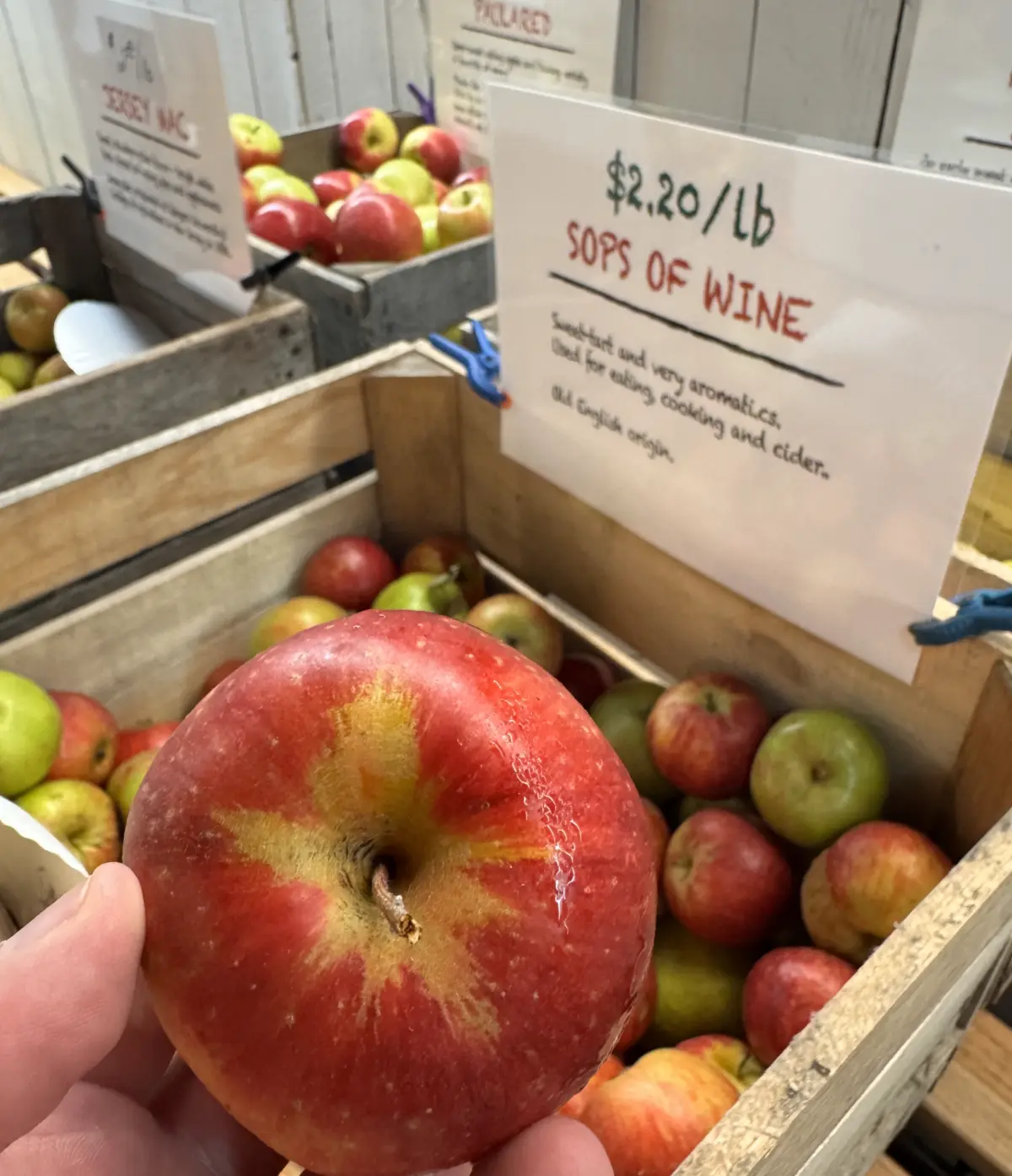
3. Sops of Wine
- Sensory Profile: Promising aromatic and flavor qualities featuring sub-acid sweetness, vanilla, and warm spice notes, severely undermined by a mealy, gritty, and structurally compromised texture.
- Botanical Taxonomy Discrepancies: While classic descriptions attribute deep red-fleshed characteristics or red-streaked white interiors to the Sops of Wine lineage, this specimen presented standard internal coloration. Pomological experts have long debated whether "Sops of Wine" represents a singular, distinct genetic variety or serves as a catch-all umbrella term for multiple historical fruit types.
- Rating: 3.5 out of 10.
4. Fenceline Surprise
- Sensory Profile: A linguistic pun on its French-inflected nomenclature, this cultivar offered little beyond a brief, fleeting whisper of pear-like mist before deteriorating into a dry, sand-textured mush.
- Post-Harvest Pathology: Despite signage classifying the batch as "firm," the physical reality suggested advanced over-maturation or severe cold-storage failure prior to retail acquisition.
- Rating: 1.0 out of 10.
5. Americus Crab
- Sensory Profile: A textbook crabapple exhibiting formidable physical toughness, high tannin concentrations, and a complex interplay of savory and tart notes. Unsuitable for out-of-hand consumption by the casual consumer.
- Cultural Impact: Noted for its evocative name, which conjures imagery of classic adventure fiction and eccentric late-nineteenth-century inventors.
- Rating: 2.5 out of 10.
6. Campfield (False?)
- Sensory Profile: A chewy, high-tannin cider fruit featuring an awkward sugar-to-tannin ratio that creates an astringent sensation.
- Historical Provenance: Archival tracking links the Campfield lineage directly to early colonial agricultural mandates.
- Rating: 4.1 out of 10.
7. Graham
- Sensory Profile: Exceptionally dense, rock-hard structural integrity capable of inducing localized jaw fatigue. Upon structural penetration via a glacier-like fracture, the fruit yields a remarkably unexpected, dominant flavor profile identical to commercial Juicy Fruit chewing gum.
- Rating: 8.0 out of 10.
Supporting Context & Historical Metrics
To fully contextualize the 2026 harvest data, one must examine the intersection of agricultural history, pomological nomenclature, and regional distribution patterns.
The Campfield Historical Lineage
The inclusion of the Campfield (False?) variety opened a fascinating window into early American agrarian policy. Archival records from the New Haven Colony and subsequent settlements in Newark, New Jersey, highlight the rigorous expectations placed upon early landholders, known as "freeholders."

Under historical town mandates, citizens acquiring vacant lots were legally obligated to cultivate significant portions of their acreage—frequently four acres—into functional fruit orchards. Matthew Canfield (whose surname evolved into Campfield), an anti-royalist Puritan arriving from Harleston, England, during the Great Puritan Migration of 1637, stands as a prime example of this ecosystem. His integration into colonial civic life—ranging from municipal judge and customs collector to overseer of swine damage and fence inspections—occurred parallel to his production of winter fruit ciders.
The survival of such legacy cider apples into the modern era provides contemporary tasting panels with a direct link to the dietary and brewing habits of the early American republic, even if their high tannin loads render them fundamentally unpalatable for raw, fresh-market consumption.
Official Statements and Horticultural Observations
Pomological analysis requires an acknowledgment of the subjective psychological responses triggered by fruit consumption. Tasting panels frequently report auditory and visual hallucinations driven entirely by linguistic association.

During the evaluation of the Sops of Wine cultivar, auditors noted an involuntary psychological intrusion—specifically, the internal recitation of cinematic dialogue related to tomato consumption by the Steward of Gondor. Similarly, the nomenclature of the Americus Crab prompted extensive debate regarding the necessity of historical, pulp-fiction-style superhero archetypes dedicated to marine-based environmental defense.
From a horticultural perspective, the variance observed between individual specimens of the same labeled variety highlights ongoing supply chain vulnerabilities. As apples transition from arboreal harvest to cold-storage holding facilities, enzymatic breakdowns rapidly alter pectin structures. Varieties lacking robust cellular walls—such as the Fenceline Surprise—demonstrate how minor lapses in supply chain refrigeration can transform a theoretically firm fruit into a compromised, sandy disappointment.
Conversely, outliers like the Graham demonstrate the genetic lottery of heirloom cultivation, where extreme physical defense mechanisms (high-density cell walls) shield unusual, confectionery flavor compounds (such as artificial bubblegum esters) from premature environmental degradation.

Future Outlook
As the Apple Snack Gang prepares to mobilize for its upcoming regional expansion across New York, New England, and cross-border Canadian territories, the operational outlook for the remainder of the season remains dynamic.
Regional microclimates in these northern latitudes are anticipated to yield late-season heavyweights characterized by extended cold-weather maturation periods. Observers expect heightened acidity, improved cellular density, and more pronounced secondary aromatic profiles in upcoming audit batches.
Consumers, growers, and fellow apple enthusiasts are encouraged to monitor upcoming public appearance schedules and prepare appropriate pomological tributes. The pursuit of the ultimate apple continues unabated, and the upcoming cross-continental expedition promises to push the boundaries of modern fruit critique into uncharted territory.