

Executive Overview
In the realm of seasonal agricultural assessments, few endeavors match the unyielding rigor, chaotic introspection, and sensory dedication of the ongoing Apple Snack Gang trials. Following the initial barrage of pomological evaluations, the second installment of this season’s audit plunges deeper into the murky, unpredictable waters of heirloom and specialty apple varieties.
The findings detailed herein represent a comprehensive sensory and structural autopsy of seven distinct apple cultivars harvested during the peak of the 2026 agricultural cycle. From the nutmeg-heavy density of the Kickapoo Spice to the jaw-shattering, gum-flavored resilience of the Graham, this investigation explores the vast chasm between agricultural marketing and the raw, unvarnished reality of the modern fruit market.

Utilizing a strict, albeit idiosyncratic, ten-point evaluation matrix, this report synthesizes field-testing notes, historical context, psychological phenomena triggered by fruit consumption, and structural integrity metrics. The overarching takeaway from this phase of the audit is clear: the modern consumer navigates a labyrinthine landscape where nomenclature bears little resemblance to flavor, storage duration dictates edibility, and certain cultivars demand a level of dental fortitude bordering on the hazardous.
Detailed Chronology of the Harvest Audit
The evaluation phase took place across multiple controlled environments—primarily kitchen counters, improvised tasting stations, and post-excursion recovery zones. Each specimen was subjected to standardized criteria: structural resistance upon initial incision (bite-force analysis), aromatic profiling, sapidity, aftertaste endurance, and an intuitive psychological response index.

1. Kickapoo Spice
- Structural Profile: Dense, non-juicy, structurally imposing.
- Aromatic & Flavor Notes: Heavy concentration of nutmeg, secondary notes of cinnamon and clove, accompanied by an intrusive, unrefined aftertaste reminiscent of freshly cut grass.
- Pomological Assessment: True to its moniker, the spice component dominates the profile, confirming the accuracy of its nomenclature. However, the lack of internal moisture and the presence of a grassy finish indicate suboptimal storage management. Pomologists have long noted that post-harvest maturation is a precarious tightrope walk; certain cultivars improve dramatically in cold storage, while others initiate an immediate descent toward degradation. The Kickapoo Spice sits in a liminal space, offering an interesting intellectual tasting experience despite physical shortcomings.
- Metric Score: 6.9 / 10
2. St Edmunds Pippin
- Structural Profile: Rough-skinned exterior coupled with a sharp, satisfying snap upon impact.
- Aromatic & Flavor Notes: Bright, herbal undertones carrying distinct fennel pollen characteristics, balanced by a robust tart-to-sweet ratio.
- Pomological Assessment: Serving as the maiden voyage of the season’s serious tastings, the St Edmunds Pippin defied its tactile abrasiveness—described colloquially as "licking a shark backward"—to deliver an elite sensory experience. The internal architecture provides an aggressive, crisp break that yields immediately to a flood of bright, complex juices. It stands as a masterclass in how heirloom characteristics can eclipse modern aesthetic uniformity.
- Metric Score: 8.3 / 10
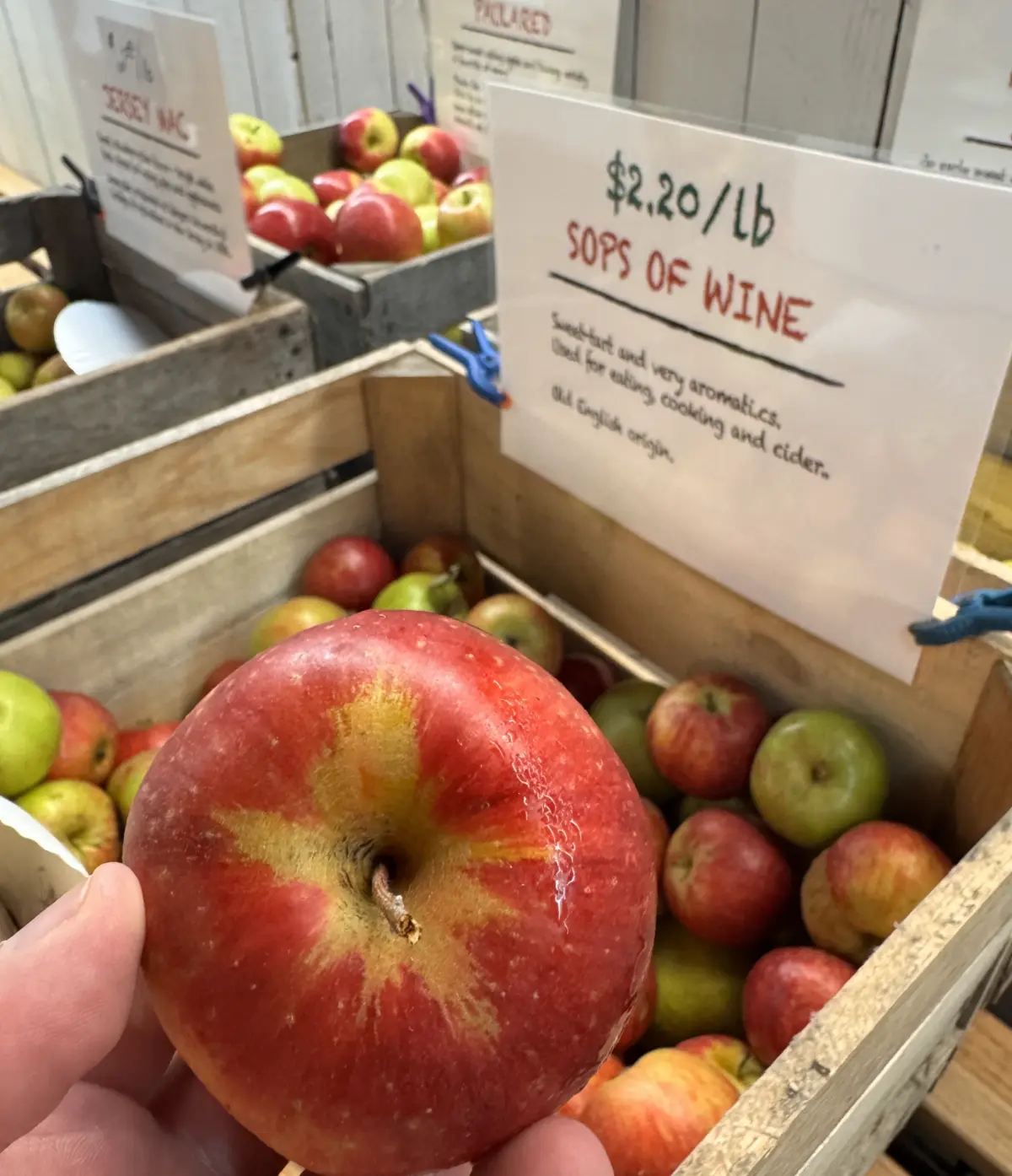
3. Sops of Wine
- Structural Profile: Mealy, gritty, and structurally compromised due to advanced post-harvest timeline deterioration.
- Aromatic & Flavor Notes: Subacid sweetness underpinned by subtle notes of vanilla and traditional baking spices.
- Pomological Assessment: The evaluation of the Sops of Wine was hampered by severe textural degradation. Despite offering a complex, funky flavor profile with whispers of vanilla, the mealy consistency rendered it a trial to consume. Furthermore, historical ambiguities plague this cultivar: while traditional texts describe specimens featuring crimson-stained or entirely red flesh, this particular audit subject displayed standard white tissue. Whether "Sops of Wine" represents a singular, highly variable lineage or a catch-all umbrella term for a cluster of archaic cider types remains a subject of fierce debate within horticultural circles.
- Metric Score: 3.5 / 10
4. Fenceline Surprise
- Structural Profile: Soft, mushy, lacking any meaningful structural resistance.
- Aromatic & Flavor Notes: Fleeting, ghostly wisps of pear juice that evaporate instantaneously, leaving a lingering impression of beach sand.
- Pomological Assessment: Despite signage promising a "firm apple," the Fenceline Surprise delivered a textural disaster. Labeled with linguistic irony that invites a continental pronunciation, the reality of the fruit fell tragically short. Internal analysis suggests the specimen had either languished far too long in cold storage or suffered from inherent developmental flaws. The complete absence of structural integrity paired with a sand-like mouthfeel relegates this cultivar to the absolute cellar of the evaluation index.
- Metric Score: 1.0 / 10
5. Americus Crab
- Structural Profile: Exceptionally tough, tannin-heavy, dense crabapple architecture.
- Aromatic & Flavor Notes: Savory, astringent, aggressively tart, defiant of standard culinary consumption parameters.
- Pomological Assessment: The Americus Crab is not designed for casual, out-of-hand consumption by the uninitiated public. Bursting with tannins and structural defiance, it operates as a bridge between wild foraging and intentional culinary processing. While it fails as a standard snack, its unapologetic hostility earns it a niche spot for adventurous palates willing to brave high astringency levels.
- Metric Score: 2.5 / 10
6. Campfield (False?)
- Structural Profile: Chewy, callused texture; dual-action structural resistance that feels simultaneously firm and yielding.
- Aromatic & Flavor Notes: Overly saccharine counterbalanced by a punishing surge of dry, mouth-puckering tannins.
- Pomological Assessment: Labeled cryptically as "(false)" upon acquisition, the Campfield proved to be a quintessential cider apple masquerading as a table fruit. It is inherently unsuited for human consumption in its raw state, requiring the transformative intervention of fermentation before its harsh tannins settle into harmony. Its evaluation serves as a reminder of the historical bifurcation between eating apples and brewing stock.
- Metric Score: 4.1 / 10
7. Graham
- Structural Profile: Impenetrably dense, muscular architecture requiring extreme jaw exertion; breaks with the sudden violence of a calving glacier.
- Aromatic & Flavor Notes: Unmistakable, unfiltered, direct replication of artificial Juicy Fruit chewing gum.
- Pomological Assessment: The Graham represents the ultimate anomaly of the 2026 harvest. Its exterior density poses a genuine threat to human temporomandibular joints, demanding a level of mechanical chewing force usually reserved for compressed timber. Yet, breaching its defenses reveals a reward of staggering proportions: a fluid, exceptionally juicy interior whose flavor profile inexplicably mirrors commercial confectionery gum. Despite the physical toll exacted during the consumption process, its flavor singularity secures its status as a top-tier contender.
- Metric Score: 8.0 / 10
Supporting Context & Metrics
To contextualize the variances observed across these seven cultivars, pomologists examine a confluence of agricultural metrics, including harvest windows, Brix levels, and historical lineage.
[2026 APPLE AUDIT PERFORMANCE MATRIX]

8.3 | [St Edmunds Pippin] (Exceptional snap, fennel/herbal notes)
8.0 | [Graham]            (Extreme density, Juicy Fruit flavor)
6.9 | [Kickapoo Spice]    (Nutmeg-heavy, grassy aftertaste)
4.1 | [Campfield (False)] (Cider-grade, high tannin load)
3.5 | [Sops of Wine]      (Mealy texture, vanilla/subacid)
2.5 | [Americus Crab]     (Astringent, high-tannin wild type)
1.0 | [Fenceline Surprise](Structural collapse, sandy texture)
    +---------------------------------------------------------
The data illustrates a distinct bifurcation in modern fruit evaluation: cultivars engineered or selected for raw, immediate consumption (such as the St Edmunds Pippin and Graham) consistently outperform heritage or processing varieties when judged on a tabletop snacking metric. Conversely, historical anomalies like the Campfield and Americus Crab suffer heavily when forced into a category for which they were never biologically optimized.

Official Statements and Horticultural Lore
The integration of historical research into pomological evaluations often yields unexpected narrative threads. Of particular note during this audit cycle is the archival lineage associated with the Campfield apple.
Historical records tie the cultivar directly to early colonial agricultural mandates. Genealogical research indicates that the Campfield lineage traces back to Matthew Canfield (historical variants including Campfield and Mathew), an anti-royalist Puritan who arrived in New England during the Great Puritan Migration of 1637. As a founding figure in the New Haven Colony, Norwalk, and Newark, Canfield’s civic duties were deeply intertwined with pomology. Town records from the era mandated that "freeholders"—those granted voting privileges—cultivate a minimum of four acres, with strict requirements to establish functional orchards.

Canfield’s integration into the historical record is cemented by transactions involving early American infrastructure:
- The Corn Mill Subsidy: Records show Canfield contributing his financial portion toward the construction of a municipal corn mill, reimbursed through the acquisition of "three barrels of good cider made of winter fruit."
- Civic Administration: Operating as a judge, customs collector, and committee member tasked with assessing damage caused by stray swine and inspecting boundary fences, Canfield’s legacy is quite literally rooted in the New Jersey soil where he was eventually interred beneath City Hall.
This deep historical linkage underscores a fundamental truth of heritage fruit auditing: we are not merely consuming agricultural produce; we are ingesting centuries of agrarian policy, political migration, and selective breeding designed to produce potable alcohol and winter sustenance.

Future Outlook
As the 2026 harvest progresses, the focus of the Apple Snack Gang shifts northward. Upcoming expeditions into the orchards of New York, New England, and Canada promise to unearth a fresh cohort of regional oddities, forgotten heirloom species, and cold-hardy titans.
Field investigators are advised to maintain rigorous dental preparation protocols, particularly when approaching dense, high-density cultivars whose structural integrity matches or exceeds that of standard building materials. As regional markets open their autumn stalls, consumers and investigators alike must remain vigilant against the twin perils of premature harvest degradation and deceptive nomenclature. The search for the ultimate pomological specimen continues unabated.