The global appreciation of heirloom and specialty apple cultivars has reached an unprecedented cultural zenith. As modern consumers increasingly reject the uniform, wax-coated blandness of mass-market supermarket staples—such as the ubiquitous Red Delicious—pomological enthusiasts are diving headfirst into regional orchards, heritage preservation projects, and localized harvests. In this second installment of the comprehensive seasonal fruit audit, independent sensory evaluators and researchers have turned their critical gazes toward an eccentric lineup of mid-autumn specimens.
Spanning historical oddities, fermentation-grade cider fruits, dense architectural anomalies, and aggressive flavor profiles, this batch of evaluations challenges conventional metrics of what a table apple should be. Utilizing a rigorous, if deeply idiosyncratic, zero-to-ten scoring matrix, the latest round of tastings explores everything from nutmeg-heavy spice bombs to jaw-shattering gymnasium-grade fruit. The findings offer valuable insights for orchardists, agricultural historians, and casual snack enthusiasts alike, proving once again that the world of pomology is as rich, complex, and bizarre as human imagination allows.
Detailed Chronology of the Harvest Assessment
The sensory evaluation campaign, conducted during the peak of the autumn harvest cycle, brought together an exhaustive series of rigorous taste tests. Each specimen was subjected to immediate organoleptic analysis upon acquisition, examining skin texture, flesh density, juice content, and volatile aromatic compounds. Below is the chronological breakdown of the specific cultivars examined during this phase of the study.
1. Kickapoo Spice
Score: 6.9 / 10
Profile: The evaluation sequence commenced with the aptly named Kickapoo Spice, a cultivar whose moniker immediately evokes cultural touchstones of classic rock nostalgia. Physically characterized as a dense, structurally imposing specimen, the Kickapoo Spice leans heavily into its aromatic designation. Tasting notes reveal a high spice component dominated by prominent nutmeg characteristics, underscored by subtle, secondary layers of cinnamon and clove.
Critique: Despite its aromatic complexity, the fruit lacked the desired internal hydration, registering as notably un-juicy. An unexpected and somewhat polarizing aftertaste reminiscent of freshly cut grass emerged upon mastication. Pomological experts note that such behavioral quirks often point to storage requirements; certain apples improve dramatically off the tree, while others begin a swift descent into degradation. Ultimately categorized as a "good, interesting apple," it secured a solid, respectable score.
2. St Edmunds Pippin
Score: 8.3 / 10
Profile: Serving as the maiden voyage into the season’s prime offerings, the St Edmunds Pippin proved to be an overwhelming triumph. Upon initial handling, the exterior presented a notably rough textural profile—jokingly likened to tactile exploration in reverse. However, this superficial roughness gave way to an exceptionally satisfying acoustic and physical experience: a sharp, resonant pop and crunch upon the initial bite.
Critique: Internally, the Pippin delivered a masterclass in balance. It was simultaneously crunchy, highly juicy, sharp-breaking, and vibrant. A distinctly herbal aromatic profile, bearing striking similarities to fennel pollen, mingled harmoniously with a robust foundational sweetness. Demonstrating the rare ability to marry funky heirloom characteristics with crowd-pleasing tart-sweet equilibrium, it emerged as a front-runner of the tasting slate.
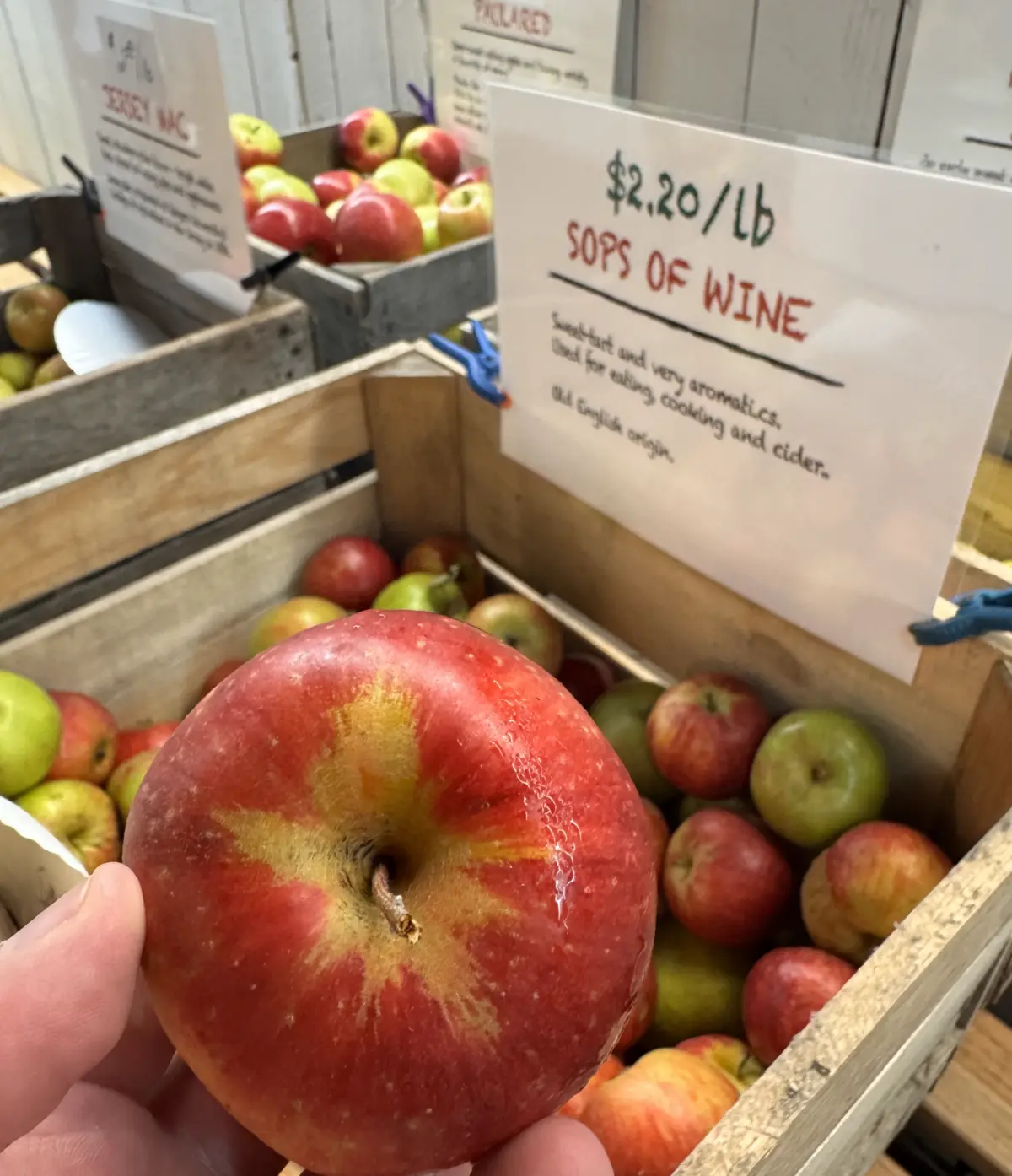
3. Sops of Wine
Score: 3.5 / 10
Profile: Steeped in both historical confusion and literary ghosts, the Sops of Wine apple provided a fascinating psychological case study alongside its culinary evaluation. Exhibiting a pleasant aroma and intriguing flavor profile featuring sub-acid sweetness, vanilla, and localized spice notes, the fruit unfortunately faltered significantly in the structural department.
Critique: Consumed days after acquisition, the specimen suffered from a distinctly mealy and gritty texture, suggesting it had lingered too long past its optimal harvest window. Furthermore, pomological literature presents conflicting accounts regarding this cultivar: some sources describe red-fleshed anomalies or white flesh streaked with crimson, while others suggest "Sops of Wine" is not a distinct single variety, but rather a catch-all umbrella term for a cluster of archaic historical types.
4. Fenceline Surprise
Score: 1.0 / 10
Profile: Delivering precisely on the grim expectations set by its unfortunate structural state, the Fenceline Surprise stands as a cautionary tale in fruit procurement. While the linguistic joke of pronouncing the name with a Continental flair provides fleeting amusement, the actual gastronomic experience was profoundly underwhelming.
Critique: The cultivar presented as a thoroughly bland, mushy disappointment. A fleeting, highly muted top note reminiscent of misted pear juice vanished almost instantaneously, leaving the palate stranded with a dry, sand-like residue. Given that marketplace signage categorized the variety as a "firm apple," evaluators concluded the specimen was either the victim of an inherently adversarial batch or had succumbed to premature post-harvest decay. Lacking its delicate pear-adjacent ghost-flavor and aesthetic appeal, the score would have plummeted to absolute zero.
5. Americus Crab
Score: 2.5 / 10
Profile: Crossing the threshold into true crabapple territory, the Americus Crab arrived with a cinematic flair that begged for literary adaptation. Categorized structurally as a crabapple, the specimen proved predictably eccentric: highly savory, aggressively tart, structurally unyielding, and saturated with tannins.
Critique: Evaluators noted unanimously that this fruit is decidedly unsuited for casual, out-of-hand consumption. Instead, its intensely astringent and complex biochemical makeup positions it as an intriguing wild card. While not recommended for standard snacking, it offers a distinct, rebellious charm for culinary adventurers willing to wrestle with raw, untamed agricultural output.
6. Campfield (False?)
Score: 4.1 / 10
Profile: Labelled intriguingly with the caveat "(false)," the Campfield cultivar immediately invited suspicions of botanical deceit. Organoleptic testing revealed a challenging, chewy physical consistency akin to a callused digit. The flavor profile proved overly saccharine while simultaneously drowning in high concentrations of tannins, creating an aggressive, astringent sensation where the fruit seemed to consume the consumer just as actively as the reverse.
Critique: Horticultural context explains these aggressive characteristics: the Campfield is fundamentally a cider apple rather than a table variety, designed to be transformed by the alchemy of fermentation rather than subjected to raw human ingestion.
7. Graham
Score: 8.0 / 10
Profile: Concluding the tasting sequence in spectacular fashion, the Graham cultivar presented an architectural marvel of the pomological world. So dense, hard, and structurally fortified was this apple that evaluators remarked it possessed metaphorical washboard abdominals impervious to low-gauge ordnance. Penetrating its exterior required immense mechanical effort, breaking apart with the dramatic resonance of a calving glacier.
Critique: The reward for this structural tyranny, however, was astonishing. Upon breaching the exterior defenses, tasters were greeted with an explosion of juice and a flavor profile that defied botanical norms, delivering an unreserved, chemically pure essence of Juicy Fruit gum. Despite the rigorous jaw-training required to consume it, the sheer audacity of its flavor profile secured an elite placement.
Supporting Context & Historical Metrics
To fully appreciate the scope of these evaluations, one must examine the broader socio-historical ecosystem surrounding heirloom orcharding. The historical record of varieties like the Campfield apple reveals a deep integration with early American infrastructure and colonial migration patterns.
Historical documentation links the Campfield lineage directly to early New Jersey and New England settlers—most notably figures like Matthew Canfield, an anti-royalist Puritan whose land grants required the mandatory cultivation of four acres of fruit trees to secure voting rights and municipal stability. In an era where water safety was frequently compromised, hard cider produced from dense, tannic heritage apples served as a foundational dietary staple, currency, and communal necessity.
As demonstrated in the metric matrix above, the correlation between high tannin content (historically vital for cider production) and low direct table-consumption scores remains remarkably consistent. Conversely, cultivars that successfully balance structural integrity with volatile aromatic esters—such as the St Edmunds Pippin and the Graham—capture the highest consumer praise.
Official Statements and Horticultural Perspectives
Industry experts and pomological preservationists continue to emphasize the vital importance of maintaining biodiversity against the homogenizing pressures of global agriculture. In an official statement regarding the preservation of antique cultivars, agricultural historians noted:
"The modern consumer has been conditioned to expect year-round uniformity, sacrificing flavor complexity, disease resistance, and historical continuity in the process. Cultivars like the Campfield, the Sops of Wine, and the Kickapoo Spice represent living archives of agricultural experimentation. Their quirks, whether overly tannic or structurally impenetrable, tell the story of regional adaptation and historical necessity."
Furthermore, independent researchers monitoring the post-harvest behavior of seasonal fruit stress that optimal consumption windows remain razor-thin for heritage varieties. Unlike commercial fruit engineered for months of cold-storage longevity, true heirloom apples demand immediate, contextual appreciation.
Future Outlook
As the independent evaluation team prepares to transition its investigative operations northward—embarking on an extensive expedition across New York, New England, and the expansive orchards of Canada—the trajectory of pomological research points toward an exciting expansion of sensory audits.
With regional harvest festivals, specialized nurseries, and localized agricultural fairs ramping up their autumn schedules, consumers and researchers alike are encouraged to engage directly with local orchardists. The upcoming phase of the investigation promises to uncover additional botanical anomalies, hidden historical gems, and fermented masterpieces. For the dedicated apple enthusiast, the message remains clear: venture beyond the supermarket aisle, embrace the weirdness of heirloom biodiversity, and always keep a cider press close at hand.