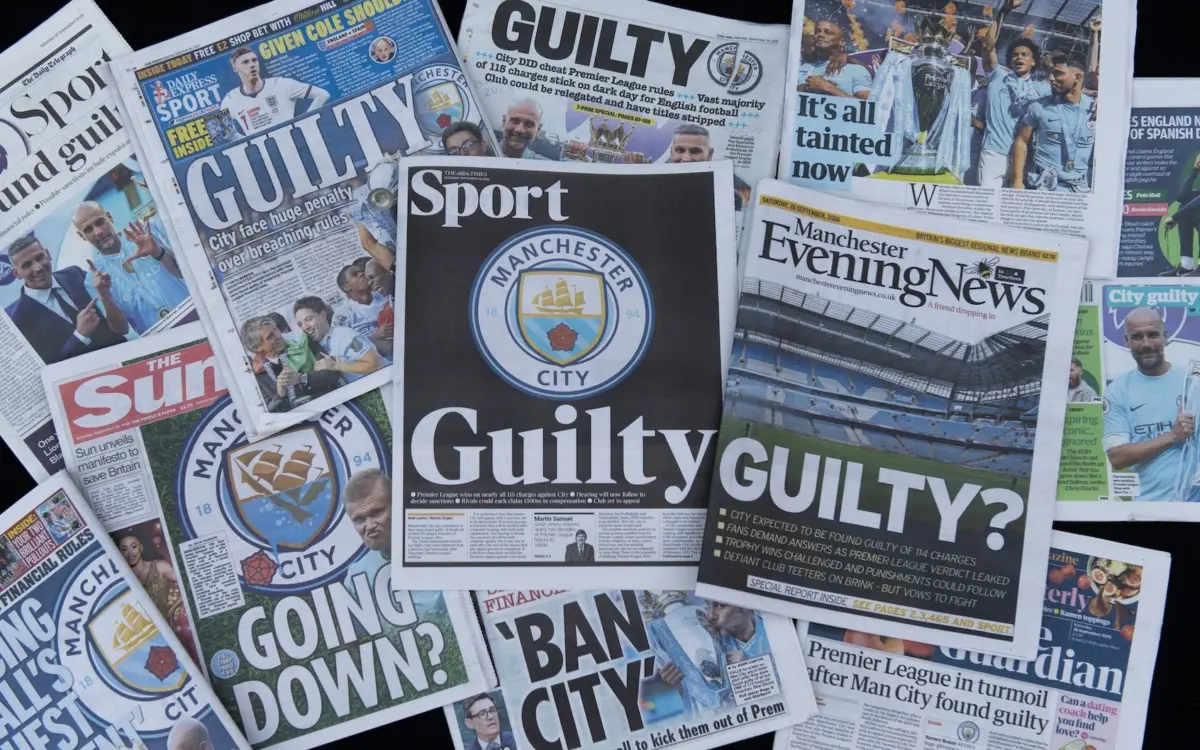
In what is unquestionably the most seismic scandal in modern professional sports history, a landmark independent legal panel delivered a devastating verdict against Manchester City Football Club, finding the English Premier League (EPL) powerhouse guilty on an astonishing 114 counts of systematic financial fraud. Spanning the years 2009 to 2018, the ruling uncovers more than a billion dollars in falsified revenues, clandestine subsidiary funding, and sham commercial sponsorships orchestrated by the club’s Abu Dhabi-based ownership.
While the British media has dissolved into paroxysms of hysteria over the fate of the league’s glittering trophies and superstar rosters, the implications of this ruling extend far beyond the pitch. This is not merely a story about a football club bending bookkeeping rules to outspend its rivals. Rather, the Manchester City scandal serves as a glaring window into a much larger, systemic global malaise: the normalization of petro-state "sportswashing," the unchecked rise of a new global oligarchy, and the deep, corrosive cynicism that forces regular citizens to accept the unacceptable.
For over a decade, the warning signs were blindingly obvious. The football world knew, the regulators suspected, and the fans actively looked the other way, seduced by the hypnotic pull of world-class athleticism and endless streams of foreign capital. Now, as the club faces unprecedented sanctions—ranging from historic points deductions and stripped titles to total expulsion from top-flight competition—the reckoning forces us to confront an uncomfortable truth: this is a tangled tale of global corruption, and through our collective complacency, we are all complicit.
Detailed Chronology: From Modest Mediocrity to Global Hegemony
To understand the magnitude of the current crisis, one must trace the rapid, gravity-defying trajectory of Manchester City from a historically unremarkable regional club to a planetary merchandising juggernaut.
For decades, Manchester City lived heavily in the shadow of its cross-town rival, Manchester United, who dominated English football throughout the 1990s and early 2000s. City was defined by its modest fan base, erratic attendance, crumbling infrastructure, and a heartbreaking penchant for underachievement. That all changed fundamentally in September 2008.
September 2008: The Abu Dhabi United Group (ADUG), a private equity vehicle closely linked to the royal family of the United Arab Emirates, officially acquires Manchester City. Overnight, a club plagued by financial fragility transforms into the wealthiest sporting entity on the planet, backed by the virtually limitless reserves of Sheikh Mansour bin Zayed Al Nahyan, the brother of Abu Dhabi’s absolute ruler.
2009–2018 (The Fraud Window): As detailed in the recent 114-count independent panel verdict, club executives orchestrate a massive accounting sham. To bypass UEFA and Premier League Financial Fair Play (FFP) regulations—which are designed to restrict owners from pumping unlimited private wealth into clubs—City invents multi-million-dollar shell corporations and heavily inflates sponsorship deals with state-backed entities like Etihad Airways.
The Golden Era on the Pitch: Funded by these illicit petrodollars, City ascends to unprecedented heights. The club hires the Catalan tactical genius Pep Guardiola and amasses a galaxy of star players, including Erling Haaland, Kevin De Bruyne, and Sergio Agüero. City sweeps multiple Premier League titles, domestic cups, and eventually the elusive UEFA Champions League trophy, fundamentally altering the economics and competitive balance of world football.
Global Expansion: Buoyed by its on-field success, the City Football Group (CFG)—the parent network of ADUG—expands aggressively across international borders. CFG builds a multi-club portfolio spanning the globe, including Major League Soccer’s New York City FC, which establishes deep footprints in American sports real estate, further embedding Gulf state influence into Western civic infrastructure.
September–October 2026: Following years of legal maneuverings, delayed disclosures, and jurisdictional tug-of-wars, an independent legal commission finally releases its definitive verdict, finding City guilty on all major counts of systematic fraud. The ruling triggers an immediate media firestorm across the UK, setting the stage for what promises to be a grueling, years-long appeals process.
Supporting Context & Metrics: The Economics of Sportswashing
The Manchester City scandal cannot be analyzed in a vacuum; it is the crowning achievement of the modern era of "sportswashing"—a geopolitical strategy wherein authoritarian regimes utilize high-profile sports franchises to project soft power, launder their international reputations, and distract from human rights abuses and democratic deficits at home.
The financial metrics underpinning this case are staggering:
114 Counts of Fraud: The independent panel’s indictment covers over a decade of systematic rule-breaking, representing the most sweeping regulatory enforcement action in sports history.
$1 Billion+ in Falsified Revenues: Investigators uncovered an intricate web of sham commercial partnerships designed to mask the direct injection of state capital from Abu Dhabi into the club’s operational ledger.
The Global Footprint: CFG now directly controls or holds stakes in over a dozen clubs worldwide, creating a synchronized global pipeline for talent, marketing, and geopolitical influence that stretches from Manchester to Melbourne, New York to Yokohama.
As journalist Alex Shepherd astutely observed in The New Republic, Manchester City’s fraud was concealed in the most threadbare fashion because it was deliberately tolerated by the establishment:
"Manchester City committed fraud on a massive scale primarily as a soft power project for an authoritarian nation because it was allowed to do so. The Premier League chose to look away. The team was good and the money was flowing. Questions about its finances — let alone about its ownership — were swept under the rug. As Manchester City became the best team in the Premier League, the Premier League became the most powerful league in Europe and, by extension, the world."
This symbiotic relationship created a monstrous paradox. The Premier League wanted global dominance, record television rights packages, and astronomical commercial valuations. The Gulf states wanted international legitimacy, cultural cachet, and economic integration into Western markets. Both parties got what they wanted, creating a multi-billion-dollar house of cards built on deliberate ignorance.
Official Statements & Institutional Responses
Unsurprisingly, the institutional reaction to the verdict has been characterized by intense legal posturing, defensive spin, and notable political cowardice.
Manchester City’s Defense
In the wake of the verdict, Manchester City’s executive board issued a sharply worded rebuttal, expressing "surprise and profound disappointment" at the panel’s findings. The club has vowed to mount a vigorous, multi-year appeal, arguing that the independent commission fundamentally misunderstood complex modern football economics and applied rules unfairly designed to protect legacy clubs (such as Liverpool, Manchester United, and Arsenal) from dynamic new market entrants. Legal experts anticipate that City’s defense will challenge the jurisdiction of the independent panel and drag the process out through civil courts.
The Premier League’s Dilemma
For the Premier League, the verdict represents a terrifying double-edged sword. While leadership felt compelled to act to preserve whatever shreds of regulatory integrity remained, prosecuting its most marketable and financially dominant asset risks severely damaging the brand value of the league. Executives are acutely aware that a harsh punishment—such as relegation or the retroactive stripping of titles—could trigger retaliatory legal warfare, alienate global broadcast partners, and send shockwaves through English football’s financial ecosystem.
Political Silence
The complicity extends far beyond sports administrators into the halls of political power. British Prime Minister Andy Burnham, known for taking muscular, forthright stances on high-profile international geopolitical disputes, has offered only vague, muted remarks regarding the Manchester City scandal. This diplomatic hesitation is hardly accidental. Abu Dhabi’s petrodollars are inextricably baked into the modern British economy—funding real estate developments, municipal projects, defense contracts, and energy grids. To genuinely sever ties with or severely penalize the UAE’s premier cultural asset would invite cascading economic repercussions that Westminster is entirely unprepared to face.
Future Outlook: What Happens Next?
As Manchester City prepares its protracted legal appeal, the ramifications of this scandal will ripple across the global sports and political landscape for years to come.
The Legal Labyrinth: The appeal process is expected to drag on for many months, if not years. Whether the ultimate penalties—ranging from severe points deductions and multi-year transfer bans to expulsion from the league—will be upheld, mitigated, or settled through closed-door negotiations remains an open question.
A Reckoning for American and Global Sports: The Manchester City case acts as a cautionary tale for other major sports leagues. As American franchises in Major League Baseball, the NBA, and the NFL increasingly open their doors to sovereign wealth funds and private equity capital, the inherent friction between competitive integrity and untethered oligarchic wealth will only intensify.
The Erosion of Public Cynicism: Ultimately, the deeper lesson of the Etihad Stadium scandal transcends soccer. It holds up an unsparing mirror to a world shaped by extreme inequality, where ordinary people are conditioned to believe that billionaires, tech monopolists, and fossil-fuel autocrats operate entirely above the law.
When fans tune in to watch Manchester City play its first match in the post-verdict era—perhaps wincing at the cognitive dissonance of cheering for a team built on fraudulent foundations—they are participating in a microcosm of modern civic life. We know the system is rigged. We know the money is dirty. We know the institutions looked away until looking away became too costly to sustain.
Yet, as history continually demonstrates, illusions eventually shatter. You can fool all of the people some of the time, and some of the people all of the time, but you cannot fool all of the people forever. Whether this landmark verdict marks the beginning of a genuine cultural and economic reckoning, or merely another speed bump on the highway of unchecked global oligarchy, remains the defining question of our era. As for our hands? None of them are entirely clean.