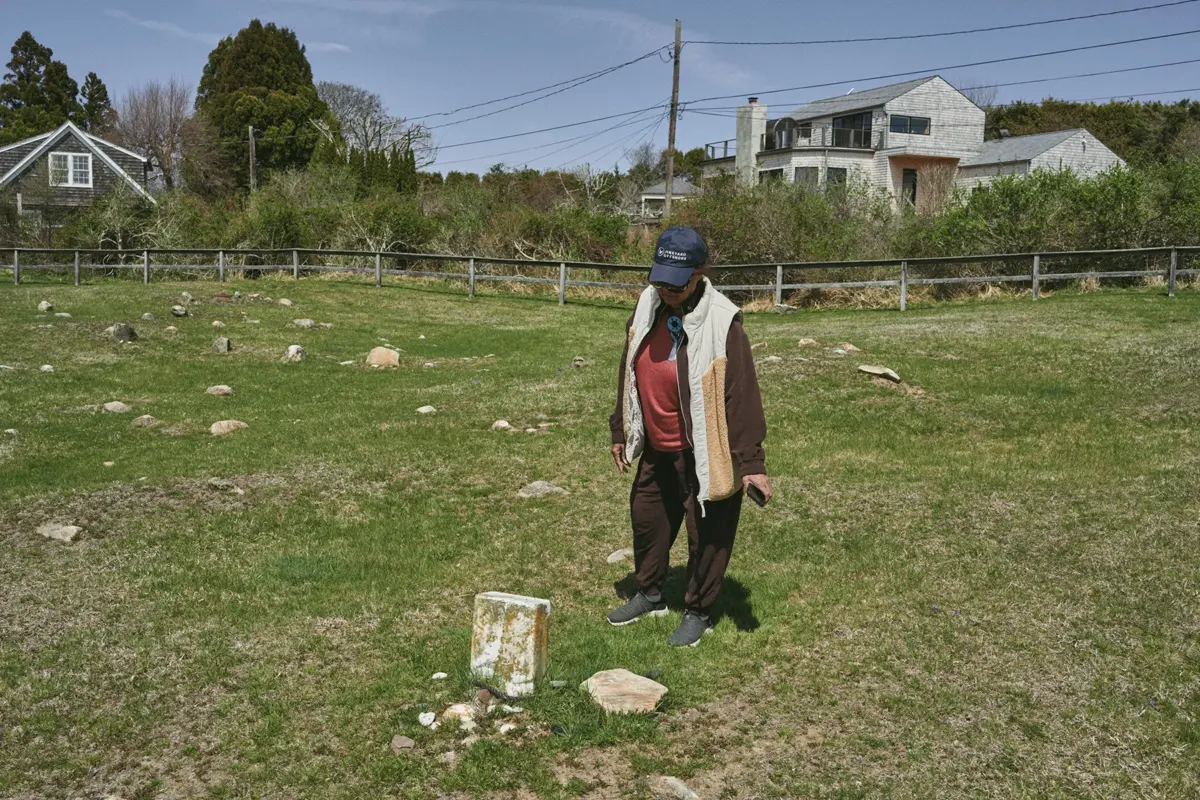
Sandwiched between two rows of suburban Long Island homes, a fenced-off tract of grass looks like any ordinary construction-ready lot. Yet, a walk inside reveals faint, weathered slabs of rock—gravestones from a centuries-old Indigenous family cemetery long obscured by time, development, and official neglect.
“When we started working here seven years ago, it was nothing but trees and trash—there were couches buried here, you name it,” says Sandi Brewster-walker, an octogenarian Montaukett tribal historian and guide. Bending over to retrieve a discarded beer bottle, she adds, “People in the houses throw stuff over the fence, so it’s been a project.”
For Brewster-walker and her people, this space is sacred ground. It is the final resting place of at least 80 members of the Montaukett Indian Nation, with authorities currently working to clear brush concealing dozens more graves. For a decade, uncovering lost history and setting the historical record straight has been an obsession for Brewster-walker. Her tireless efforts—digging through public archives, tracing complex genealogies, and petitioning local officials—have led the town of Babylon to install remembrance plaques and maintain the grounds.
Yet, this local respect contrasts sharply with the posture of New York State. Despite winning overwhelming, bipartisan majorities across eight separate legislative bills to reinstate the tribe’s official recognition, the Montaukett have faced a wall of executive resistance. Successive Democratic governors—Andrew Cuomo and Kathy Hochul—have repeatedly vetoed recognition. This persistent refusal highlights a staggering case of legal erasure that continues to stain New York’s political and judicial history.
Detailed Chronology: A Century of Dispossession
The systematic marginalization of the Montaukett people is rooted in a deliberate historical strategy to displace an Indigenous population for commercial gain. Archaeological evidence establishes that Algonquian-speaking Montauketts inhabited the easternmost reaches of Long Island for approximately 10,000 years. Their flourishing society relied on the region’s rich marine life, dense woodlands, and expansive trade networks that reached deep into southern New England.
When European settlers arrived in the early 17th century, the native population was estimated at 10,000. Within decades, however, intertribal conflicts driven by European powers and imported diseases reduced their numbers to roughly 500.
The 1910 Judicial Edict
The definitive blow to the tribe’s sovereignty occurred in 1910. Montaukett leaders and 75 tribal members sat in a courtroom as a New York State Supreme Court judge declared the tribe "extinct," transferring their remaining ancestral lands to a white developer. This verdict flew in the face of a prior U.S. Supreme Court ruling confirming their eligibility for federal recognition and a 1906 Department of the Interior memorandum explicitly acknowledging the Montauketts as an "existing Indian tribe."
Judge Abel Blackmar’s ruling in Pharaoh v. Benson weaponized prevailing racial prejudices. He claimed that because the Montauketts had culturally assimilated, intermarried with freed Black residents, and worked as whalers and laborers, their Indigenous traits had been "obliterated."
Fred W. Thiele Jr., a former Democratic state assemblyman who sponsored multiple reinstatement bills, notes the gravity of the decision:
“It’s one of the most racist court decisions in the history of New York State jurisprudence… There’s a wrong that needs to be corrected, and we shouldn’t be making them go back to square one to prove something that we already know is true.”
Supporting Context & Metrics: The Geopolitics of Real Estate and Eugenics
The legal annihilation of the Montauketts coincided with the rise of the American eugenics movement, which had a major epicenter on Long Island. In 1910—the exact year of the Pharaoh v. Benson ruling—the Eugenics Record Office was established in Cold Spring Harbor to promote a white hereditary ideal by purging the nation of those deemed "unfit." Concurrently, discriminatory housing policies, redlining, and infrastructure projects engineered by urban planner Robert Moses limited minority access to Long Island’s burgeoning recreational spaces.
With the legal barriers removed, developers transformed the East Hampton-Montauk corridor into one of the wealthiest enclaves in the United States. In 1925, investor Carl G. Fisher purchased 10,000 acres of former Montaukett land for $2.5 million, envisioning "the Miami Beach of the North." Today, the Hamptons stand as an exclusive summer playground where average home values approach $3 million.
Despite sitting on some of the most valuable real estate in the country, the Montauketts harbor no desire for mass land restitution or mass displacement. As hereditary Chief Robert Pharaoh clarifies:
“I don’t want to throw anybody out of their houses, and I’m not looking for any big pieces of land. The only thing I want is a piece of property big enough that I can put a museum or cultural research center on, and maybe put up a natural Indian village outside. That’s all.”
Official Statements and Political Obstacles
While bills recognizing the Montauketts have passed the State Assembly and Senate with near-unanimous bipartisan support year after year, they have routinely met an end-of-year gubernatorial veto.
Brewster-walker highlights the cruelty of the timing: tribal leaders negotiate in good faith throughout the year, only to receive a phone call from an Albany area code around the Christmas holidays—ensuring lawmakers are unavailable to override the veto.
Governor Kathy Hochul’s administration defends these actions through legal caution. Ken Lovett, a spokesman for Governor Hochul, stated:
“Gov. Hochul is committed to supporting and strengthening relationships with Indigenous peoples and Nations across New York State… She has worked hard to right some of the horrific wrongs inflicted in the past on Indigenous peoples and takes seriously the responsibility of determining whether to recognize a Native American tribe, which would be a sovereign nation. That includes ensuring any claims of tribal leadership can be substantiated.”
Critics and tribal advocates, however, point to deep-seated economic anxieties. Many believe Albany’s resistance stems from the fear of future land claims, interference with the luxury real estate market, and potential competition with multi-billion-dollar downstate casino projects.
The struggles of their landed cousins, the Shinnecock Indian Nation, provide a cautionary precedent. Despite securing federal recognition after a grueling 32-year battle, the Shinnecock have faced continuous state litigation over economic initiatives, ranging from commercial fishing ventures to digital highway billboards. Lance Gumbs, vice chairman of the Shinnecock Nation’s Council of Trustees, notes:
“There’s been this concerted effort by the town and the state to keep us subservient… At the end of the day, [the state] turned its nose at us.”
Future Outlook: Persistence Overcomes Resistance
Despite repeated setbacks, the Montaukett Nation remains unbowed. With another bipartisan recognition bill working its way through the state legislature, Brewster-walker and her allies are already mapping out alternative strategies should another veto occur.
Plans are underway to introduce comprehensive legislation that would strip the governor of unilateral veto power over tribal recognition, alongside preparations to initiate the federal recognition process.
For Brewster-walker, the struggle is an existential duty to her ancestors and future generations:
“They think I’ll give up sooner or later. Well, I’m not giving up—and I’m preparing other people behind me. Every time we get vetoed, we get stronger. This is a matter of justice, of right and wrong, and we’re not going to be erased.”
Reporting for this story was supported with a grant from IllumiNative.