

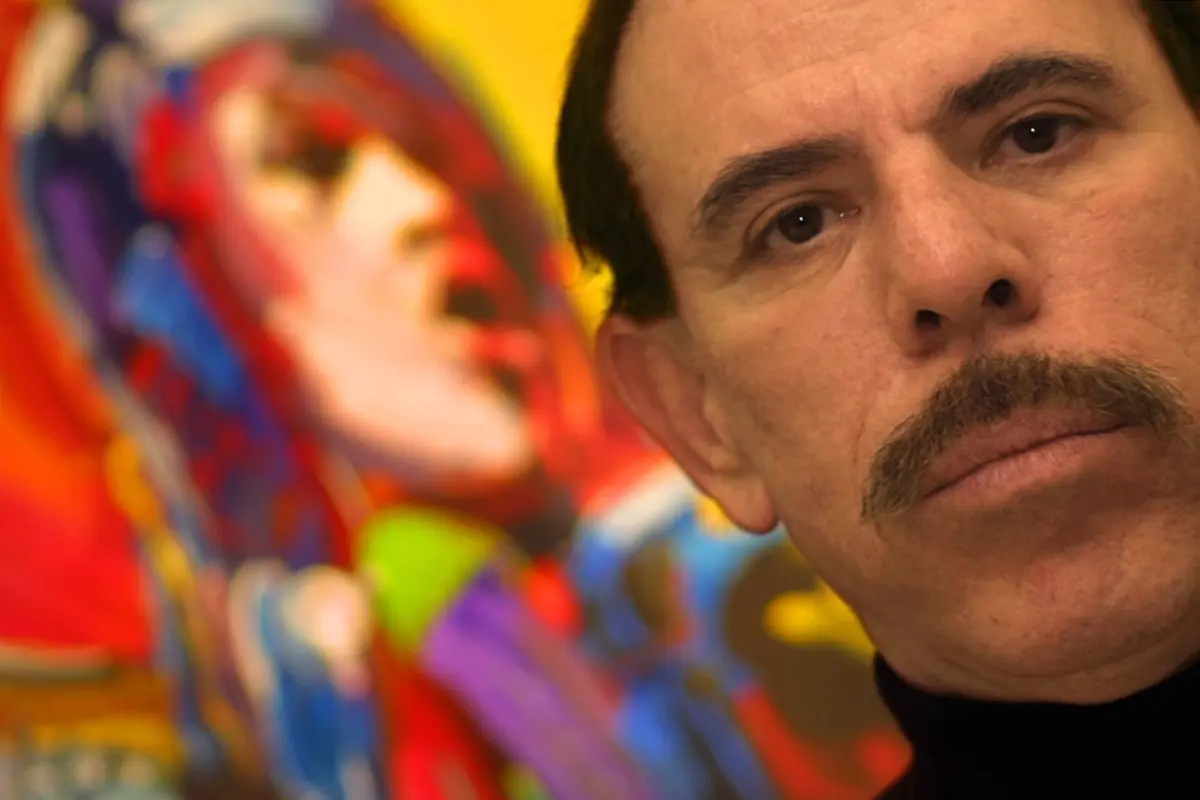
NEW YORK — Peter Max, the visionary German-American artist whose euphoric, color-saturated posters and rainbow-hued portraits came to define the visual vocabulary of the 1960s counterculture, has died. He was 88.
Max passed away on Monday at a Manhattan hospital following a prolonged battle with Alzheimer’s disease, according to his close friend and longtime spokesperson, Michael Pagnotta. Max is survived by his children, Adam and Libra, who remained devoted to him through his final years.
Across a career spanning more than half a century, Max transformed how America saw itself. Armed with vibrant hues of hot pink, electric blue, and sunburst yellow, his work bridged the gap between avant-garde pop art and mass commercial appeal. From iconic counterculture posters that rallied hundreds of thousands to Central Park during the Summer of Love, to official commissions for United States border crossings, presidential portraits of everyone from Bob Dylan and Ringo Starr to Barack Obama and Taylor Swift, Max’s aesthetic was inescapable. He was the rare artist who refused to let art remain trapped behind museum glass, believing instead that creativity belonged in the hands, homes, and everyday lives of the public.
Executive Overview
The death of Peter Max marks the passing of one of the final giants of the classic Pop Art era. Emerging alongside contemporaries who pushed the boundaries of post-war visual culture, Max captured a specific lightning-in-a-bottle cultural phenomenon.
While musicians like The Beatles provided the auditory soundtrack to the turbulent yet hopeful 1960s, Peter Max provided the visual architecture. His art married the post-war optimism of a booming America with Eastern spiritualism, cosmic iconography, and a relentless devotion to color.
Yet, beyond his dizzying commercial success and ubiquitous cultural footprint—which ranged from college dorm-room posters to licensed consumer goods like watches and bath towels—Max’s life story was one of profound resilience. An infant refugee fleeing Nazi persecution, he traversed the globe before finding his artistic home in New York City. His final years, unfortunately, were complicated by well-publicized family and legal battles over his care and guardianship, casting a complex shadow over the twilight of an otherwise jubilant career. Nevertheless, his legacy remains anchored in the boundless, kaleidoscopic joy he injected into the global cultural consciousness.
Detailed Chronology: From Refugee to Cultural Icon
Early Life and Global Upheaval (1937–1953)
Born Peter Max Finkelstein to Jewish parents in Berlin in 1937, his earliest years were shaped by the looming terror of the Nazi regime. As an infant, his family made the harrowing decision to flee Germany, embarking on a prolonged odyssey of displacement.
The family spent roughly a decade finding sanctuary in Shanghai, China, where Max absorbed early visual influences from Asian art and architecture. Following their time in Shanghai, the family lived for several years in Israel before finally immigrating to the United States and settling in Brooklyn in 1953. This cross-cultural upbringing instilled in Max a profound sense of global interconnectedness, which would later manifest in his universal themes of peace, love, and cosmic unity.
Artistic Awakening in New York (Late 1950s–1960s)
After completing high school, Max pursued formal artistic training at the prestigious Art Students League of New York. The institution was a crucible for America’s post-war art scene, having trained luminaries such as Roy Lichtenstein, Robert Rauschenberg, and Cy Twombly.
During this period, the art world was pivoting away from the brooding intensity of Abstract Expressionism toward the accessible, everyday imagery of Pop Art. Max embraced this shift wholeheartedly, though he injected his work with a distinctly psychedelic, spiritual, and utopian sensibility.
His breakthrough came in the late 1960s with iconic pieces like the "Be In" poster. Layering the word "Love" over a vibrant rainbow background, the poster became a clarion call for the generation, inspiring hundreds of thousands of young people to gather in New York City’s Central Park to immortalize the historic Summer of Love.
Commercial Dominance and Government Commissions (1970s)
By the 1970s, Max’s artistic footprint was everywhere. His signature creation, the "Cosmic Jumper"—a weightless, joyful figure clad in a bell-bottomed suit soaring through dreamscapes of saturated color—became a defining symbol of the era. The character achieved national permanence in 1974 when it was featured on a U.S. postage stamp commemorating the Spokane World’s Fair.
His rising prominence caught the attention of the federal government. In the mid-1970s, Max was hired to design a series of "Welcome to the U.S." signs for entry points along the Canadian and Mexican borders. Drenched in vibrant pinks, blues, and yellows, the trippy designs initially met bureaucratic resistance; some officials questioned whether their psychedelic aesthetic was too radical for government signage, leading the project to be shelved in storage.
However, President Jimmy Carter later championed the initiative. In 1978, more than 100 of Max’s welcoming signs were officially installed at border crossings, greeting millions of international travelers entering the country with a burst of artistic optimism.
Mature Works, Memoir, and Later Years (2013–2024)
As decades progressed, Max expanded his portraiture, capturing cultural icons, athletes, and politicians across generations, ranging from rock royalty like Bob Dylan and Ringo Starr to modern superstars like Taylor Swift, alongside presidential figures like Barack Obama.
In 2013, Max published his visual memoir, The Universe of Peter Max, chronicling his incredible life journey. In the book, he credited renowned yoga master Swami Satchidananda with profoundly shaping his philosophy: “Who taught me the art of letting go and being in the flow.”
Astrophysicist Neil deGrasse Tyson penned the book’s introduction, lauding Max for his unique ability to capture "the soul of the cosmos on canvas."
Supporting Context & Metrics: The Scale of Max’s Impact
To understand Peter Max is to understand the democratization of art. Unlike fine artists who restricted their output to elite galleries, Max believed deeply in mass appeal.
- The Consumer Landscape: At the height of his 1960s and 70s fame, Max’s artwork was licensed across an astonishing array of consumer goods. His prints adorned college dorm-room walls, fashion scarves, watches, butter dishes, bath towels, and even General Electric clocks.
- Global Reach: Millions of travelers encountered his work daily via his federal border-crossing installations.
- Institutional Lineage: Having trained at the Art Students League alongside Pop Art pioneers, Max helped bridge the gap between high-art theory and commercial graphic design, paving the way for modern graphic artists and street artists alike.
Despite his massive commercial success, Max maintained a prolific studio practice well into his later decades, frequently creating live paintings at charity events and donating works to environmental and humanitarian causes.
Official Statements and Tributes
Tributes poured in from across the cultural spectrum following the announcement of his death.
Michael Pagnotta, his close friend and spokesperson who began working with Max in the mid-1980s, offered a poignant reflection on the artist’s unique place in history:
"He had a very expansive mind. As much as the Beatles provided a soundtrack for that era and for that generation, Peter visualized it, and he just exploded onto the scene in the late 1960s.
Whatever kind of post-war optimism existed in the country, even though it was very turbulent times, Peter was able to capture that and marry it to that sort of spiritual eastern magical mystery thing, and it worked perfectly. And he believed in the mass appeal of what he was doing. He believed in making art accessible to people."
In his 2013 memoir, Max himself summarized his life’s philosophy on creativity and the cosmos:
"To me, the universe is itself the ultimate expression of creativity. That we, as human beings, have been endowed with the ability to channel that creativity fills me with a sense of awe and wonder. When I tap into my inner cosmos — that nucleus of creativity within me — it becomes a source of ever-expanding possibilities, enabling me to go from magical adventure to another."
Future Outlook and Continuing Legacy
While Peter Max’s physical presence has left the world, his cultural footprint remains permanently woven into the fabric of modern art history. His bright, bold palettes anticipated the neon-drenched aesthetics of the 1980s and continue to influence contemporary graphic design, illustration, and pop surrealism.
At the same time, the conclusion of his life is intertwined with modern legal discourse surrounding elder care. In the years leading up to his passing, his daughter, Libra Max, went public with a high-profile legal dispute against his court-appointed guardian. She raised serious concerns regarding her father’s isolation from family and friends, as well as the restriction of information surrounding his health—a legal battle that drew widespread media attention and highlighted the vulnerabilities faced by aging artists.
As the legal dust settles and art historians begin the task of cataloging his immense, sprawling archive, Peter Max’s true legacy will ultimately rest where he always wanted it: in the vibrant colors of his canvases, the joyful smiles of those who look upon his cosmic jumpers, and an enduring, radical belief that art has the power to unify, uplift, and transform the human soul.