In the fast-paced ecosystem of modern search engine optimization (SEO), relying on static spreadsheets or outdated weekly data is a recipe for strategic failure. As search engine result pages (SERPs) evolve with volatile algorithm updates, dynamic AI-generated summaries, and localized features, digital marketers, agencies, and enterprise brands require instantaneous, granular visibility. Modern SERP tracking tools do far more than just log keyword positions; they serve as mission-critical intelligence hubs that map ranking fluctuations directly to traffic acquisition, user behavior, and revenue generation.
This in-depth review evaluates the top seven SERP tracking tools available in 2025. By dividing the market into dedicated, standalone tracking powerhouses and robust all-in-one SEO platforms, this analysis helps organizations select the precise software architecture required to protect and scale their organic search footprint.
Detailed Chronology: The Evolution of Rank Tracking
To understand where SERP tracking stands today, it is helpful to look at how the industry has matured:
The Manual Era (Pre-2010s): Practitioners relied on manual browser searches, checking positions line-by-line and storing data in clunky Excel sheets. Data was prone to human error, heavily influenced by localized personalization biases, and restricted by infrequent check intervals.
The Rise of Automated Trackers (2010–2018): Dedicated rank trackers emerged to automate daily queries. However, these early tools were often plagued by proxy bans, slow scraping speeds, and limited support for global search engines or localized zip-code tracking.
The Feature-Rich Ecosystem (2018–2023): Platforms began incorporating advanced SERP feature monitoring (such as Knowledge Panels, People Also Ask, and video carousels) alongside API integrations with Business Intelligence (BI) and reporting suites like Google Data Studio.
The Modern Era of AI & Real-Time Intelligence (2024–2025): Today’s tools must contend with complex search landscapes dominated by AI Overviews and fluid layout shifts. Modern SERP trackers offer on-demand data refreshes, deep CRM and analytics integrations, and predictive gap analysis to uncover lost traffic opportunities instantly.
Supporting Context & Metrics: Why Accurate Tracking Matters
Investing in enterprise-grade SERP tracking software is no longer a luxury; it is a fundamental requirement for validating organic search budgets. According to industry benchmarks, over 70% of top-performing SEO agencies attribute their client retention and revenue growth to their ability to transparently tie granular SERP movements to bottom-line conversions.
9 Essential Features to Look for in SERP Tracking Software
When evaluating software options, organizations must ensure the platform incorporates these core capabilities:
Access Accurate On-Demand Ranking Updates: Rapidly shifting algorithms demand real-time data refreshes rather than waiting days for scheduled updates.
Monitor Performance Across SERP Features: Identify which keywords trigger AI Overviews, featured snippets, and video carousels so you can steal these high-visibility positions from competitors.
Track SERP Movement Across All Major Search Engines: Go beyond Google to monitor Bing, Baidu, Yandex, and YouTube, especially for international campaigns.
Granular Tracking (By Location and Device): Differentiate between desktop and mobile rankings while scaling down from national coverage to hyper-local zip-code accuracy.
Map SERP Movements to Traffic and Revenue: Integrate with Google Analytics or Adobe Analytics to correlate ranking jumps with actual user behavior and financial returns.
View Historical Rank Performance: Analyze long-term ranking trends and benchmark performance against competitors over extended periods.
Run Competitor Comparisons: Group keywords by ranking brackets (e.g., positions 1–3, 4–10) to identify emerging threats and market share shifts.
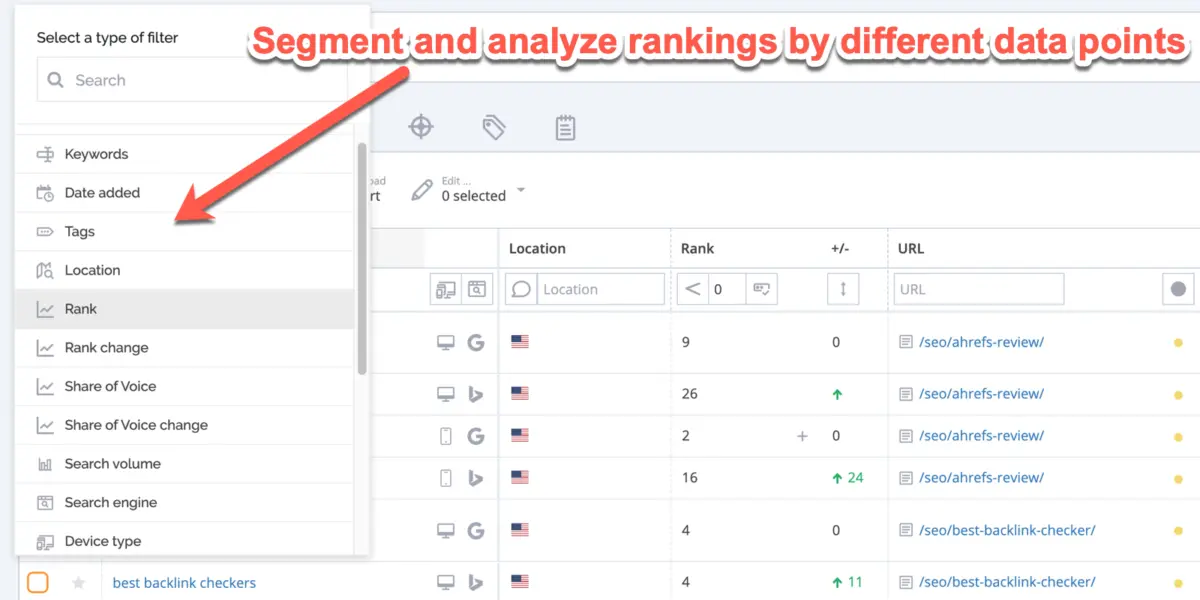
Tag and Segment Rankings Data: Categorize keywords by funnel stage, topic, content asset type, and device category to extract actionable insights.
Generate White-Label Reports: Deliver polished, automated reports directly to clients or plug data smoothly into third-party dashboards like Looker Studio (formerly Google Data Studio) and Databox.
The 7 Best SERP Tracking Tools for 2025
The market features countless options, but the following seven platforms stand out for their accuracy, scale, and comprehensive feature sets.
1. AccuRanker
Type: Standalone SERP Tracker
Best For: Agencies, enterprises, and high-growth brands demanding rapid data refreshes and deep analytics integrations.
AccuRanker is widely regarded as a premier standalone tracking solution, trusted by over 32,000 companies globally, including enterprise leaders like HubSpot and IKEA. It stands out by updating keyword sets automatically every 24 hours while allowing users to trigger on-demand data refreshes instantly.
Key Features: Tracks over 50 distinct SERP features, supports major search engines (Google, Bing, Baidu, Yandex, YouTube), and offers robust integrations with Google Analytics and Adobe Analytics to evaluate landing page performance and Share of Voice.
Pricing: Subscription plans scale based on tracked keyword volume, starting at $116/month for up to 1,000 keywords.
2. Semrush (Position Tracker & SERP Gap Analyzer)
Type: All-in-One SEO Platform
Best For: Digital marketing professionals and enterprises seeking a comprehensive marketing suite alongside elite rank tracking.
Serving over 10 million users from global brands like Samsung and Booking.com, Semrush offers a Position Tracking tool that rivals dedicated trackers in speed and accuracy. Beyond basic tracking, its App Center features the SERP Gap Analyzer, an advanced tool that scans Google results to discover under-optimized content, saving teams hours of manual research.
Key Features: Hyper-local tracking down to the zip code, device comparisons, robust competitive position distribution charts, and Google Search Console integrations for low-hanging fruit keyword discovery.
Pricing: Platform plans start at $139.95/month.
3. ProRankTracker
Type: Standalone SERP Tracker
Best For: SEM agencies, ecommerce brands, and international video marketers.
ProRankTracker is a cost-effective, highly scalable tool trusted by over 60,000 users. It specializes in delivering precise, multi-language SERP data across an immense variety of global locations and device configurations.
Key Features: Advanced white-label reporting, comprehensive video rank tracking, and intuitive dashboards designed to manage high volumes of client data efficiently.
Pricing: Plans start at an accessible $39/month.
4. Advanced Web Ranking (AWR)
Type: Standalone SERP Tracker
Best For: In-house marketing teams and large agencies needing customizable reporting infrastructure.
Advanced Web Ranking has built a stellar reputation among enterprise SEOs—serving organizations like Microsoft—by providing reliable, scalable keyword monitoring across desktop, mobile, and localized search environments.
Key Features: Deep historical performance tracking, flexible user permissions for agency teams, and robust white-label reporting options.
Pricing: Subscription models begin at $99/month.
5. SERPWatcher (by Mangools)
Type: All-in-One SEO Platform Tracker
Best For: Small-to-medium businesses, startups, and freelancers looking for simplicity and affordability.
Part of the Mangools toolset (which also includes SERPChecker for deep analysis), SERPWatcher is trusted by enterprise giants like Airbnb and Adidas. Its proprietary Performance Index metric helps users instantly gauge organic traffic potential across tracked keywords.
Key Features: Clean, interactive user interfaces, interactive alert systems for ranking changes, and seamless integration with the broader Mangools research suite.
Pricing: Mangools plans begin at $29.90/month.
6. SE Ranking
Type: All-in-One SEO Platform
Best For: Small business owners and digital agencies seeking an all-inclusive toolkit.
SE Ranking simulates real user behavior within specific geographic coordinates to secure 100% accurate ranking data across major search engines. It balances a robust suite of SEO tools with an intuitive position-tracking module.
Pricing: Starts at $52/month based on daily updates for 500 keywords.
7. Nightwatch
Type: Standalone SERP Tracker
Best For: Brands of all sizes requiring hyper-local global tracking.
Nightwatch stands out as an exceptionally accurate daily tracker utilized by companies like Shopify, Scotiabank, and Coinbase. It delivers deep data insights drawn from over 107,000 global locations.
Pricing: Offers a 14-day free trial, with paid plans starting at $32/month for up to 250 keywords.
Official Industry Statements & Expert Insights
Industry leaders consistently emphasize the necessity of leveraging automated intelligence over manual spreadsheets.
"It’s by far the best keyword ranking tracker in the market and has a ton of great reporting functions. If you want visibility on large volumes of keywords housed within a nice dashboard—this is for you."
— Matthew Howells-Barby, Co-Founder, TrafficThinkTank
Furthermore, modern reporting demands fluid integrations. As noted by Ian Howells, Co-Founder of Traffic Think Tank:
"The thing that really got me using them heavily in the last month or two is their Looker Studio/Data Studio connector. Combining the tag feature, as well as the Share of Voice metric… has been a big help in making these reports immediately digestible."
Future Outlook: The Next Wave of SERP Tracking
As we look toward the remainder of the decade, the SERP tracking landscape will continue to transform alongside advancements in artificial intelligence and machine learning. Search engines are no longer presenting static lists of blue links; instead, zero-click searches, AI-generated summaries, and dynamic entity cards dominate user interfaces.
Future-proof SERP tracking tools will need to evolve beyond simple numerical rankings (positions 1 through 100). They will increasingly focus on Share of Screen, measuring visual real estate dominance within AI-driven search results, and predicting user intent shifts before they impact traffic flows. Organizations that adopt agile, feature-rich tracking solutions today will be best positioned to capture organic market share, defend their digital assets, and prove clear return on investment in tomorrow’s automated search economy.