

Executive Overview
Nearly 700,000 years ago, a landscape vastly different from today’s arid realities flourished in what is now northern Israel. Encompassing a rich tapestry of dense forests, winding rivers, expansive wetlands, and vibrant vegetation, this prehistoric ecosystem supported some of the planet’s largest land mammals alongside some of the earliest human populations to venture out of Africa.
Today, this lost world is coming back into sharp focus thanks to a remarkable scientific breakthrough: the comprehensive analysis of a single ancient elephant tooth.
Published in the prestigious journal Quaternary Science Reviews, a groundbreaking study has leveraged advanced analytical techniques—ranging from high-resolution CT scans and three-dimensional digital reconstructions to micro-wear analysis, isotope geochemistry, and palynology (pollen analysis)—to decode the environmental secrets locked within a fossilized molar and tusk fragments.
Led by Hannah Farrell, a Ph.D. candidate at the University of Haifa, the research team treated the fossil not merely as a biological remain, but as a sophisticated environmental archive. The tooth belonged to Palaeoloxodon antiquus, the formidable straight-tusked elephant of the Pleistocene epoch. By interrogating the chemical and structural composition of the molar, scientists have reconstructed the intricate ecological backdrop of Gesher Benot Ya’aqov (GBY-NBA).
This pivotal archaeological site, situated in the Jordan Rift Valley just south of the modern Hula Valley, has long been recognized for its abundant stone tool assemblages. However, the new findings elevate our understanding of the region from a localized artifact repository to a vital ecological refuge.
Operating within the Levantine Corridor—the principal natural land bridge connecting Africa and Eurasia—this prehistoric oasis offered a dependable abundance of water, flora, and fauna. For the Acheulian hominin populations traversing these ancient pathways, the Hula Valley served as a critical survival corridor.
By demonstrating how early humans and megafauna coexisted and thrived within a remarkably stable environment, this study offers profound insights into the ecological drivers of human migration, adaptation, and survival during the Middle Pleistocene.
Detailed Chronology and Archaeological Context
To fully appreciate the gravity of the recent discoveries at Gesher Benot Ya’aqov, one must trace the deep history of both the site itself and the scientific expeditions that have unspooled its secrets over decades of meticulous excavation.
The Acheulian Footprint at Gesher Benot Ya’aqov
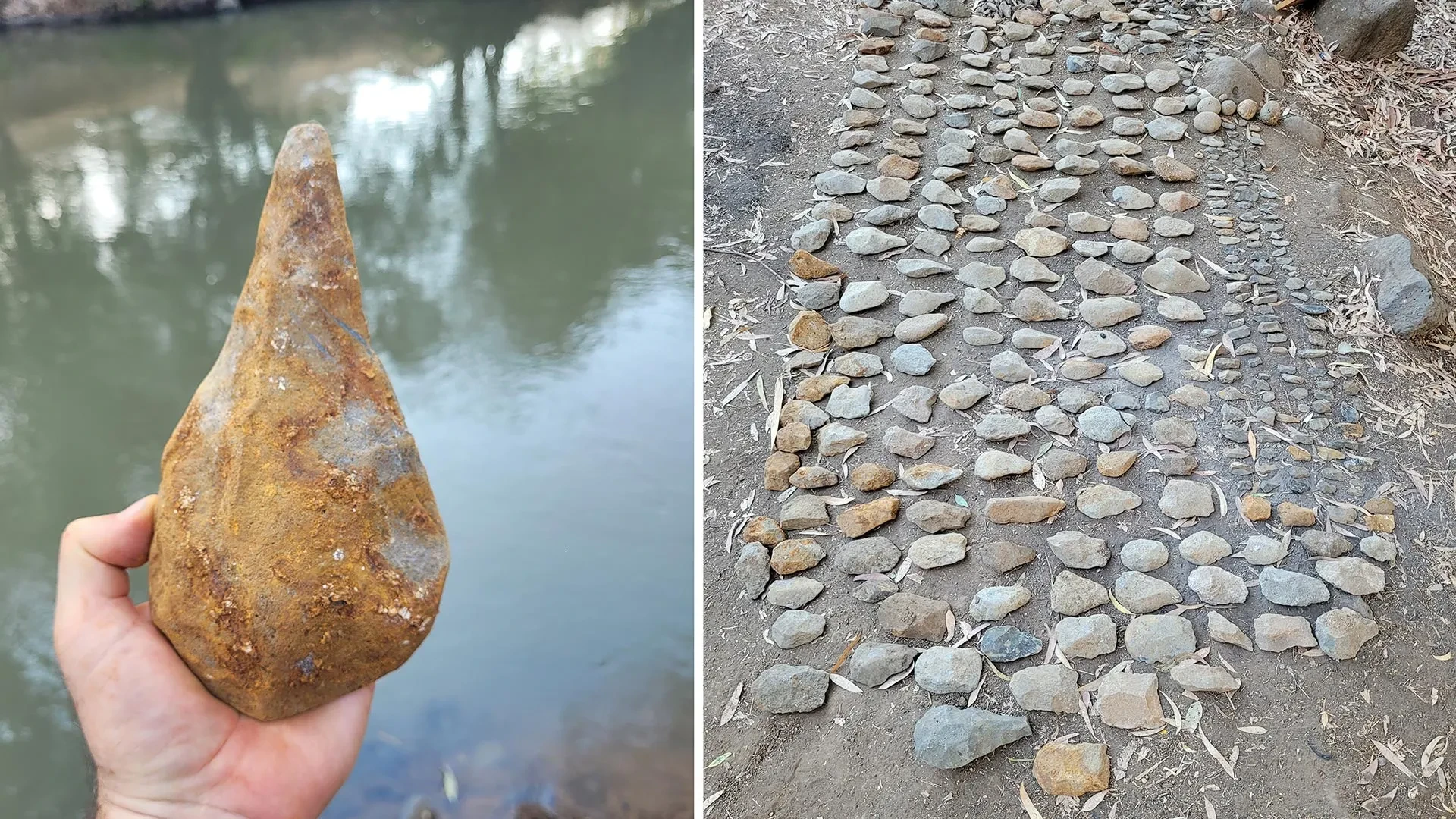
Located along the Daughters of Jacob Bridge site in the northern Jordan Rift Valley, Gesher Benot Ya’aqov (GBY) represents one of the most important Lower Paleolithic localities in the Old World. For years, archaeologists have unearthed dense concentrations of material culture here, prominently featuring stone tools belonging to the Acheulian technological tradition.
Acheulian toolmakers were master artisans of their era, renowned for crafting standardized, symmetrical implements such as basalt handaxes and cleavers. At GBY, these heavy-duty volcanic rock tools are frequently found in direct spatial association with the skeletal remains of large mammals, particularly extinct elephants.
This juxtaposition has long fueled scientific debate regarding early human subsistence strategies. Did these hominins actively hunt giant pachyderms, or did they opportunistically scavenge carcasses bogged down by natural hazards in the marshy terrain? While the debate continues, the discovery of butchery marks and coordinated tool use at similar sites underscores a sophisticated relationship between early humans and the megafauna that dominated their landscape.
The Interdisciplinary Breakthrough
The recent breakthrough stems from a collaborative, multi-institutional initiative uniting specialists across various scientific disciplines. The research was spearheaded by Hannah Farrell under the academic supervision of the University of Haifa, building directly upon the foundational excavations directed by Professor Gonen Sharon of Tel-Hai College in the Galilee.
Recognizing that bones and teeth act as biochemical "black boxes" recording the life history of an animal and its environment, Farrell and her colleagues embarked on a multi-pronged analytical campaign. The project integrated expertise from several leading Israeli academic institutions:
- Isotope Geochemistry: Led by Dr. Cheryl A. Makarewicz of the University of Haifa, analyzing chemical signatures within the tooth enamel to reconstruct dietary inputs and hydrological conditions.
- Archaeozoology: Headed by Dr. Nimrod Marom of the University of Haifa, contextualizing the faunal remains within broader Pleistocene ecological frameworks.
- Pollen and Vegetation Analysis: Conducted by Minji Jin and Professor Dafna Langgut of Tel Aviv University, extracting microscopic fossilized pollen from associated sedimentary layers to map out ancient flora species.
By fusing these distinct methodologies with non-destructive high-resolution CT scanning and 3D geometric morphometrics, the team bypassed traditional limitations of fossil analysis, extracting a high-definition environmental narrative from a single dental artifact.
Supporting Context, Metrics, and Scientific Methodology
The methodological rigor applied to the GBY elephant tooth highlights a major evolution in how contemporary paleoanthropologists and paleoecologists study ancient terrestrial ecosystems.
Decoding the Palaeoloxodon antiquus Molar
The subject of the study—a large molar and accompanying tusk fragments—belonged to Palaeoloxodon antiquus, the straight-tusked elephant. Dominating the Pleistocene landscape, this colossal herbivore reached heights of up to 4 meters at the shoulder and weighed upwards of 14 tons, dwarfing modern African and Asian elephants.
Because teeth grow incrementally and incorporate chemical elements from the surrounding environment into their mineral matrices (hydroxyapatite) as they develop, they serve as long-term diaries of an animal’s life.
- Computed Tomography (CT) Scanning: High-resolution digital imaging allowed researchers to peer inside the fossil without causing structural damage. This revealed internal wear patterns, enamel thickness, and structural integrity, shedding light on the animal’s age at death and masticatory mechanics.
- Dental Micro-wear Analysis: By examining microscopic scratches and pits on the enamel surface under high magnification, scientists determined the precise nature of the elephant’s diet—differentiating between browsing on woody vegetation and grazing on open-land grasses.
- Isotope Geochemistry: The analysis of stable carbon ($^13textC/^12textC$) and oxygen ($^18textO/^16textO$) isotopes extracted from the tooth enamel enamel provided hard data regarding local aridity, seasonal temperature fluctuations, and the types of plants (C3 versus C4 photosynthetic pathways) consumed by the animal. The chemical signatures confirmed that the elephant inhabited a well-watered, temperate ecosystem characterized by reliable precipitation and dense vegetation.
- Palynology (Pollen Analysis): Extracting fossilized pollen grains from sedimentary matrices immediately surrounding the fossil site allowed researchers to construct a floral inventory. The data revealed a rich mosaic of wetland species—including reeds (Phragmites), sedges (Cyperaceae), willows (Salix), and tamarisk (Tamarix)—alongside forest-dwelling trees and open grassland flora.
The Environmental Mosaic of the Middle Pleistocene
Rather than depicting a uniform, static landscape, the data paint a picture of a dynamic, highly productive ecological matrix. The Hula Valley 700,000 years ago featured:
- Riparian Forests and Woodlands: Providing shade, timber, and diverse foraging opportunities.
- Open Grasslands: Supporting large herds of herbivores.
- Extensive Wetlands and Marshes: Offering stable, year-round water sources and rich aquatic biological productivity.
This environmental stability was critical. During the Pleistocene, global climatic oscillations frequently triggered dramatic environmental shifts, plunging large parts of Eurasia and Africa into severe glacial or arid phases. However, the Hula Valley—bolstered by its unique rift valley geography and perennial water sources—acted as an ecological buffer zone.
Official Statements and Expert Perspectives
The implications of the study extend far beyond local archaeology, offering a vital lens through which to view human evolution on a continental scale.
Professor Gonen Sharon of Tel-Hai College, whose field excavations at Gesher Benot Ya’aqov provided the primary archaeological context for the study, emphasizes the interconnected nature of human and animal survival during this epoch:
"Understanding how humans and animals responded to environmental change hundreds of thousands of years ago helps us better understand the forces that shaped our species. The availability of water, vegetation, and animal resources shaped where humans and wildlife could survive. The wetlands, rivers, and woodlands of the Hula Valley helped sustain life along one of the world’s earliest migration corridors, offering a rare opportunity to understand the ecological conditions that supported both animals and human populations nearly 700,000 years ago."
Sharon’s perspective underscores a paradigm shift in modern archaeology: artifacts and bones can no longer be interpreted in isolation. Without reconstructing the surrounding environment—the forests, the water tables, the flora, and the climate—researchers miss half the story of how hominins navigated the prehistoric world.
Lead researcher Hannah Farrell elaborates on the analytical power of applying multi-proxy scientific techniques to single specimens:
"By looking beyond the morphology of the fossil and interrogating its internal chemistry and micro-structure, we are essentially reading an environmental diary written hundreds of thousands of years ago. The straight-tusked elephant was a massive consumer of its environment; its tooth preserves a cumulative record of what it ate and the water it drank across its lifetime. When we match that chemical record with the pollen and sediment data from GBY, a remarkably consistent, lush picture of the Levantine Corridor emerges—proving it was a haven for both megafauna and early human explorers."
Dr. Dafna Langgut of Tel Aviv University, who contributed to the palynological analysis, notes the exceptional preservation quality of the Jordan Rift Valley sediments:
"The preservation of delicate pollen grains alongside heavy basalt handaxes and massive elephant teeth is extraordinary. It allows us to reconstruct plant communities with high taxonomic resolution. We can identify not only the presence of water, but the exact composition of the wetland margins that early humans utilized for foraging and tool manufacturing."
Future Outlook and Broader Implications
As the scientific community digests the findings published in Quaternary Science Reviews, the research opens up exciting new avenues for future investigation in the Jordan Rift Valley and along the broader Levantine Corridor.
Unraveling Out-of-Africa Migrations
The Levantine Corridor is universally recognized as the primary terrestrial artery utilized by hominins dispersing out of Africa into Eurasia during the Early and Middle Pleistocene. However, the exact mechanics of these migrations—whether they occurred in pulses driven by climate change, or along steady trickle routes supported by ecological oases—have long remained heavily debated.
The GBY study provides a concrete ecological model demonstrating how refugia like the ancient Hula Valley functioned. By maintaining stable, resource-rich habitats during periods of regional climatic stress, these oases effectively lowered the evolutionary and physiological risks associated with crossing unfamiliar or arid landscapes. Future research will likely focus on applying similar multi-proxy chemical and palynological analyses to other sites along the corridor to determine whether similar ecological buffers existed further north and south.
Technological and Methodological Advancements
The success of Hannah Farrell’s team highlights the immense value of non-destructive, high-resolution analytical techniques in paleoanthropology. As isotope geochemistry, ancient DNA extraction, dental micro-wear mapping, and 3D digital imaging continue to advance, researchers can extract exponentially more data from existing museum collections and newly excavated fossils.
Institutions across Israel and internationally are already planning follow-up studies targeting other mammalian remains from Gesher Benot Ya’aqov, including rhinos, hippos, and deer. By comparing the isotopic and dietary profiles of multiple species across different stratigraphic layers, scientists aim to construct a high-resolution, multi-species timeline of environmental change in the Jordan Rift Valley.
Conservation and Modern Parallels
Beyond pure scientific curiosity, reconstructing ancient responses to environmental fluctuation carries profound contemporary relevance. As modern ecosystems face unprecedented anthropogenic climate change, understanding how Pleistocene landscapes adapted to shifting temperatures and precipitation regimes offers valuable empirical data for modern conservation biology. The Hula Valley—historically plagued by extensive drainage projects in the 20th century and subsequent ecological restoration efforts—serves as a living laboratory demonstrating the resilience and fragility of wetland-dependent biodiversity.
Ultimately, the humble elephant tooth from Gesher Benot Ya’aqov serves as a powerful reminder of deep-time connections. Seven hundred thousand years ago, a giant mammal grazed along the rivers of a lush Levantine paradise, leaving behind a chemical signature of its world. Today, that single fossil has allowed modern science to resurrect an ancient landscape, shedding brilliant light on the fragile environmental threads that sustained our earliest human ancestors on their monumental journey across the globe.