

Executive Overview
NASA’s stalwart Juno spacecraft, orbiting the gas giant Jupiter since July 2016, has fundamentally altered our understanding of planetary physics. A team of researchers led by scientists at the University of Iowa has uncovered unprecedented details regarding how the solar system’s largest planet protects itself against the relentless, high-energy stream of charged particles known as the solar wind. Published online in Nature Communications under the title "Plasma wave observations from Juno spacecraft at the Jovian bow shock," the findings prove that Jupiter utilizes a significantly more sophisticated and multi-layered defense system than Earth.
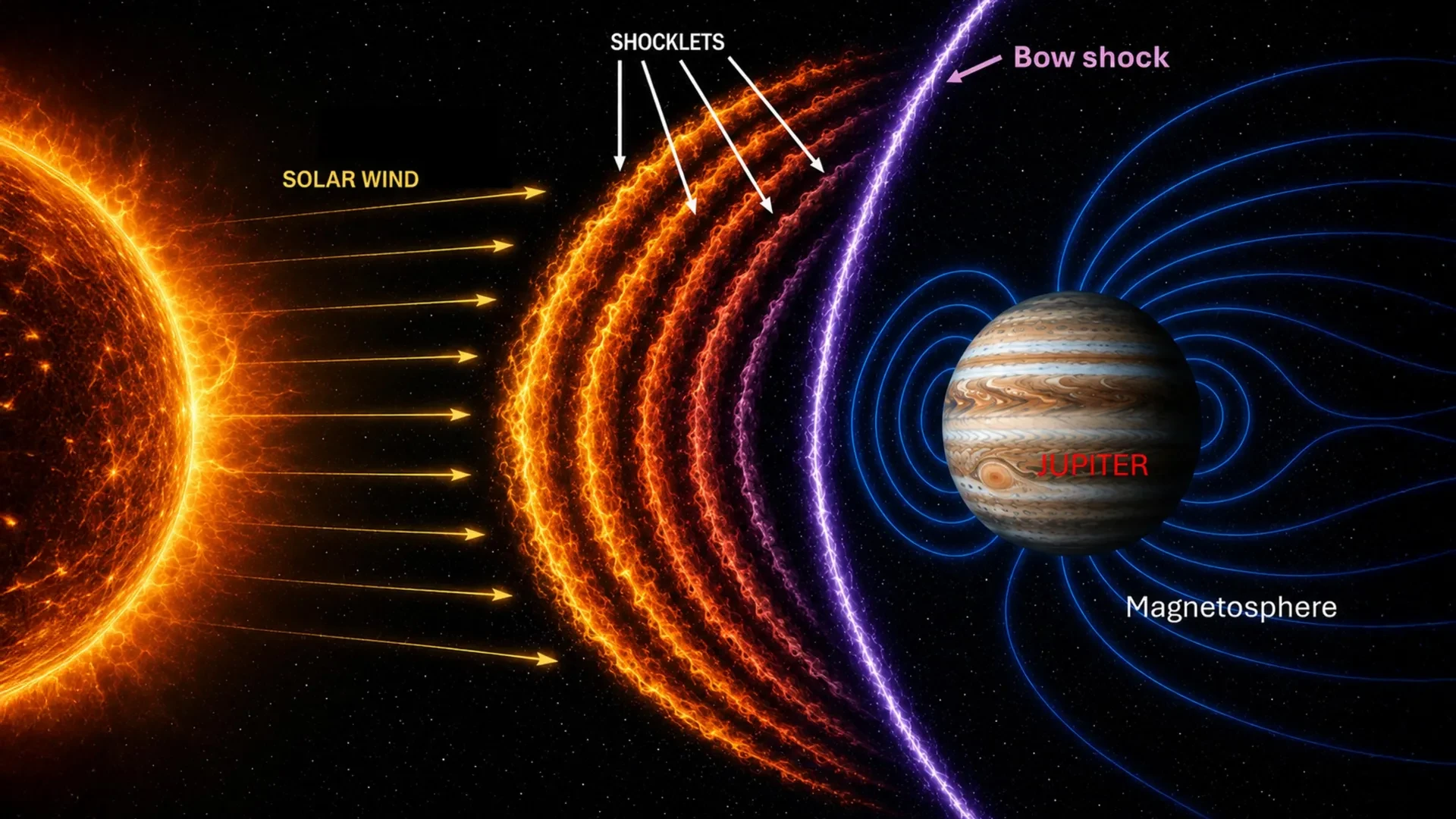
Unlike our home planet, which relies on a relatively straightforward, single-frequency plasma wave barrier, Jupiter deploys a complex, multi-harmonic symphony of plasma waves alongside an extra line of defense featuring smaller upstream structures called "shocklets." This cosmic architecture not only highlights the unique environmental physics of the Jovian system but also provides astrophysicists with a pristine, nearby laboratory. By studying Jupiter’s gargantuan bow shock—the invisible boundary where solar wind meets the planet’s magnetic bubble—researchers gain direct, measurable insights into some of the most violent events in the cosmos, including the extreme shock waves generated by exploding stars and supernova remnants.
Detailed Chronology and Discovery Timeline
The roadmap to this monumental discovery spans decades of interplanetary exploration, culminating in a breakthrough data-gathering campaign enabled by Juno’s specialized suite of instruments.
The Evolution of Outer Planet Exploration
Decades ago, early flyby missions to the outer solar system detected the presence of bow shocks surrounding gas and ice giants. However, these historic spacecraft were transient visitors, rushing past the massive worlds in a matter of hours or days. Consequently, they lacked the prolonged orbital residency, close-proximity positioning, and high-resolution instrumentation required to capture the fine-grained structure of the plasma waves operating within these distant boundaries.
The launch of NASA’s Juno spacecraft in August 2011 fundamentally changed this paradigm. After a five-year, 1.7-billion-mile journey, Juno successfully inserted itself into a polar orbit around Jupiter on July 5, 2016. Its primary mission was to peer beneath the dense, swirling cloud tops of the gas giant to understand its origin, interior structure, deep atmosphere, and powerful magnetosphere. However, Juno’s sweeping, highly elliptical orbits frequently carry it through the outer boundaries of Jupiter’s magnetic domain, placing it in prime position to sample the Jovian bow shock directly.
The December 2024 Breakthrough
The critical empirical breakthrough occurred in December 2024, when Juno passed through Jupiter’s bow shock and captured high-fidelity measurements using its onboard Juno Waves instrument. Designed and built by expert physicists at the University of Iowa, the Waves instrument is engineered to measure electric and magnetic wave activity across a broad frequency spectrum.
As Juno intersected the bow shock, the instrument recorded unprecedentedly clear signatures of plasma behavior. When the research team analyzed the telemetry back on Earth, they realized they were looking at something entirely unexpected: a rich, multi-frequency tapestry of plasma waves and precursor shocklets that fundamentally separated Jupiter’s shock dynamics from anything observed at Earth or Mars. The culmination of this rigorous data analysis was formally documented and published on July 31 in Nature Communications, marking a new milestone in planetary magnetospheric physics.
Supporting Context & Metrics: Anatomy of a Planetary Shield
To fully grasp the magnitude of the Juno team’s discovery, one must examine the mechanics of the solar wind, the nature of bow shocks, and the specific metrics that separate Earth’s modest defense shield from Jupiter’s titan-scale barrier.
The Mechanics of the Solar Wind and Bow Shocks
The Sun acts as a continuous, restless engine, throwing off an incessant gale of electrically charged particles—primarily protons and electrons—known as the solar wind. Streaming outward through interplanetary space at tremendous velocities, these particles frequently travel faster than the local speed of sound within the ambient plasma.
When this supersonic river of charged matter encounters an obstacle like a magnetized planet, it cannot simply flow around it smoothly. Instead, it forms a shock wave known as a bow shock. Much like the shock wave formed at the bow of a ship cutting through water, a planetary bow shock forces the supersonic solar wind to abruptly slow down, heat up, and deflect around the planet’s magnetosphere—the invisible magnetic bubble enveloping the world.
Comparative Metrics: Earth vs. Jupiter
While both Earth and Jupiter feature bow shocks, the operational parameters of these two planetary environments differ by orders of magnitude:
- Planetary Scale: Jupiter’s radius is roughly eleven times that of Earth, and its volume could contain more than 1,300 Earths. Its magnetosphere is so vast that, if it were visible to the naked eye in our night sky, it would appear larger than the full Moon.
- Magnetic Field Strength: Jupiter possesses the strongest planetary magnetic field in the solar system. Its dipole magnetic moment is nearly 20,000 times that of Earth’s, creating a magnetosphere that extends millions of miles into space.
- Wave Frequencies and Harmonics: Earth’s bow shock primarily utilizes plasma waves concentrated around a single, uniform frequency. This simpler arrangement is entirely adequate to decelerate and redirect the relatively modest solar wind reaching Earth’s distance from the Sun ($1 text AU$). In stark contrast, Juno’s data reveals that Jupiter employs a multi-frequency harmonic structure. These overlapping wave frequencies act like multiple musical notes blending into a chord, interacting with incoming solar particles in a vastly more complex, energy-dissipating choreography.
- Precursor Shocklets: Before the solar wind even reaches Jupiter’s primary bow shock boundary, it encounters smaller, localized shock structures known as "shocklets." These structures serve as an extra line of defense, incrementally slowing the solar wind before it slams into the main barrier. Earth lacks these extensive precursor structures because the localized impact pressure of the solar wind at Earth’s orbit is far less intense, rendering such redundant defense mechanisms unnecessary.
Official Statements and Expert Analysis
The research team behind the study has emphasized both the immediate planetary implications and the broader astrophysical significance of their findings.
Jayasri Joseph, a postdoctoral researcher in the Department of Physics and Astronomy at the University of Iowa and the corresponding author of the study, explains the musical analogy behind Jupiter’s plasma wave mechanics:
"Jupiter has found its own way to deal with the solar wind, through plasma waves that are stronger and exhibit richer harmonic structures. That’s important because if you have multiple frequencies, you can heat more particles in the solar wind and slow them down."
Bill Kurth, a senior research scientist in Iowa’s Department of Physics and Astronomy and a coauthor who has participated in NASA’s Juno mission since its 2011 launch, highlights why Earth’s defensive architecture is so much simpler:
"Earth does not need to take these extra steps to handle the solar wind because the impact isn’t as powerful."
Expanding on the universal applications of the discovery, Joseph notes that Jupiter serves as an accessible proxy for violent processes occurring across deep space:
"Because even more powerful shocks occur around astrophysical objects such as supernova remnants, Jupiter’s bow shock offers a nearby natural laboratory for exploring and for understanding how nature converts enormous amounts of flow energy into heat and energetic particles."
Future Outlook: Implications for Astrophysics and Beyond
The implications of Juno’s discoveries extend far beyond the Jovian system, promising to reshape our understanding of high-energy astrophysics.
Bridging Planetary Science and Deep Space Astrophysics
Shock waves are ubiquitous throughout the universe. They govern the behavior of stellar winds colliding with interstellar gas, dictate the dynamics of material spiraling into black holes, and drive the expansion of supernova remnants—the cataclysmic shock waves left behind when massive stars exhaust their nuclear fuel and violently detonate.
However, studying these distant cosmic shocks presents a monumental challenge. Because supernova remnants and active galactic nuclei are light-years away, astrophysicists must rely on remote sensing and theoretical modeling, often struggling to measure the microphysics of energy conversion directly within the plasma.
By utilizing Jupiter’s bow shock as a nearby, accessible natural laboratory, scientists can test fundamental theories of plasma physics under conditions that mimic, on a smaller scale, the extreme environments of deep space. The discovery that multi-frequency harmonic waves and precursor shocklets play a vital role in energy dissipation provides a new template for how theoretical models simulate cosmic shocks.
Next Steps for the Juno Mission and Beyond
As NASA’s Juno spacecraft continues its extended mission operations, researchers will comb through subsequent orbital passes to determine whether Jupiter’s complex bow shock structure changes in response to fluctuations in solar activity. The Sun operates on an 11-year solar cycle, meaning the density, speed, and intensity of the solar wind vary dramatically over time. Observing how Jupiter’s multi-frequency wave patterns and shocklets adapt during different phases of the solar cycle will yield even deeper insights into magnetospheric resilience.
Furthermore, these findings lay critical groundwork for future missions destined for the outer solar system, such as NASA’s Europa Clipper and the European Space Agency’s JUICE (Jovian Icy Moons Explorer) mission. As humanity deepens its exploration of the Jovian system, understanding the harsh radiation environment and plasma dynamics shaped by the planet’s bow shock will be essential for protecting sensitive electronics and instrumentation on future orbiters and landers.
Ultimately, Juno’s revelation that Jupiter defends itself with a complex, harmonic symphony of plasma waves proves that the solar system’s largest planet is not just a passive giant absorbing the fury of the Sun, but an active, elegantly tuned physics laboratory hiding secrets of the wider universe within its magnetic embrace.