

Executive Overview
For millennia, humanity has looked up at the winter night sky and traced the striking, reddish constellation of Orion. Anchoring one of its upper corners is Betelgeuse, a luminescent red supergiant that has captivated stargazers, poets, and scientists alike. Despite its familiarity and centuries of intense scientific scrutiny, this celestial giant has managed to keep secrets.
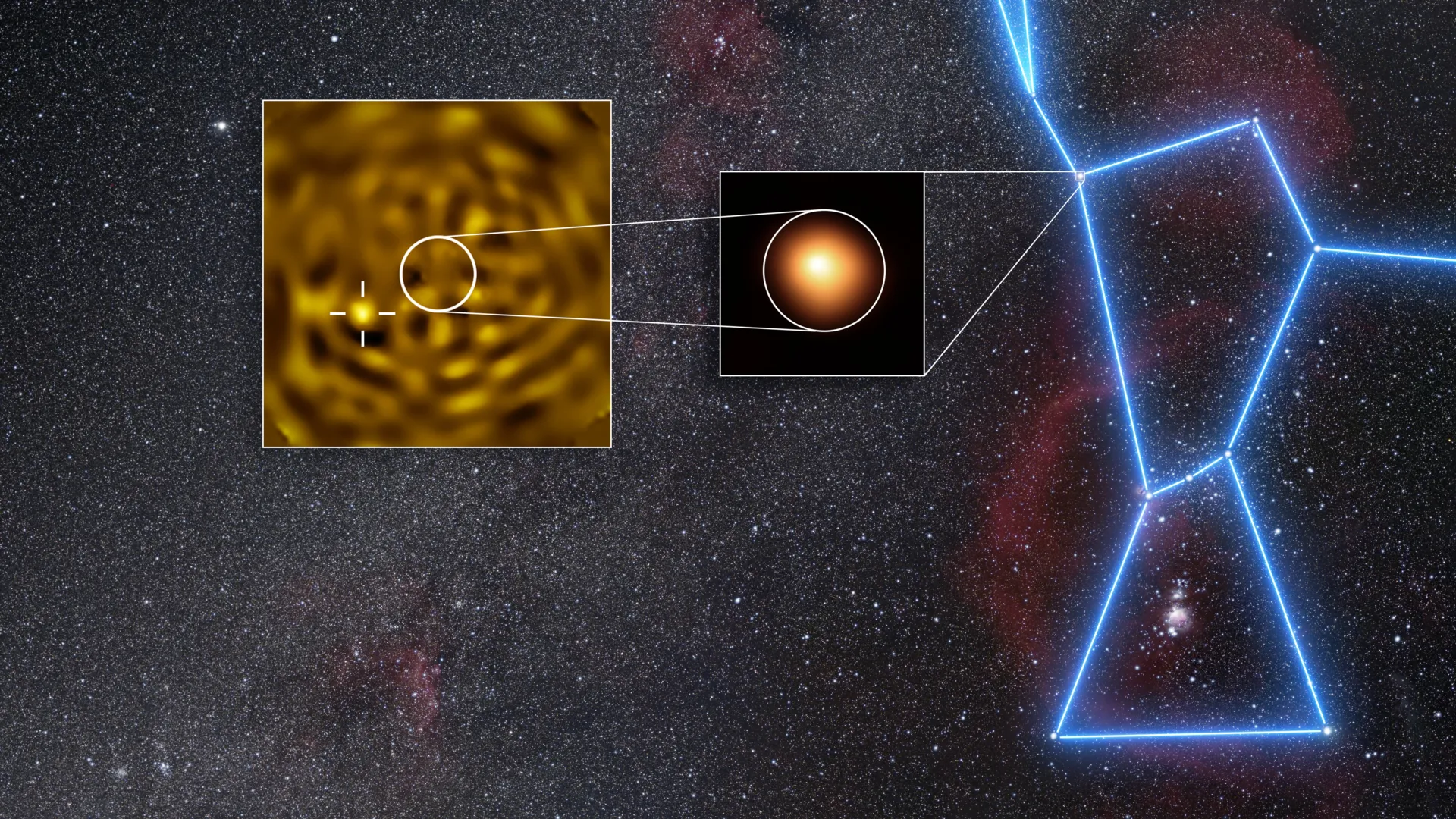
Now, an international team of astronomers has unveiled the strongest evidence to date that Betelgeuse is not a solitary star, but part of a binary system. Utilizing the European Southern Observatory’s Very Large Telescope (ESO’s VLT) situated in Chile’s Atacama Desert, researchers have captured the clearest, most direct image yet of what is believed to be Betelgeuse B—a faint, massive stellar companion orbiting the famous supergiant.
"This is the conclusion of a century-long quest," declares Dr. Miguel Montargès, an astronomer at the Observatoire de Paris–PSL in France and lead author of the breakthrough study published in Astronomy & Astrophysics. "We have shown that Betelgeuse is not single; it is accompanied by a faint stellar companion."
The discovery represents a major milestone in stellar astrophysics. Not only does it solve a century-old mystery regarding the star’s erratic fluctuations in brightness, but it also opens up entirely new avenues of research regarding how massive stars evolve and eventually die. As scientists scramble to confirm the orbit of Betelgeuse B, this finding challenges prevailing models of stellar evolution, introduces a new variable into the countdown toward Betelgeuse’s anticipated supernova, and demonstrates the astonishing versatility of modern exoplanet-hunting technology when turned inward toward our own galactic neighborhood.
Detailed Chronology: A Century-Long Quest for Betelgeuse B
The journey toward confirming Betelgeuse B spans generations of astronomical detective work, marked by theoretical predictions, technological leaps, and moments of sheer scientific astonishment.
1. The Early Theories (The 1920s – 2023)
The hypothesis that Betelgeuse might harbor an unseen companion first emerged roughly a century ago. As early astronomers tracked the star’s variable brightness—noting that it periodically swells, fades, and pulsates—they struggled to reconcile all of its photometric anomalies using single-star models alone. Some researchers suggested that a secondary body, gravitationally bound to the red supergiant, could be subtly modulating its light or disrupting its outer atmosphere.
However, proving this hypothesis proved exceptionally difficult. Betelgeuse is a hyper-giant star with a physical diameter so immense that if it were placed at the center of our solar system, its outer surface would extend out past the orbit of Jupiter, swallowing Mercury, Venus, Earth, and Mars. Furthermore, the blinding glare of the supergiant utterly overwhelms any light coming from a smaller, fainter companion sitting right next to it. For decades, the technology simply did not exist to pierce through the stellar glare and resolve a companion star.
2. The Breakthrough Predictions (2024)
The tide turned in 2024 with the publication of two independent theoretical studies in The Astrophysical Journal. These papers mathematically mapped out the suspected orbital dynamics of the system, making bold, precise predictions about where Betelgeuse’s hypothetical companion should be located from our perspective on Earth.
Crucially, the models indicated that Betelgeuse B would reach its maximum apparent angular separation from the primary star in December 2024. This alignment provided astronomers with a narrow, optimal window of opportunity to bypass the supergiant’s blinding halo and catch a glimpse of the companion.
3. The Observation and the Shock (December 2024 – Present)
Seizing the moment, Dr. Montargès and his colleagues turned the immense light-gathering power of ESO’s VLT toward Orion in December 2024. They utilized the SPHERE (Spectro-Polarimetric High-contrast Exoplanet REsearch) instrument, an advanced adaptive-optics system originally engineered to spot faint, distant exoplanets orbiting other stars.
Following the observations, the team spent several months meticulously processing the raw data, applying sophisticated post-processing algorithms to subtract Betelgeuse’s overwhelming glare. When the final images materialized on his screen, Dr. Montargès admits he was stunned.
"I jumped from my chair when I saw the processed images," recalls Montargès. "Honestly, I thought we did not have the sensitivity to detect Betelgeuse B as it was predicted. Because it is more massive than predicted, we see it!"
While preliminary clues had trickled in earlier—including a potential direct detection using the Gemini North Telescope in Hawaiʻi—the VLT/SPHERE images provided unprecedented clarity. The discovery paper, titled "VLT/SPHERE images the candidate companion of Betelgeuse," marks a definitive turning point in our understanding of the star. Yet, the scientific method demands absolute verification: to formally close the case, the team aims to observe the companion again once it swings around to the opposite side of the star along its predicted orbit.
Supporting Context & Metrics: Unpacking the Scale of Betelgeuse B
To fully appreciate the significance of this discovery, one must examine the physical scale, mass, and behavioral characteristics of the Betelgeuse system through hard data and astrophysical context.
Mass Revisions: Bigger Than Expected
Before the December 2024 observations, theoretical models estimated that if a companion existed, it would likely be a low-mass star—roughly equivalent to our own Sun in mass. However, the unexpected clarity and brightness of the VLT images shattered those assumptions.
- Estimated Mass: Current analysis indicates that Betelgeuse B possesses two to three times the mass of the Sun.
- Brightness: The companion is significantly brighter than initial models predicted, allowing SPHERE’s exoplanet-detection optics to capture its direct light signature rather than just indirect gravitational perturbations.
"The fact that we can still discover a nearby companion, more massive and brighter than the Sun, around such a well-studied star is remarkable," notes Montargès. "These are among the best moments in science: seeing something new, unexpected."
The Great Dimming Event Revisited
The scientific world closely watched Betelgeuse several years ago during its dramatic, highly publicized "Great Dimming." As the supergiant’s apparent magnitude plummeted, social media and mainstream news outlets briefly buzzed with speculation that the massive star was undergoing final pre-supernova convulsions.
Subsequent observations led by Dr. Montargès using ESO’s VLT proved that speculation wrong, revealing that a massive plume of superheated gas had been ejected from the star’s surface, cooling into a localized cloud of obscuring dust that blocked our line of sight.
With the confirmation of Betelgeuse B, astronomers now realize they have another critical factor to integrate into stellar models. While the dust cloud explained the 2019–2020 dimming event, the gravitational and physical interplay between Betelgeuse and its massive companion could play a long-term role in mass-loss episodes, surface convection, and the overall lifecycle of the red supergiant.
Official Statements and Perspectives
The discovery has sent ripples through the astrophysical community, highlighting the power of cross-disciplinary technology—specifically techniques borrowed from exoplanet science—applied to stellar evolution.
-
Dr. Miguel Montargès (Observatoire de Paris – PSL, Lead Author):
"This is the conclusion of a century-long quest. We have shown that Betelgeuse is not single, it is accompanied by a faint stellar companion… To be certain that the companion is really there, we still need to observe it in one year on the other side of the star, but there is very little space left for doubt."
-
Dr. Anthony Boccaletti (Observatoire de Paris, Co-Author):
"It is remarkable to see how SPHERE and advanced post-processing techniques, originally developed to find exoplanets, also excel at detecting a companion around a massive, evolved star like Betelgeuse."
The international research collaboration spans prestigious institutions across Europe, the Americas, and beyond. Alongside Montargès and Boccaletti, the study’s co-authors include researchers from the Centre de Recherche Astrophysique de Lyon (France), the Anton Pannekoek Institute for Astronomy (The Netherlands), IPAG (France), the French-Chilean Laboratory for Astronomy (Chile/France), the National Optical Astronomy Observatory (USA), the University of Cologne (Germany), Observatoire de la Côte d’Azur (France), the Harvard & Smithsonian Center for Astrophysics (USA), KU Leuven (Belgium), and the American Association of Variable Star Observers (AAVSO).
Future Outlook: Will Betelgeuse B Trigger a Cosmic Catalyst?
As the astronomical community digests the implications of the Astronomy & Astrophysics paper, attention immediately shifts to what comes next. The discovery of Betelgeuse B is not merely a taxonomic victory; it introduces profound physical questions about the future of the Orion constellation.
1. The Orbit Verification
The immediate next step is time-sensitive. Because astronomers have calculated a tentative orbital path for Betelgeuse B, they must wait for the companion to complete its transit to the opposite side of the red supergiant. Observing the star in its predicted post-opposition position will provide the definitive, unassailable proof required to satisfy the strictest criteria of the scientific method.
2. Impact on the Imminent Supernova
Betelgeuse is destined to end its life in a spectacular core-collapse supernova. Because the star is relatively close to Earth—roughly 642 light-years away—when it finally explodes, it will briefly shine as brightly as a full moon in our daytime sky, casting shadows at night and remaining visible for weeks.
For decades, astronomers modeled this impending explosion assuming Betelgeuse evolved in isolation. Now, the presence of a companion possessing two to three solar masses changes the dynamical landscape.
- Could the gravitational tide of Betelgeuse B strip material from the outer layers of the supergiant?
- Might the companion accelerate mass loss, altering the timing or the geometry of the eventual supernova blast?
- Could the interaction between the two stars generate unique polarization signatures or asymmetric shockwaves when the primary star finally collapses?
"The question is truly opened whether this companion is going to have an impact on the evolution of the red supergiant," concludes Montargès.
As telescopes point back toward Orion for the next phase of observations, humanity stands on the precipice of a deeper understanding of one of the universe’s most famous beacons. Betelgeuse has guarded its secrets for thousands of years of human observation, but as high-contrast imaging and stellar modeling continue to evolve, the veil is finally lifting.