

Executive Overview
The design and product development communities have fallen headfirst into a dangerous era of conversational tunnel vision. Because Large Language Models (LLMs) are natively trained on dialogue data, the tech industry has collectively, and somewhat lazily, decided that the chat bubble is the universal container for every conceivable AI capability.
While a chat interface is a powerful and flexible tool for open-ended exploration, it is merely one instrument in an expansive UX toolkit. By defaulting every digital product into a text box, engineering and design teams are forcing users to conform to the machine’s native tongue rather than building systems that respect human capabilities, physical limitations, and cognitive bandwidth.
Great user experience (UX) design has always been about matching modality to a user’s immediate context, intent, and cognitive load. Modality—the sensory channels through which humans interact with systems, such as seeing, hearing, touching, speaking, or typing—must dynamically adapt to the user. When an interface fails to account for whether a user’s hands are full, their eyes are occupied, or their psychological bandwidth is maxed out, even the most brilliant underlying AI model will feel broken, anxiety-inducing, and fundamentally unusable.
Detailed Chronology: The Rise and Fall of the Chat Bubble Monopoly
To understand how the tech industry arrived at the ubiquitous chat window, one must trace the rapid evolution of generative AI deployment over the past several years.
Phase 1: The Novelty of the Blank Slate (2022–2023)
When foundational text-based LLMs exploded into public consciousness, the blank chat box was hailed as a triumph of interface design. For decades, software required rigid graphical user interfaces (GUIs) loaded with complex menus, toggles, and buttons. The chatbot offered a seductive alternative: a blank slate capable of handling seemingly any natural language prompt. Product teams rushed to integrate chat windows into enterprise software, consumer apps, and productivity suites, viewing conversation as a universal panacea that eliminated the need for complex information architecture.
Phase 2: The Onset of Choice Paralysis and Linguistic Barriers (2023–2024)
As the novelty faded, enterprise users and everyday consumers began experiencing the hidden tax of conversational design. A blank text box shifted the burden of execution entirely onto the user. Instead of recognizing options via visual menus, users were forced to remember exact terminologies, construct precise syntactic prompts, and translate vague mental goals into complex linguistic commands. Data analysts found themselves writing elaborate sentences to filter spreadsheets instead of clicking a column header; managers struggled to describe scheduling shifts that could be intuitively managed via drag-and-drop calendars.
Phase 3: The Cognitive Cost of Dense Output (2024–Present)
Simultaneously, the industry realized that text-heavy AI outputs imposed an equally heavy cognitive tax. When an AI responds to a quick status check with three paragraphs of prose, it forces the user into sequential, serial reading. This slow, error-prone extraction process replaced the instant, low-effort "glance verification" historically provided by color-coded dashboards and data visualizations. The realization sparked a growing design rebellion: product teams began demanding frameworks to break free from the chat bubble monopoly and match interface modalities directly to human realities.
Supporting Context & Metrics: The Physics of Human Interaction
To dismantle conversational tunnel vision, designers must evaluate interaction through two interconnected lenses: physical constraints and cognitive load.

The High Cost of Mismatched Modalities
Picture a traveler sprinting across a bustling, noisy airport terminal after a sudden gate change. They are dragging a heavy roller bag in one hand and clutching a hot coffee in the other. When they open their airline’s mobile app to check updated travel details, the app immediately fails the input modality test. It forces the traveler to stop, balance their coffee, and type a lengthy booking reference into a tiny chat box.
Upon hitting send, the system fails the output modality test. Instead of flashing a high-contrast, large-format gate number, the AI returns a dense block of text detailing the atmospheric weather patterns causing the delay, burying the actual gate number at the very bottom. While the traveler may ultimately catch their flight, the interface has instilled an acute sense of anxiety, validating the pervasive consumer fear that software is built without empathy for human context.
The Cognitive Spectrum of Interaction
Interaction methods occupy a wide spectrum of mental effort:
- Low-Effort, Ambient Interactions: Push notifications, single-tap buttons, and audio alerts allow users to maintain situational awareness without breaking concentration from primary physical tasks.
- Medium-Effort Interactions: Short text summaries, structured forms, and step-by-step wizards guide users through predictable workflows with minimal friction.
- High-Effort, Focused Interactions: Natural language chat boxes, complex multi-modal prompts, and dense visual dashboards demand deep concentration, spatial reasoning, and linguistic dexterity.
When an enterprise forces a high-effort interaction (like chat) onto a low-effort context (like walking through a factory or driving a vehicle), productivity plummets and error rates skyrocket.

Official Statements and Frameworks: The Task Audit & Alignment Matrix
Leading UX researchers and product architects have introduced formalized evaluation frameworks to help teams escape conversational defaults. At the core of these frameworks are two primary tools: the Task Audit and the Input/Output Alignment Matrix.
The Task Audit Framework
Before writing a single line of code, product teams must conduct a formal Task Audit to ground interface decisions in field evidence rather than software convention. The audit relies on three primary research pillars:
- Contextual Inquiry and Observation: Researchers shadow users in their natural operational environments—such as warehouses, operating rooms, or field utility sites—to document hidden physical workarounds and environmental constraints (e.g., screen glare, heavy protective gear, ambient noise).
- Focused Interviews: One-on-one sessions uncover the mental models, decision points, and verification anxieties that standard usage data fails to capture.
- Collaborative Workshops: Cross-functional teams comprising product managers, engineers, and designers build a comprehensive task inventory, ensuring that technical requirements align directly with user realities.
The Input/Output Alignment Matrix
Once field evidence is gathered, teams consult an alignment matrix to map user intent to optimal modality combinations:
| User Intent | Optimal Input Modality | Optimal Output Modality | Environmental Fit |
|---|---|---|---|
| Quick Status Check | Voice or Single-tap Button | Audio or Push Notification | Hands-busy, Eyes-busy (e.g., Technician on ladder) |
| Specific Detail Query | Natural Language Chat | Short Text Summary | Focused, low-density data need |
| Complex Analysis | GUI (Filters, Sliders) | Visual Dashboard (Charts, Tables) | Desk-based, high-resolution screen |
| Creative Generation | Multi-modal (Image + Text) | Interactive Canvas | Design or drafting environment |
| Monitoring / Alert | Passive (background system) | Push Notification or Audio Alert | Any environment; task is ambient awareness |
| Guided Task Completion | Structured Form or Wizard | Inline Confirmation + Progress Indicator | Focused workflow; user needs verification feedback |
Future Outlook: Adaptive Modality and Cross-Device Handoffs
The future of AI interface design is not monolithic; it is a diverse, multi-modal ecosystem comprising visual, vocal, haptic, and ambient modalities calibrated seamlessly to user intent.

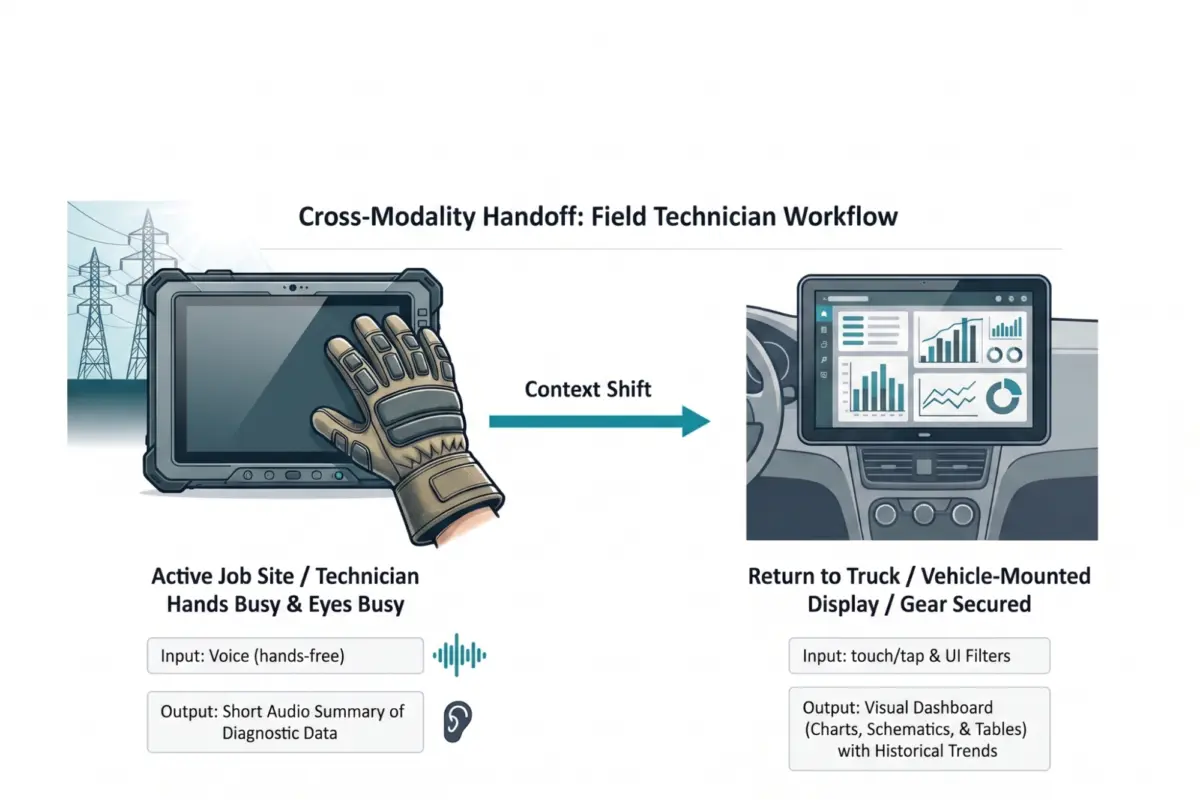
A prime example of this future is seen in high-risk industrial environments, such as electrical grid maintenance. When field technicians service high-voltage equipment while wearing thick protective gloves at significant heights, touchscreens and text chat are safety hazards. Modern adaptive systems utilize a multi-modal handoff: technicians issue hands-free voice inputs and receive concise audio summaries of immediate diagnostic data. Once they return to their utility vehicles and secure their safety gear, the system automatically transitions the workflow to a large-format vehicle-mounted visual dashboard capable of displaying complex schematics and historical trend data.
This adaptive, context-aware approach reduced diagnostic times by 20% and significantly boosted daily tool adoption in field case studies.
Where the Industry Goes From Here
As generative AI matures, the metric of success will no longer be how eloquently a language model can converse, but how effortlessly an interface disappears into the background of human activity. By abandoning conversational tunnel vision, conducting rigorous task audits, and matching modalities to human intent and environment, product designers can build AI tools that truly serve humanity—meeting users precisely where they are, in body and mind.
