

Executive Overview
In the rapidly evolving landscape of product design and user experience (UX), a dangerous illusion persists: the belief that companies truly understand what their users want. Organizations routinely invest heavily in surveys, focus groups, and direct questioning, operating under the assumption that asking customers what they desire will yield a roadmap for success. Yet, modern UX research reveals a starkly different reality—what people say, what they think, what they feel, and what they actually do are frequently disconnected, often contradictory, and deeply influenced by cognitive biases.
Direct questioning is remarkably unreliable. When prompted to articulate their preferences, users frequently exaggerate edge cases, prioritize short-term desires over long-term utility, and apply highly subjective interpretations to basic terminology. Furthermore, reliance on vanity metrics like the Net Promoter Score (NPS) often masks underlying friction points, luring product teams into a false sense of security.
To break free from this cycle of costly assumptions, industry frameworks like Hannah Shamji’s "Four Levels of Customer Understanding" urge product teams to move past surface-level feedback. By triangulating across what users say, think, do, and why they do it, designers can uncover root motivations. This investigative approach demands a shift away from traditional "validation"—which often serves merely to confirm pre-existing corporate biases—toward rigorous observation, diagnostic evaluation, and genuine empathy. Ultimately, building exceptional digital products requires looking past self-reported data to decode real-world behavior, ensuring that design decisions are anchored in objective reality rather than well-intentioned guesswork.
Detailed Chronology: The Evolution of Customer Insight Methodologies
For decades, the UX industry relied on standard market research templates borrowed from traditional retail and political polling. Understanding how this methodology has evolved highlights why modern practitioners are shifting away from passive listening and toward active behavioral diagnostics.
Phase 1: The Era of Direct Inquiry (Late 20th Century)
During the early days of digital product development, user research was largely synonymous with asking questions. Focus groups and extensive surveys dominated the landscape. Companies believed that if they wanted to know why a user abandoned a cart or what feature they wanted next, they simply needed to ask.
However, behavioral psychologists and early UX pioneers quickly realized a fatal flaw: humans possess limited introspective access to their own cognitive processes. People are notoriously poor at predicting their future behavior or identifying the exact stimuli that drive their decisions. Direct inquiry frequently captured what users wished they did, rather than what they actually did in practice.
Phase 2: The Rise of Usability Labs and the "Speak-Aloud" Protocol
As the discipline matured, the industry shifted toward contextual observation. Usability testing labs emerged, and practitioners adopted the "think-aloud" protocol, asking participants to verbalize their thought processes in real time while completing tasks.
While this was a massive step forward from surveys, researchers soon uncovered secondary distortions. Forcing a user to continuously narrate their actions introduces cognitive overhead, altering their natural behavior and masking subtle emotional responses. The act of speaking can suppress frustration, smooth over hesitation, and obscure the very friction points designers need to identify.
Phase 3: The Behavioral Turn and Mixed-Method Triangulation
Today, cutting-edge UX research rejects single-source insights. Practitioners recognize that no single metric, survey, or interview can capture the complexity of human interaction with digital systems.
The current era is defined by triangulation—combining quantitative analytics (clicks, hover states, scroll depth, session durations) with qualitative observations (micro-expressions, hesitation patterns) and deep contextual interviews. Rather than asking users to "validate" pre-built concepts, modern researchers observe untracked behavior, diagnose friction points, and map their findings across multi-layered frameworks to reveal the true drivers of customer engagement.
Supporting Context & Metrics: Decoding the Four Levels of Customer Understanding
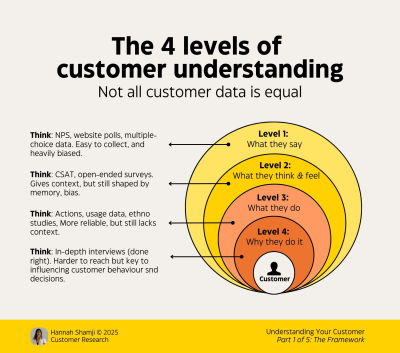
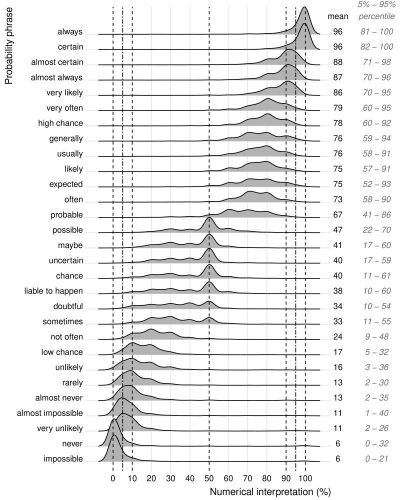
To construct a realistic, unbiased picture of user needs, practitioners must examine behavior across four distinct, nested layers. Popularized by researcher Hannah Shamji, this framework illustrates how surface-level statements obscure deep-seated motivations.
[Level 1: What they SAY]
  └── [Level 2: What they THINK or FEEL]
        └── [Level 3: What they DO]
              └── [Level 4: WHY they do it]
1. Level 1: What They Say
This is the outermost and most deceptive layer. It encompasses explicit feedback gathered through customer support tickets, surveys, reviews, and interviews. While easy to collect, it is heavily skewed by social desirability bias, poor memory, and framing effects. For instance, if a user states in an interview that they "must have a dense comparison table," it reflects their immediate mental model of how they think they process information, not necessarily the most efficient path to their underlying goal.
2. Level 2: What They Think or Feel
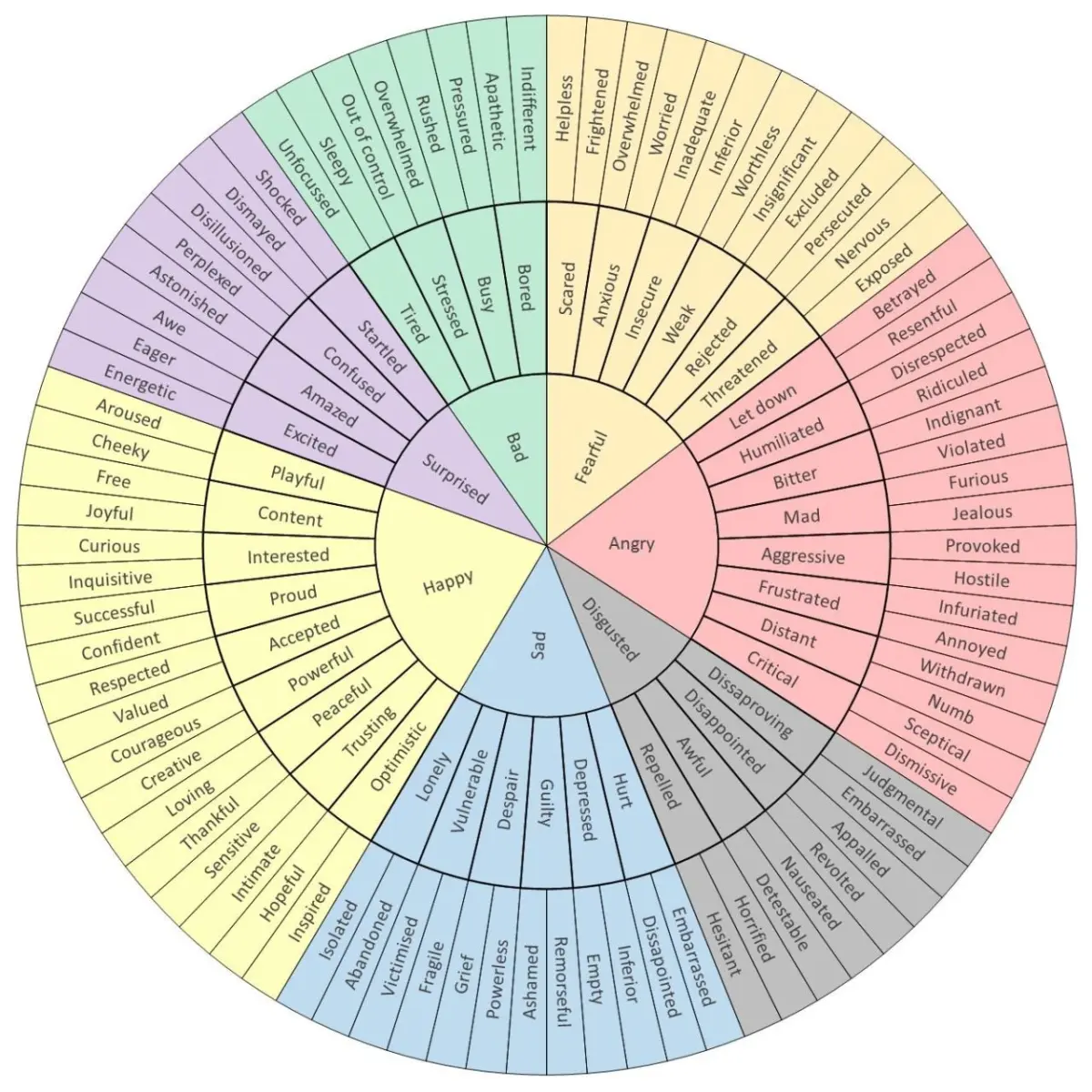
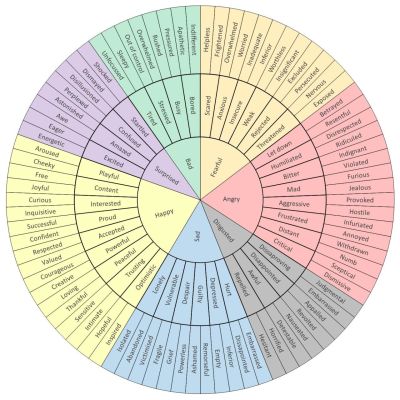
Beneath spoken words lie unspoken thoughts and emotional reactions. Emotions act as critical signals regarding user engagement, confidence, and frustration. However, capturing emotion requires moving beyond binary feedback ("good" or "bad") and utilizing precise instruments like the Emotion Wheel. Recognizing whether a user is experiencing apprehension, confusion, or satisfaction allows teams to evaluate aesthetic and functional impact accurately.
3. Level 3: What They Do
Actions speak louder than stated preferences. This level focuses entirely on observable behavior: where a user clicks, how long they hover over an element, where they scroll rapidly, and where they abandon a workflow. Observing objective actions without external interference strips away the artificial polish that users often apply when speaking to an interviewer.
4. Level 4: Why They Do It
At the core of the framework lies root-cause motivation. Why did the user hesitate at the checkout page? Was it a lack of trust, a confusing pricing tier, or an unexpected cognitive load? Reaching this innermost layer requires synthesizing data from the previous three levels, reconciling contradictions, and diagnosing the structural or psychological triggers behind user behavior.
The Problem with Semantic Nuance and Probability
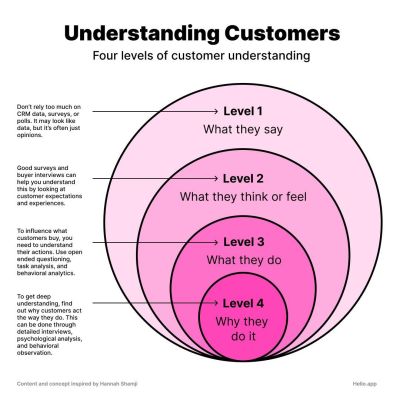
Language itself introduces substantial noise into research data. A study on verbal probability terms highlights how subjective words can distort findings. When a survey asks users if an outcome is "possible," "plausible," or "likely," different individuals attach vastly different numerical interpretations to those terms. Extreme words maintain some baseline agreement, but ambiguous terms like "maybe" or "uncertain" lead to wide spreads of interpretation. Relying on self-reported verbal scales without behavioral backing is an invitation for miscalculation.
Official Statements & Industry Perspectives
Prominent voices in the UX and design community have increasingly challenged conventional research paradigms, advocating for rigorous diagnostics over polite confirmation.
-
On the Fallacy of Direct Questions:
Design author Erika Hall famously noted that asking a question directly is often the worst way to get a true and useful answer. Because humans naturally apply subjective context, exaggerate edge cases, and favor short-term gratification over long-term utility, direct questions trap researchers in an echo chamber of assumptions.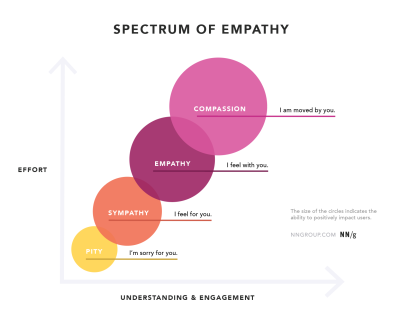
-
On Moving Beyond Empathy Performance:
Design researcher Alin Buda raised a provocative counter-perspective on the limits of empathy in product design:"Our work is about others — their problems, their pain, their mess. Our job is to make sense of it and then do something about it. Not to emote or perform but to act on and solve it. There is a flawed belief that to build great things, you first need to emotionally fully absorb someone else’s experience."
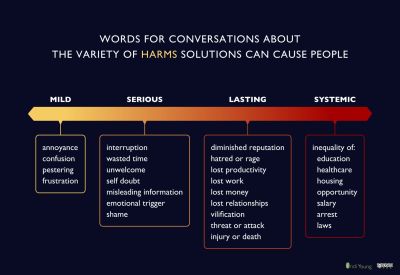
While emotional resonance remains a vital signal of user engagement, top-tier practitioners argue that emotional absorption must be paired with concrete, structural action to prevent severe customer harms.
-
On Shifting Vocabulary from "Validation" to "Research":
UX consultant Nikki Anderson emphasizes the danger of the word "validation" within corporate environments. The moment a team sets out to "validate" an idea, confirmation bias takes over. Instead, teams should substitute words like research, investigate, assess, evaluate, examine, and learn. True research does not seek to prove an assumption right; it seeks to discover what is actually happening.
Future Outlook: Practical Steps for Organizations
As product development becomes increasingly data-driven, organizations must modernize how they uncover and operationalize user needs. Relying on expensive focus groups or blunt metrics like Net Promoter Score (NPS) is no longer sufficient.
1. Shift from Observation to Continuous Diagnosis
Product teams should phase out disruptive "speak-aloud" usability sessions in favor of silent behavioral tracking paired with post-task debriefs. By observing where users waste time, hesitate, or circle with their mouse cursor without taking action, researchers can pinpoint structural flaws without artificially altering the user’s cognitive flow.
2. Democratize User Struggles Across the Company
Uncovering user needs should not be restricted to dedicated research silos. Organizations can foster company-wide empathy and alignment by sharing digestible insights across departments:
- Micro-Clips: Circulating short, anonymized video snippets of user sessions highlighting specific friction points.
- Monthly Insight Newsletters: Distilling key behavioral takeaways to keep engineering, marketing, and product teams aligned on real customer pain points.
- Cross-Functional Review Sessions: Bringing developers and designers into observation rooms to witness firsthand where products break down for everyday users.
3. Move Beyond Hunches
Ultimately, the future of product design belongs to teams willing to embrace methodological rigor. By dismantling the divide between what users say and what they actually do, organizations can eliminate costly assumptions. When research is treated as an investigative tool to diagnose true user motivations—rather than a corporate exercise in validation—designers can build resilient, impactful products that truly resonate with human needs.