

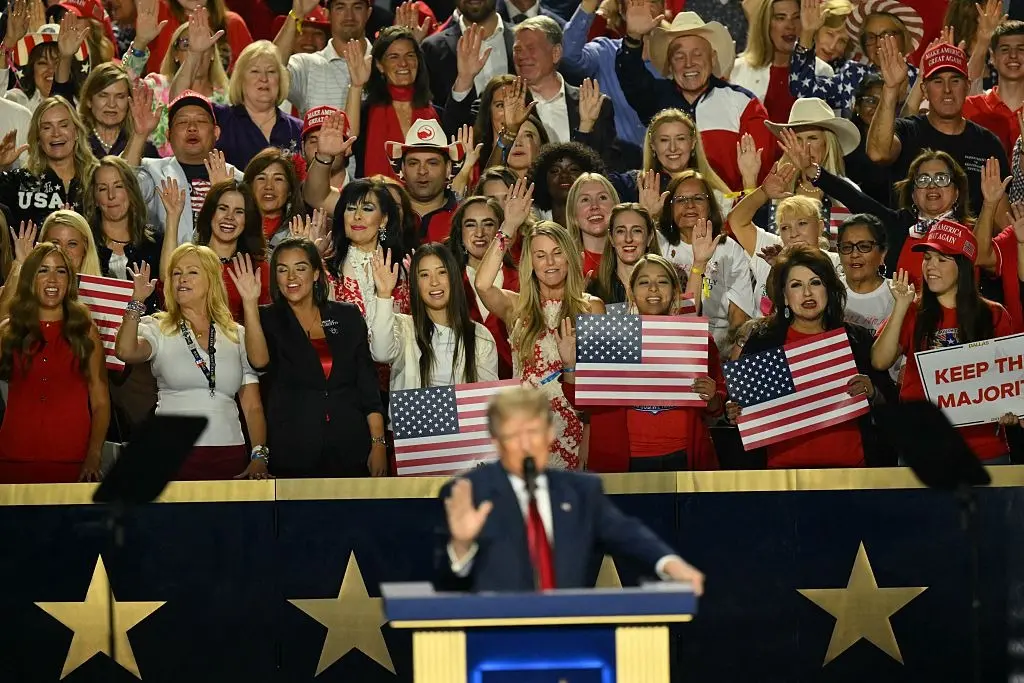
In a striking and unconventional climax to the Republican National Committee’s inaugural midterm convention in Dallas, Texas, President Donald Trump led thousands of cheering supporters in a synchronized loyalty oath. The gathering, designed to galvanize the conservative base ahead of high-stakes congressional elections, took a surreal turn when the commander-in-chief instructed attendees to raise their right hands and pledge allegiance not merely to the nation or the party, but explicitly to him.
The pledge quickly unspooled from standard partisan rhetoric into controversial territory. Urging the crowd to mobilize for the upcoming November midterms, Trump commanded supporters to vow that they would "try and cheat like hell, like they do"—a deliberate echo of his long-running, unsubstantiated allegations regarding Democratic electoral malfeasance. The moment underscored the extent to which the 2026 midterm cycle is being framed as an absolute referendum on Trump’s political gravity, even though his name does not appear on any ballot this cycle.
Political analysts, constitutional scholars, and opposition leaders have sharply condemned the rhetoric, viewing it as a systemic erosion of democratic norms. Yet, within the arena, the spectacle served its immediate tactical purpose: fusing personal fealty to Donald Trump with the baseline survival mechanics of the Republican congressional majority.
Detailed Chronology: The Dallas Convention and the Unprecedented Oath
Setting the Stage: The RNC’s First-Ever Midterm Convention
The two-day Republican National Committee midterm convention, held in Dallas in September 2026, represented a historic departure from traditional party planning. Historically, midterm conventions are subdued affairs orchestrated by party chairs to highlight local congressional candidates, policy platforms, and grassroots legislative achievements.
Instead, the RNC’s gathering was entirely consumed by the orbit of Donald Trump. Throughout the opening day, the president made clear that the traditional boundaries separating a sitting executive from congressional candidate races were to be ignored. Urging supporters to treat the upcoming legislative contests as if he were personally running for reelection, Trump repeatedly commanded the room to "pretend that I’m on the ballot."
The Final Address: Escalating Rhetoric
The convention reached its crescendo on Thursday afternoon during Trump’s closing remarks. Addressing a packed hall of delegates, party officials, and grassroots activists, the president transitioned from standard stump-speech grievances to a participatory exercise.
Calling for absolute unity, Trump asked the audience to stand, raise their right hands, and repeat a customized oath line-by-line. According to transcripts and video footage from the event, the pledge began with self-aggrandizing declarations:
"I pledge to the greatest president in the history of the United States, that loves us so much he can’t even breathe."
From there, the language shifted abruptly from political hyperbole into legally and ethically ambiguous directives. Trump instructed the crowd to commit not only to voting and dragging friends and family to the polls, but to embrace subversion under the guise of self-defense.
The "Cheat Like Hell" Directive
"I don’t care if I’m registered or not," Trump prompted the audience to repeat, steering the oath into confrontational territory. "I’m going to try and cheat like hell, like they do."
The remark was rooted in Trump’s persistent, unfounded narratives that Democratic victories are exclusively the product of systemic election rigging. Earlier in the evening, he leveraged the same logic to attack opponents of the Republican-backed SAVE America Act, asserting that Democrats opposed the voter identification and registration overhaul simply because "they want to cheat."
In a bizarre rhetorical pivot moments later, Trump attempted to temper the instruction by telling attendees to bring friends and family to vote "even if they vote for Democrats"—a suggestion that drew audible boos and uneasy murmurs from sections of the faithful crowd. Nevertheless, the pledge was brought to a formal, paradoxical close with the traditional invocation: "So help me God."
The speech concluded with another quintessential Trumpian warning regarding civic duty. Pacing the stage, he asked the audience, "You know what happens if you don’t vote? You go to hell."
Supporting Context & Metrics: The Stakes of the 2026 Midterms
To understand the urgency behind Trump’s unconventional mobilization tactics, one must examine the precarious political and financial mathematics surrounding the 2026 midterms.
The "$5,000 Trump Dividend" Proposal
In a bid to solve the perennial midterm problem of presidential party voter fatigue, Trump introduced a massive populist economic incentive during the convention. He formally promised every American adult a $5,000 "Trump Dividend"—contingent entirely upon Republicans maintaining their congressional majorities.
- Fiscal Impact: Economists estimate that a direct payout of this scale to the adult population would cost well in excess of $1 trillion.
- Legislative Feasibility: Because the executive branch lacks unilateral power of the purse under Article I of the Constitution, enacting the dividend would require immediate, cohesive congressional approval—a heavy lift even for a unified GOP caucus, let alone a split or narrow legislative body.
- Criticism: Opponents have labeled the promise an overt attempt to "bribe voters," drawing sharp rebukes from fiscal conservatives and Democrats who point out the inflationary risks and national debt implications of such a proposal.
The Legislative Battleground: The SAVE America Act
The rhetoric surrounding election rules at the convention directly mirrors ongoing legislative battles on Capitol Hill. The Republican-backed SAVE America Act has become a central legislative pillar for the GOP ahead of November. Proponents argue the bill is necessary to restore ballot integrity through stringent proof-of-citizenship requirements for voter registration.
Conversely, voting rights organizations and congressional Democrats argue that the bill is an exercise in voter suppression designed to disenfranchise millions of eligible citizens, particularly low-income, minority, and student populations. Trump’s Dallas comments directly tied the passage and defense of this bill to the survival of the Republican majority, weaponizing distrust in democratic institutions as a core motivational tool for his base.
Official Statements and Reactions
The fallout from the Dallas convention was immediate, sparking fierce debates across the American political landscape.
- The White House and RNC Defense: Defenders of the president minimized the "cheat like hell" remarks, characterizing them as colloquial hyperbole meant to highlight what the campaign views as an uneven playing field. RNC spokespeople emphasized that Trump was speaking metaphorically about aggressive ballot harvesting and legal ground-game tactics utilized by modern political campaigns on both sides of the aisle.
- Democratic Condemnations: Opposition leaders reacted with alarm, pointing to the pledge as explicit proof of authoritarian inclinations. Democratic National Committee representatives released statements arguing that Trump’s rhetoric treats democratic elections not as a sacred civic process, but as a rigged game where rules are meant to be broken. "When a former president asks his followers to swear an oath of personal loyalty and promises to ‘cheat like hell,’ he is actively signaling contempt for the American experiment," a DNC spokesperson noted.
- Legal and Constitutional Scholars: Constitutional experts expressed profound concern over the blending of personal fealty oaths with democratic electoral participation. Several legal analysts pointed out that while political hyperbole is protected speech, normalizing rhetoric that encourages electoral subversion degrades public trust in election workers, local clerks, and the peaceful transfer of power.
Future Outlook: The Path to November
As the calendar turns toward the crucial final months of the 2026 midterm campaign, the Republican strategy is crystal clear: nationalize local congressional races and tie every single contest directly to Donald Trump’s political brand.
Whether the high-risk gamble of trading traditional policy appeals for populist economic bribes and loyalty-based oaths will yield success remains to be seen. Historically, midterm elections act as a referendum on the sitting administration, often resulting in losses for the party in power. By transforming the ballot box into a personal proxy war, Trump is attempting to defy historical trends.
However, alienating moderate voters with fringe rhetoric while motivating a fervent base creates a narrow path forward. As both parties pour billions of dollars into battleground districts across the country, the events in Dallas will undoubtedly serve as a defining touchstone—haunted by the chilling refrain of thousands of citizens raising their hands, swearing allegiance, and vowing to "cheat like hell" for the sake of a political movement.