

Published: September 12, 2026
Dateline: WASHINGTON, D.C.
By: Investigative News Desk
Executive Overview
The unfolding saga surrounding the high-profile, $14.7 million renovation of the Lincoln Memorial Reflecting Pool has taken a definitive and embarrassing turn for federal officials. For months, the site’s striking degradation—characterized by murky green algae, bubbling surfaces, and peeling material—was pinned on malicious actors. President Donald Trump and various federal agencies repeatedly blamed vandals, claiming bad actors had snuck into the drained or newly filled basin to deliberately slice the custom "American flag blue" liner with knives and box cutters.
Federal prosecutors even went so far as to bring criminal charges against several individuals. However, those cases rapidly unraveled under basic scrutiny.
Now, newly obtained government documents and internal reports from the project’s primary contractor, Atlantic Industrial Coatings, have laid the blame squarely where it belongs: on the rushed timeline, human error, and a critical chemical failure. According to these files, the catastrophic blistering and peeling of the pool’s liner were caused by inadequate primer application and a dangerous chemical incompatibility between two substances used in the coating material itself. The upper layer of the liner grew hot enough during the curing process to literally burn and destroy the structural layers beneath it.
This comprehensive report breaks down the timeline of the disaster, the false vandalism narratives, the technical failures that doomed the project, and the lingering accountability questions facing the Department of the Interior.
Detailed Chronology: From Fast-Tracked Ambition to Public Fiasco
The Road to the Independence Day Deadline
The renovation of the Lincoln Memorial Reflecting Pool was conceived as a centerpiece of President Trump’s broader Washington, D.C., beautification and modernization initiatives. The administration set an aggressively fast-tracked timeline, demanding that the multi-million-dollar overhaul be fully completed ahead of the nation’s July Fourth celebrations.
Such ambitious scheduling often compresses standard engineering and construction phases, forcing contractors to execute complex industrial coatings under extreme time constraints. In the case of the Reflecting Pool, this meant applying specialized, heavy-duty polymeric liners across massive surface areas with minimal margin for environmental or operational error.
Immediate Disasters and the "Green Water" Phase
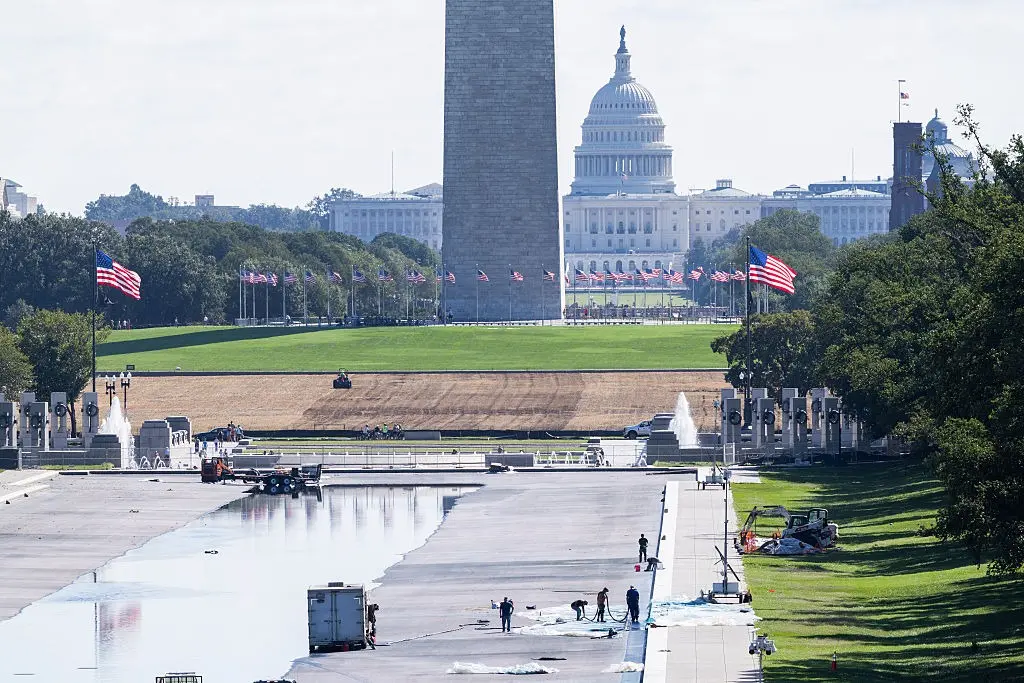
Almost as soon as the newly renovated basin was refilled, signs of trouble emerged. Rather than presenting a pristine, crystalline mirror to reflect the National Mall and the Lincoln Memorial, the water rapidly transformed into a vibrant, algae-choked shade of green.
While onlookers and tourists chuckled or groaned at the emerald hue, the aesthetic failure was merely a precursor to structural catastrophe. Within weeks of reopening, patches of the newly installed "American flag blue" liner began to blister, bubble, and actively detach from the concrete basin floor.
The Vandalism Narrative and Wrongful Prosecutions
Facing intense public scrutiny over the deteriorating landmark, the administration sought external explanations. President Trump publicly advanced the narrative that the damage was the result of a coordinated vandalism campaign. The administration claimed that individuals had bypassed security, entered the pool enclosure, and intentionally slashed the state-of-the-art lining material with knives and box cutters.
Acting on these assertions, federal prosecutors initiated criminal charges against several suspects. For a brief moment, the narrative of external sabotage deflected administrative embarrassment.
However, forensic evaluations and contractor reviews quickly exposed the hollow nature of the charges. Prosecutors realized that the physical characteristics of the damage—scaling, blistering from the bottom up, and chemical degradation—bore zero resemblance to physical cuts made by hand tools. By July, the Department of Justice was forced to quietly reverse course and drop all charges against the accused individuals, admitting that the structural failure was intrinsic to the pool itself.
Technical Forensics: Human Oversight and Incompatible Chemicals
The core revelations contained in the newly reviewed government documents and contractor reports provide a textbook case of how rushed industrial projects fail. Atlantic Industrial Coatings, the firm responsible for executing the project, ultimately concluded that a combination of execution errors and baseline design flaws doomed the liner.
1. The Primer Shortfall
According to the findings, workers on the ground failed to apply an adequate amount of primer across various sections of the pool’s extensive concrete substrate. Primer serves as the essential bonding agent that anchors heavy-duty industrial coatings to concrete surfaces. Without uniform, sufficient coverage, the underlying bond lacks the tensile strength required to withstand thermal expansion, water pressure, and environmental shifts. Consequently, areas with insufficient primer quickly lost adhesion, creating pockets where the liner could easily peel away.
2. The Chemical Incompatibility Crisis
Even more damaging than the human application errors was a critical flaw in the material science of the project. The documents reveal that two distinct chemicals utilized in the formulation of the liner were fundamentally incompatible.
When mixed and applied under compressed deadlines, an unintended exothermic (heat-generating) reaction occurred. The upper layer of the coating generated extreme thermal energy during its curing phase—becoming hot enough to thermally degrade, blister, and scorch the material directly beneath it. This internal thermal destruction manifested physically as the widespread bubbling and blistering that ruined the pool’s appearance just weeks after completion.
Official Statements, Friction, and Accountability
Despite the unequivocal findings of the contractor’s internal review and the Department of Justice’s decision to drop the vandalism charges, the federal government’s messaging remains fractured.
The Department of the Interior has attempted to thread a difficult political needle. While acknowledging that contractor errors and technical challenges undeniably occurred, agency officials have continued to insist that instances of vandalism did take place alongside the structural failures. This insistence appears designed to shield the administration from total embarrassment over the security and integrity of the site during the holiday rollout.
At the same time, the Interior Department has firmly asserted that Atlantic Industrial Coatings remains entirely financially and operationally responsible for remediating the damage. Officials argue that whether the failure stemmed from poor primer application, chemical mismatches, or rushed scheduling pressures, the contractor signed off on the execution and must absorb the costs of a complete do-over.
Industry experts, however, point the finger higher up the chain of command. Critics argue that the political pressure to meet an arbitrary, immovable deadline—the July Fourth celebrations—created an untenable working environment. When political optics dictate engineering timelines, quality control protocols, curing times, and material stress tests are frequently bypassed or rushed, exponentially increasing the risk of catastrophic failure.
Future Outlook and Ongoing Remediation
As of September 2026, the Lincoln Memorial Reflecting Pool remains a focal point of administrative frustration and public fascination. The multi-million-dollar blunder has turned into a cautionary tale regarding government procurement, fast-tracked infrastructure projects, and the dangers of politicizing engineering failures.
Further repairs, draining, and complete resurfacing efforts are anticipated as the legal and financial wrangling between the federal government and Atlantic Industrial Coatings continues behind closed doors. Taxpayers, meanwhile, are left footing the bill for a project that cost $14.7 million initially, only to require extensive reconstruction before it could even complete its first full season of public service.
For Washington visitors and historians alike, the episode serves as a jarring reminder that even the most iconic monuments are vulnerable to the very modern plagues of bureaucratic haste, human oversight, and chemical miscalculation.
