

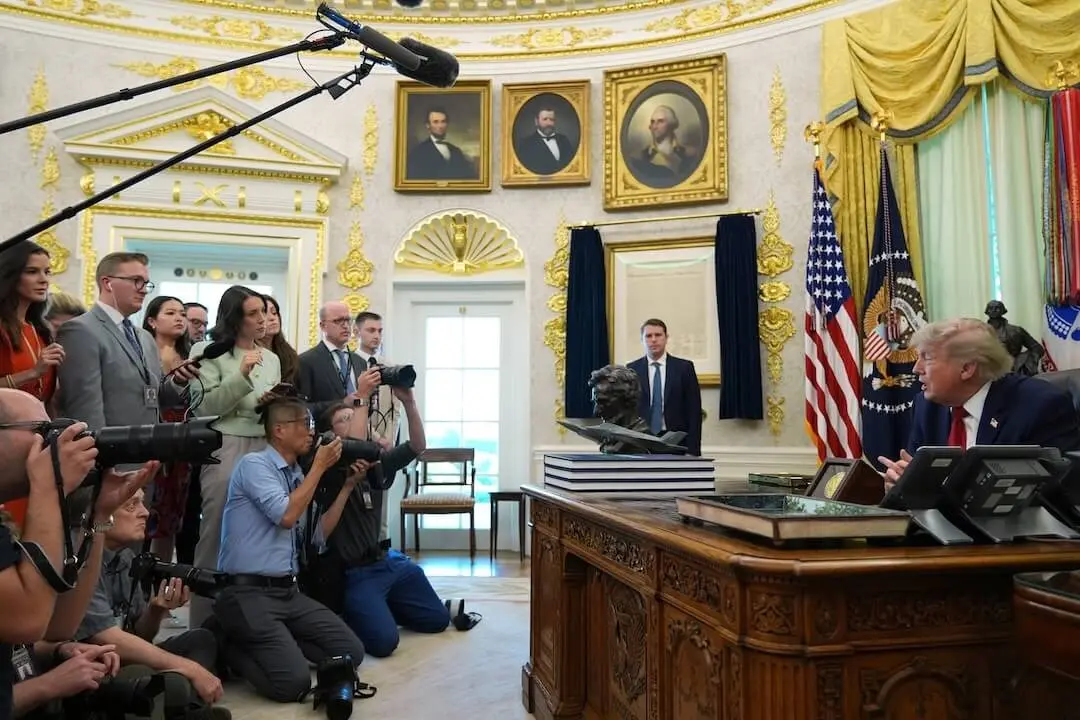
Executive Overview
A newly released collaborative report from the Pew Research Center and the Knight Foundation lays bare a profound paradox at the heart of American civic life: while approximately three-quarters of the public continue to voice rhetorical support for the concept of a free press as an indispensable pillar of society, that sweeping approval shatters the moment concrete scenarios of government intervention are introduced.
The study reveals that large pluralities—and in some cases majorities—of American citizens are surprisingly willing to countenance state censorship, news suppression, and legal penalization of media outlets under specific, emotionally charged conditions. Whether the justification is national security, the containment of inaccurate information, or the suppression of leaked government materials, the public demonstrates a deep-seated ambivalence that regularly sets journalistic imperatives on a collision course with popular sentiment.
Compounding this philosophical friction is a startling deficit in constitutional literacy. The research demonstrates that substantial segments of the American electorate fundamentally misunderstand the legal boundaries established by the First Amendment. From misplaced expectations regarding social media content moderation to widespread confusion over what the government can legally compel private publishers to do, the data suggests that public discourse on press freedom is frequently untethered from actual constitutional law.
When mapped across partisan lines, these tensions morph into a chasm. Democrats and Republicans view the very nature of press freedom through radically different prisms—disagreeing not only on what constitutes a threat to journalism, but whether the media environment is currently improving or decaying. As journalists, legal scholars, and civil liberties advocates grapple with these findings, the report serves as an urgent wake-up call regarding the fragility of public support for independent media in an increasingly polarized nation.
Detailed Chronology: The Evolution of Public Skepticism and Media Surveillance
To understand the current state of public opinion regarding the press, one must examine the shifting historical and political landscape that has steadily eroded trust in information gatekeepers over the past decade.
The Post-Leak Era and the "National Security" Exception (2013–2020)
The erosion of absolute support for a free press did not happen in a vacuum. Throughout the 2010s, high-profile intelligence leaks—most notably those orchestrated by Chelsea Manning and Edward Snowden—ignited a fierce national debate over the boundaries of classified information. These events forced citizens to weigh the public’s "right to know" against the federal government’s claims of operational security.
Focus group data embedded within the new Pew-Knight report reveals that this decade-long tension has left a permanent imprint on the public psyche. When presented with hypothetical scenarios involving classified leaks, modern citizens instantly divide over the legitimacy of the state’s claims. As one male participant in his thirties noted during the study’s qualitative sessions: "We don’t know whose lives could be at danger for this. I think there’s a reason why it’s classified. It shouldn’t be distributed."
Conversely, female participants in their forties articulated the counter-concern that has driven investigative journalism for generations: "Can we trust completely that it does have to do with national security concerns? Or is this person a whistleblower, and it’s something we really should know, but they’re putting it under the blanket of ‘this is a security concern?’"
The Escalation of Partisan Friction (2017–Present)
The entry of the Trump administration into executive politics fundamentally altered how partisans evaluate the health of the Fourth Estate. For left-leaning Americans, the period was marked by an unprecedented series of adversarial actions against institutional journalism.
The administration’s deployment of memos seeking to revoke Pentagon press credentials for publishing leaked (even unclassified) information, the aggressive use of Justice Department subpoenas targeting journalists’ phone records, and a flurry of high-profile defamation lawsuits combined to create what Democrats perceive as an existential threat to independent reporting. Approximately 70% of Democrats and Democratic-leaning independents now maintain that the press is significantly less free today than it was previously.
On the other side of the aisle, the narrative is almost diametrically opposed. Only 15% of Republicans share the view that press freedom has diminished. Instead, roughly half of all Republican respondents perceive no change in the media’s operational latitude, while fully 20% argue that the press is actually freer today. For many within this conservative bloc, the shift is tied directly to changes in the digital ecosystem—most notably billionaire Elon Musk’s acquisition of Twitter (now X). For these citizens, corporate moderation policies were long viewed as a form of ideological censorship. As one male respondent in his fifties articulated regarding the platform’s ownership transition: "He opened it up so anybody that had a thought about anything could say it. And I think it started a trend back to where things need to be."
Supporting Context & Metrics: Unpacking the Data
The Pew-Knight collaboration combines rigorous quantitative surveying with qualitative focus group insights, yielding a comprehensive dataset that exposes the precise boundaries of public tolerance for media freedom.
The Pull of the Security and Truth Labels
The study demonstrates the immense persuasive power of administrative labels when applied to media suppression:
- National Security Interventions: Over 50% of the total public believes the federal government should possess the statutory authority to order a news organization to halt publication or remove a story if it is deemed to pose a risk to national security. Broken down by party affiliation, this authoritarian impulse is bipartisan but unevenly distributed: it captures half of all Democrats and Democratic leaners, and surges to over 70% among Republicans and Republican leaners.
- Fact-Checking and Misinformation: When asked about inaccurate reporting, slightly under half of all respondents believe the government should hold the administrative power to force the retraction or removal of stories containing false information. This metric highlights a widespread public appetite for content policing, despite the profound constitutional hazards associated with granting state actors the power to arbitrate journalistic truth.
- The Watchdog Paradox: Approximately 40% of the survey respondents asserted that investigative reporters should rarely or never publish leaked government materials, directly challenging the foundational muckraking tradition that exposed scandals from Watergate to the Pentagon Papers.
Constitutional Illiteracy: A Dangerous Knowledge Gap
Perhaps the most alarming takeaway for media educators and legal scholars is the depth of public ignorance regarding the actual text and application of the United States Constitution:
+-----------------------------------------------------------------------------------------+
|                        CONSTITUTIONAL KNOWLEDGE GAP (PEW-KNIGHT STUDY)                  |
+-----------------------------------------------------------------------------------------+
| Metric                                                   | Public Awareness Percentage  |
+-----------------------------------------------------------------------------------------+
| Correctly identified that the First Amendment            |                              |
| guarantees freedom of the press                          |             ~50%             |
|                                                          |                              |
| Understands that social media platforms are private      |                              |
| entities not bound by First Amendment publication duties |             ~33%             |
|                                                          |                              |
| Knows the government cannot force private companies      |                              |
| to remove false information under current law            |             ~33%             |
+-----------------------------------------------------------------------------------------+
As detailed in the table above, only half of the American public correctly identifies that the First Amendment explicitly guarantees freedom of the press. Furthermore, only a third understand that private entities—such as social media platforms and independent newsrooms—are under no legal obligation to publish an individual’s words, and that the government cannot legally force these private corporations to scrub false information from their servers.
This pervasive baseline of legal misunderstanding complicates efforts by editors, publishers, and press freedom advocates to mount effective public awareness campaigns. If the electorate does not understand the structural boundaries of constitutional protections, messaging built around abstract legal principles is bound to falter.
Official Statements and Expert Analysis
The release of the Pew-Knight report has triggered an intensive round of commentary from legal experts, academic researchers, and press freedom advocates who see these findings as a roadmap for the challenges facing modern journalism.
To dissect these findings, leading institutions are mobilizing specialized forums. Notably, the Poynter Institute has announced a high-profile webinar scheduled for September 22, designed to unpack the report’s granular data. The panel features Kirsten Eddy, the lead researcher from the Pew Research Center; Frank LoMonte, a seasoned First Amendment lawyer and legal counsel for CNN; and Angela Fu, who directs Poynter’s Press Freedom Watch project.
In advance of the discussions, media analysts have highlighted the dangerous slippery slope inherent in public attitudes toward government censorship. Frank LoMonte noted in preliminary commentary that public willingness to surrender editorial autonomy in the name of "national security" or "accuracy" fundamentally misunderstands who wields the censoring knife.
"When citizens say they are comfortable with the government ordering news organizations to pull down stories, they are imagining an idealized, benevolent state acting purely in the public interest," legal analysts point out. "They rarely pause to consider what happens when an administration they deeply oppose steps into power and is handed that exact mechanism of administrative suppression."
Angela Fu’s work with Poynter’s Press Freedom Watch further contextualizes these findings within an increasingly hostile global and domestic environment for reporters. The project tracks legal threats, physical harassment, and structural barriers facing journalists daily, underscoring that public apathy or active hostility toward the press acts as political wind in the sails of would-be censors.
Future Outlook: Navigating the Path Ahead
As the media landscape barrels deeper into an election cycle defined by artificial intelligence, deepfakes, hyper-partisan information silos, and institutional distrust, the implications of the Pew-Knight study are profound.
The data makes it abundantly clear that the defense of press freedom cannot rely on the assumption of inherent public reverence. The old playbook—wherein media organizations simply invoke the First Amendment as an unassailable talisman—is failing to resonate with an electorate that is deeply skeptical of institutional motives, legally uninformed, and increasingly willing to trade editorial independence for perceived security or ideological alignment.
To reverse these trends, press freedom advocates face a dual imperative:
- Civic Education: Media organizations and educational institutions must aggressively invest in public literacy campaigns. Citizens must be taught not just that the press is free, but why structural separation from state control is essential to democratic accountability. They must understand the perilous mechanics of government-mandated takedowns, regardless of whether the stated justification is national security or the eradication of falsehoods.
- Bridging the Partisan Divide: Newsrooms must confront the stark reality of partisan alienation. Rebuilding trust requires greater transparency regarding editorial processes, heightened accountability for factual errors, and a renewed commitment to reporting that transcends partisan echo chambers without falling into the trap of false equivalence.
The fragile consensus revealed by Pew and Knight is a warning flare. A free press cannot survive indefinitely on a foundation of conditional public support and constitutional illiteracy. The defense of the Fourth Estate requires not only aggressive legal advocacy in the courts, but a continuous, persuasive re-engagement with the citizens it serves.