

Executive Overview
For nearly half a century, the digital world has been tethered to a singular paradigm: the Graphical User Interface (GUI). Ever since the commercialization of pioneer systems like the Xerox Star and its populist successor, the Apple Macintosh, humanity has navigated software through a mechanical labyrinth of point-and-click interactions. If a user wished to complete a multi-step task—such as booking a cross-country flight, researching complex medical symptoms, or deploying a cloud-hosted software application—they were expected to adapt to the machine. They clicked through nested menus, dragged range sliders, filled out exhaustive multi-page forms, battled cookie consent pop-ups, and manually juggled dozens of browser tabs simply to cross-reference basic pieces of data.
We have lived through an era where human beings spent the vast majority of their digital engagement managing the software rather than actually achieving their underlying goals.
Today, that foundational contract is breaking down. Driven by explosive advances in artificial intelligence (AI) and large language models (LLMs), a radical new design philosophy is taking root across the web: Intent-Driven Design. Rather than expecting users to master complex user flows, navigation bars, and elaborate sales funnels, modern web platforms are learning to capture high-level human goals and silently execute the exhaustive grunt work behind the scenes.
As the digital ecosystem shifts toward experiences shaped entirely around human intent, UX designers and software architects face an existential crossroads. The ultimate goal of modern web development is no longer to build prettier buttons, higher-contrast call-to-actions, or flashier micro-animations; it is to eliminate the interface entirely. This structural transformation demands that practitioners re-evaluate their roles, shifting from designing static, visible screens to guiding transparent, intent-driven AI experiences that prioritize seamless, invisible completion.
Detailed Chronology: From the GUI Revolution to the Zero-UI Era
To understand where the web is heading, we must first look at the historical friction we have long accepted as standard operating procedure.

The Point-and-Click Era (1970s–2010s)
The journey began in the research labs of Xerox PARC, where engineers realized that computing power could be democratized through visual metaphors. Desktops, folders, trash cans, and point-and-click mice transformed text-based command lines into accessible graphical experiences. When Apple and later Microsoft commercialized these concepts, they established the dominant human-computer interaction (HCI) model for the next fifty years.
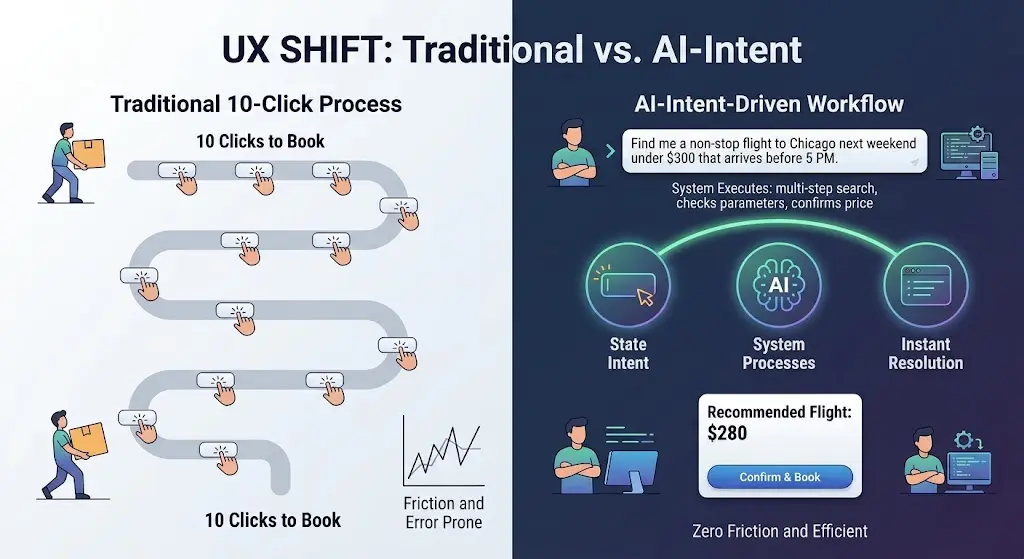
In this traditional model, the computer acts as a passive container of raw data, while the human acts as the orchestrator. The user must manually input parameters, interpret raw outputs, and execute every micro-step along the way. Consider the traditional workflow of booking a flight online:
- Open a browser tab and navigate to an Online Travel Agency (OTA).
- Input departure and arrival airports using dropdown selection menus.
- Select travel dates via a calendar widget.
- Filter results by adjusting price sliders, selecting layover preferences, and choosing airline carriers.
- Review a massive grid of flight options, open multiple tabs to compare prices across different sites, and manually check baggage fee policies.
- Select a flight, decline auxiliary upsells (insurance, premium seating), input passenger details, fill out multi-field credit card forms, and complete a two-factor authentication prompt.
This is the quintessential 10-click process. It demands immense cognitive overhead, requiring the user to execute manual labor that software should ideally handle autonomously.
The Rise of Human-Centered HCI Critiques (2010s)
As digital noise saturated daily life, early industry pioneers began pushing back against the tyranny of the screen. Interaction designer Golden Krishna published his seminal work, The Best Interface Is No Interface, arguing that digital screens and complex applications were often symptoms of lazy design rather than genuine utility. Concurrently, Don Norman’s foundational principles of human-centered design reminded the tech industry that tools should adapt to human cognitive models, not force humans to adapt to artificial computational constraints.
Despite these philosophical warnings, the web largely doubled down on engagement metrics—optimizing for "time spent in app," click-through rates (CTR), and page views per session. Websites were intentionally engineered to maximize visual engagement and interaction volume, keeping users locked inside endless digital funnels.
The Generative AI Turning Point (2020s–Present)
The commercial breakthrough of generative AI and transformer-based architectures shattered the technical limitations that kept the "No-Interface" movement in the realm of theory. Large language models provided software with the capacity to parse unstructured human intent, reason through complex multi-step workflows, and dynamically generate functional user interfaces on the fly.
Today, the web is crossing a historic threshold. Users no longer want to click through menus; they want to articulate a goal and witness its immediate fulfillment.
Supporting Context & Metrics: Redefining Digital Efficiency
When traditional user interfaces are stripped away, the core mechanics of digital interaction shift across three fundamental pillars: User Input, Interface State, and Task Execution.
| Pillar | Traditional UX Approach | Intent-Driven UX Approach |
|---|---|---|
| User Input | Micro-actions (Clicks, dropdowns, toggles, form fields) | High-level goals (Natural language prompts, contextual metadata, implicit habits) |
| Interface State | Static layouts (Every user sees the same fixed dashboard or landing page) | Generative UI (Layouts, tables, and widgets created dynamically on the fly) |
| Task Execution | Manual execution orchestrated step-by-step by the human user | Autonomous execution handled quietly by background AI agents |
1. High-Level Goals and Ambient Context
An intent-driven interface does not always wait for explicit text commands. Guided by modern design frameworks like Apple’s Human Interface Guidelines on Contextual and Ambient Design, intelligent systems leverage device state, physical location, calendar schedules, and historical interaction patterns to anticipate user needs before they are formally requested.
Rather than forcing a user to manually configure settings or search for recurring services, ambient applications read environmental metadata to initiate proactive actions safely in the background.
2. Generative UI
In legacy web development, static architecture reigns supreme. An e-commerce platform displays the exact same navigation hierarchy whether the visitor is a first-time browser seeking customer support or a loyal customer tracking an active shipment.
As highlighted by the Nielsen Norman Group in their analysis of AI as a new UX paradigm, computing is transitioning from command-based interaction to outcome-specification. This evolution enables Generative UI, where interfaces are rendered dynamically based on an individual’s immediate context. If a user expresses a desire to analyze complex quarterly financial metrics, the interface synthesizes a custom, interactive calculation widget on demand, which then dissolves once the goal is accomplished.
3. Autonomous Execution and Frictionless Reversibility
Traditional web applications are obsessed with error prevention, constantly peppering users with intrusive confirmation modals ("Are you sure you want to delete this file?").
Intent-driven platforms adapt Jakob Nielsen’s classic usability heuristics—specifically user control and error recovery—by shifting the digital safety net from strict prevention to effortless reversibility. Because autonomous agents take actions on behalf of the user, modern products prioritize frictionless rollback mechanisms. Prominent "Undo" buttons, conversational revision prompts ("Make this summary shorter"), and transparent audit logs replace irritating warning dialogs.
Real-World Case Studies: Platforms Replacing Buttons with Intent
This transition is no longer a theoretical exercise for the distant future; it is actively reshaping how millions of users interact with the web today.
1. Perplexity AI: Search Without Open Tabs
Traditional search engines like Google were originally built as digital directories. Users typed a keyword string, and the interface rewarded them with ten blue links. The actual cognitive labor—opening five separate browser tabs, skimming dense academic articles, dodging intrusive banner ads, and manually synthesizing an answer—was left entirely to the human.
Platforms like Perplexity AI pioneered instant, intent-based discovery. When a user asks a complex question (such as "Compare three budget-friendly laptops optimized for video editing under $800"), the interface bypasses the traditional link-and-tab routine entirely. It queries multiple data sources simultaneously, synthesizes the findings into an interactive comparison table, and presents a single, actionable resolution.
2. Vercel v0: Web Design Without Dragging and Dropping
For decades, building a digital product required manual layout construction. Designers and developers spent countless hours inside visual editors like Figma or drag-and-drop website builders—manually drawing rectangles, assigning hexadecimal color codes, adjusting padding values, and writing cascading style sheets (CSS).
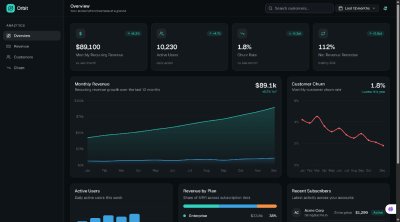
Vercel v0 reimagines this workflow through generative UI. Users can input a natural language prompt describing an application layout ("Build a modern SaaS analytics dashboard with dark mode, a revenue growth chart, and a recent user activity table"). The system instantly generates clean, production-ready frontend code and visual components on the fly, eliminating the mechanical overhead of manual prototyping.
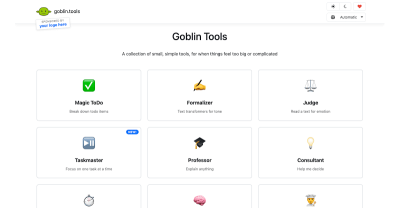
3. Goblin.tools: Breaking Down Overwhelming Tasks
Traditional productivity tools demand rigorous manual configuration: users must construct Kanban boards, create nested task lists, assign category tags, and manually set micro-deadlines. For neurodivergent individuals or anyone experiencing acute cognitive overload, these interfaces often induce paralysis rather than productivity.
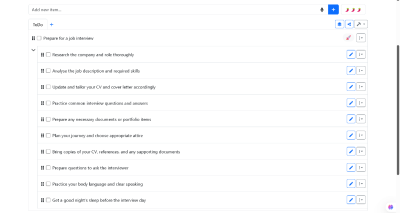
Goblin.tools provides a streamlined, single-page AI suite designed around pure intent. A user can type an overwhelming, high-level goal—such as "Plan a comprehensive job interview preparation strategy"—and the system autonomously breaks the vague objective down into manageable, step-by-step actionable checklists without requiring logins, database setups, or complex dashboard management.
Official Statements and Industry Insights
As the design community grapples with the implications of this shift, leading researchers and institutions are establishing new guardrails for human-AI interaction.
"The ultimate goal of modern web design is no longer to build prettier buttons or flashy animations; it is to eliminate the interface entirely."
— Industry Consensus on the Future of Human-Computer Interaction
However, stripping away traditional visual controls introduces profound ethical and technical challenges. When software acts on inferred intent rather than direct point-and-click commands, designers must navigate critical pitfalls, including the illusion of control and the "black box" problem.
The Illusion of Control and the Black Box Problem
When an application makes autonomous decisions on behalf of a user, it can easily cross the line from helpful to invasive. Research from the Stanford Human-Computer Interaction (HCI) Group emphasizes that automated systems must maintain rigid behavioral boundaries to prevent user alienation. Ethical frameworks from the Center for Humane Technology warn that product designers must actively guard against manipulative defaults and opaque decision-making.
To counter the frustration of the "black box" problem—where users receive unexpected outcomes without knowing why—designers rely on guidelines established by the Google PAIR (People + AI Research) Guidebook. Systems must provide transparent feedback loops, explicitly stating their interpretation of a command ("Searching for non-stop flights to Chicago under $300 arriving before 5 PM…") so users can calibrate trust and correct misinterpretations instantly.
As UX design leadership notes:
"Rather than designing static buttons and rigid forms, we need to learn to map and present dynamic, generative UI components that adapt on the fly to user intent."
Future Outlook: The Era of Seamless, Invisible Completion
For generations, the technology sector measured product success through engagement metrics that encouraged friction: time spent in app, click-through rates, and page views per session. Websites were deliberately architected to maximize visual entanglement.
The philosophy championed by Golden Krishna’s The Best Interface Is No Interface, operating in tandem with the Center for Humane Technology’s "Time Well Spent" movement, flips these legacy metrics entirely on their head. The ultimate test of a modern digital product is no longer how visually captivating its navigation menu is, but rather: How effectively did this software solve the problem and get out of the user’s way?
We are entering a definitive new era where web applications will no longer be evaluated by the aesthetic complexity of their user interfaces, but by their capacity to render those complex interfaces completely obsolete. The future of the web is not defined by more interaction, more pop-ups, or more clicks—it is defined by seamless, invisible completion.