

Executive Overview
The annual autumn pilgrimage into the idiosyncratic world of heritage pomology has yielded yet another batch of eccentric, historically rich, and occasionally punishing apple cultivars. For the uninitiated, the modern supermarket experience—dominated by a homogenized monoculture of hyper-engineered, glossy red spheres—offers little insight into the botanical chaos that has defined pomological history for centuries. Enter the relentless apple enthusiast community, spearheaded by itinerant fruit chroniclers who brave the outer limits of flavor, texture, and structural integrity to evaluate what nature (and centuries of haphazard agricultural breeding) has wrought.
This report serves as Part Two of an exhaustive, unsparing investigation into a fresh batch of uncommon apples. From historical cider varieties better left to the alchemy of fermentation to gym-honed, jaw-testing monoliths that taste inexplicably of mass-market chewing gum, this evaluation does not pull its punches. Spanning a diverse spectrum of scores—ranging from an abysmal 1 out of 10 for structural failures to respectable highs in the low 80nd-percentiles—this assessment provides a rigorous framework for understanding why some apples transcend agricultural obscurity while others rightfully descend into "crap-town."
As the international apple-touring season prepares to expand across New York, New England, and Canada, this comprehensive analysis explores the sensory profiles, historical anomalies, and structural eccentricities of seven distinct cultivars: Kickapoo Spice, St Edmunds Pippin, Sops of Wine, Fenceline Surprise, Americus Crab, Campfield (False?), and Graham.
Detailed Chronology of the Tasting Trials
The evaluation process follows a strict, empirical methodology based on fresh acquisition, tactile assessment, auditory feedback upon initial fracture, and gustatory profiling. The trials detailed in this batch occurred during the peak of the autumn harvest cycle, exposing vulnerabilities related to post-harvest storage degradation and genetic instability.

1. Kickapoo Spice
- Score: 6.9 / 10
- Profile: High spice component, dense structure, cut-grass aftertaste.
Opening the slate is Kickapoo Spice, a cultivar bearing a moniker that immediately evokes the rebellious, rock-infused spirit of early-2000s cinematic lore. Structurally described as a "dense boy" and a "weird friend," this apple exhibits an exceptionally high spice component, leaning heavily into aromatic notes of nutmeg, cinnamon, and clove.
Despite the promise of its aromatic profile, the fruit lacked foundational juiciness. A lingering aftertaste reminiscent of freshly cut grass detracted from the experience, suggesting the specimen may have suffered from improper storage curation. As seasoned pomologists note, the lifecycle of an apple is precarious: some improve gracefully off the branch, while others begin an immediate descent into agricultural irrelevance the moment they sever from the tree. Nevertheless, its unique personality secures a respectable, nice-number score of 6.9 out of 10.
2. St Edmunds Pippin
- Score: 8.3 / 10
- Profile: Sharp-breaking, fennel pollen herbal notes, high tart-sweet balance.
Representing the high-water mark of this tasting cycle, St Edmunds Pippin served as the inaugural proper apple of the season, defying low expectations set by its rough exterior. The skin’s abrasive texture—jokingly likened to "licking a shark backward"—gave way to a deeply satisfying acoustic and tactile performance. Upon biting, the fruit delivered an explosive pop and crunch, demonstrating optimal cellular turgor pressure.
Flavor-wise, St Edmunds Pippin avoided conventional boring sweetness. Instead, it offered a bright, herbal complexity with distinct undertones of fennel pollen, harmoniously balanced against a crisp, juicy, and sharp-breaking interior. Earning an 8.3 out of 10, this cultivar stands as a stellar archetype of how a "weird, funky apple" can achieve elite-tier gastronomic satisfaction.

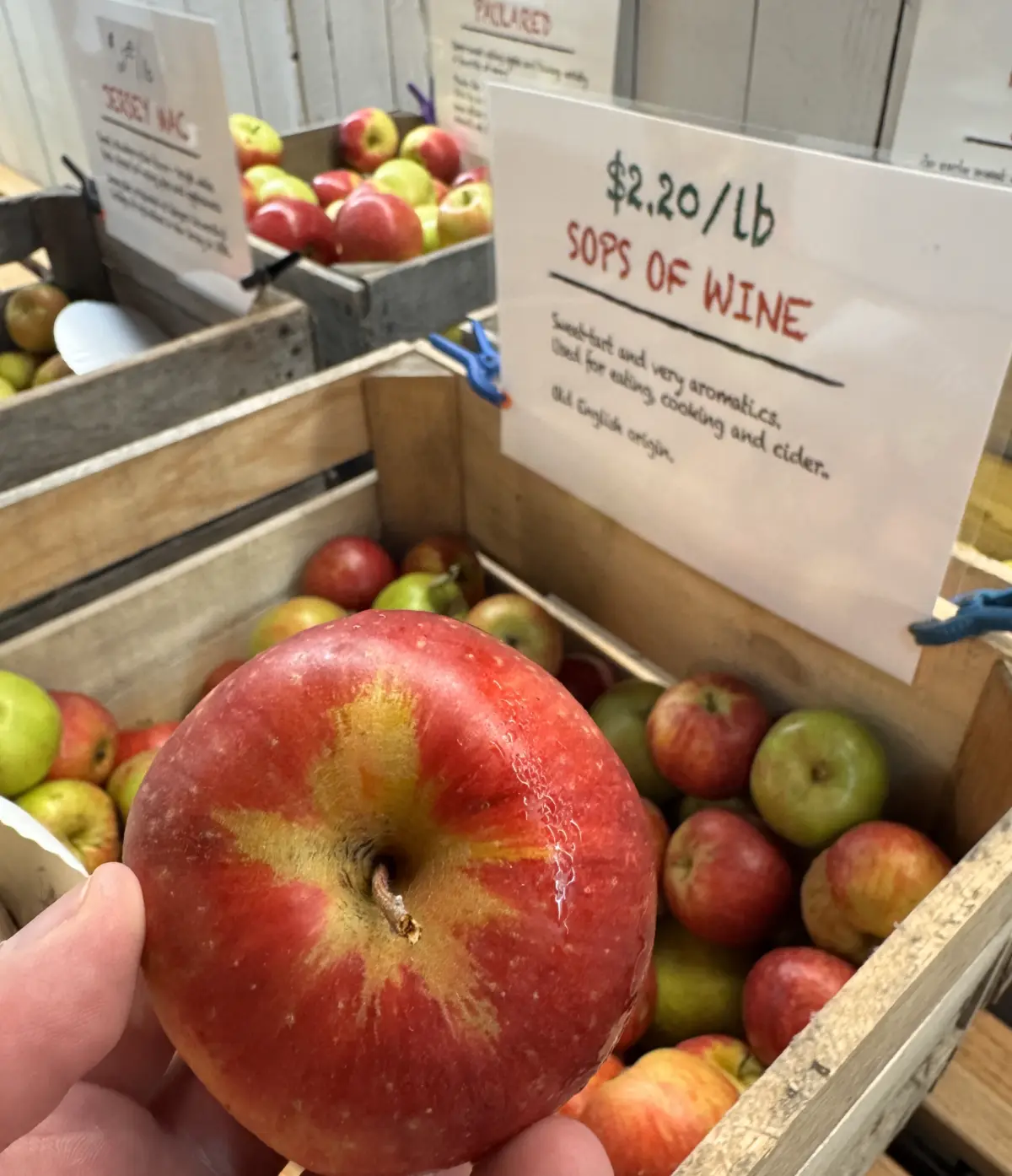
3. Sops of Wine
- Score: 3.5 / 10
- Profile: Subacid, vanilla-spice notes, mealy texture, historical ambiguity.
The psychological phenomenon of gustatory association reared its head with Sops of Wine, an apple whose very name triggers cinematic memories of Steward of Gondor Denethor aggressively consuming cherry tomatoes on screen, echoing a hollow, authoritative “SOPS OF WINE” through the observer’s psyche.
Unfortunately, the physical reality of the fruit failed to match the cinematic grandeur. While the flavor profile offered acceptable, funky notes leaning toward subacid sweetness (more sweet than tart) accompanied by subtle whispers of vanilla and spice, the texture was a distinct failure. Mealy and gritty, the apple felt past its prime. Furthermore, pomological contradictions abounded: while historical literature suggests Sops of Wine should feature red-fleshed interiors or red-streaked white meat—or perhaps represent a loose umbrella term for several disparate old-world varieties—this specific specimen offered neither clarity nor culinary redemption, landing at a disappointing 3.5 out of 10.
4. Fenceline Surprise
- Score: 1.0 / 10
- Profile: Bland mush, faint pear mist, extreme structural failure.
The "surprise" inherent in Fenceline Surprise is simple: it is a profoundly unpleasant eating experience. Despite an intriguing name that invites a sophisticated French pronunciation rather than a rustic American interpretation, the fruit inside delivered nothing short of a culinary disaster.
Characterized by a bland, mushy consistency, the apple offered a fleeting, ghostly hint of pear juice before evaporating entirely into a sensation akin to chewing beach sand. Given that store signage labeled the variety as a "firm apple," evaluators concluded that the specimen was either part of a fundamentally flawed batch or had spent far too much time languishing in cold storage—effectively arriving at the consumer as pre-chewed worm food. Devoid of redeeming structural qualities, it narrowly escaped a zero-point score solely due to its dignified name and attractive visual presentation, settling at 1.0 out of 10.

5. Americus Crab
- Score: 2.5 / 10
- Profile: Savory, highly tannic crabapple, strictly non-dessert.
Evoking the mental image of a steampunk inventor or a silver-age, sea-faring superhero ("America’s Crab!"), the Americus Crab steps outside the realm of casual snacking. As a true crabapple, it refuses to conform to the expectations of a standard dessert fruit.
Savory, aggressively tart, structurally tough, and saturated with heavy tannins, this cultivar is categorically not intended for raw, out-of-hand consumption. It serves as an adventurous novelty for foragers and experimenters who appreciate botanical elements that push the boundaries of human culinary tolerance. It earns a niche 2.5 out of 10.
6. Campfield (False?)
- Score: 4.1 / 10
- Profile: Chewy, tannic cider apple requiring the alchemy of fermentation.
Labeled ambiguously as "(false)," the Campfield cultivar behaved like a deceptive artifact, offering a chewy, callused-thumb texture that felt simultaneously sweet and violently tannic—a fruit that actively consumes the consumer as it is being eaten.
As historical context dictates, Campfield is fundamentally a hard cider apple rather than a fresh-eating table fruit; its true evolutionary destiny requires the chemical intervention of fermentation and monastic brewing practices.

Historical Context: The Matthew Canfield Legacy
Pomological records tie the lineage of the Campfield apple back to early American history. Originating from the lands of Matthew Canfield (alternally spelled Campfield), an anti-royalist Puritan who arrived from Harleston, England, during the Great Puritan Migration of 1637, this lineage helped shape the foundations of colonial New Jersey and Connecticut. As a founding father of Newark and a prominent civic figure, Canfield’s historical land grants mandated the widespread cultivation of four-acre orchards for fruit tree propagation. His historical ties to winter fruit cider production anchor the Campfield apple firmly in the annals of early American agriculture—even if its modern raw-eating profile scores a modest 4.1 out of 10.
7. Graham
- Score: 8.0 / 10
- Profile: Rock-solid density, glacier-like fracture, intense Juicy Fruit gum flavor profile.
Rounding out the trials is Graham, an absolute tank of an apple. Exhibiting a density and structural hardness that threatened the evaluators’ temporomandibular joints (TMJ), this fruit was so muscular it could arguably deflect low-gauge birdshot. Biting into it required brute physical force, causing the flesh to fracture like a calving glacial sheet.
However, the immense physical labor required to penetrate the fruit yielded a stunning reward. Upon breaching the exterior, the taster was met with an intensely juicy, shockingly vibrant flavor profile that unambiguously replicated Juicy Fruit gum. This uncanny, unrestrained burst of commercial confectionery flavor inside a heritage apple is nothing short of miraculous. Despite the structural "looksmaxxing" required by the human jaw to consume it, Graham easily secures an 8.0 out of 10.
Supporting Context & Metrics
To contextualize the vast variance in this batch, pomological performance relies heavily on three core metrics: Structural Integrity Index (SII), Tannin-Sugar Equilibrium (TSE), and Olfactory-Flavor Resonance (OFR).

| Cultivar Name | SII (Texture/Density) | TSE (Tart-Sweet-Tannin Balance) | OFR (Aromatic Profile) | Final Score |
|---|---|---|---|---|
| Kickapoo Spice | Moderate-Dense | Spice-heavy, Dry | Nutmeg, Cut Grass | 6.9 / 10 |
| St Edmunds Pippin | Crisp, Sharp-Breaking | Balanced Tart-Sweet | Fennel Pollen, Herbal | 8.3 / 10 |
| Sops of Wine | Mealy, Gritty | Subacid, Vanilla-Spice | Traditional Old-World | 3.5 / 10 |
| Fenceline Surprise | Mushy, Sandy | Bland, Pear-Misted | Faint Pear | 1.0 / 10 |
| Americus Crab | Tough, Woody | Highly Tannic, Savory | Wild/Non-Dessert | 2.5 / 10 |
| Campfield (False?) | Chewy, Dense | High Tannin / Cider Profile | Fermentation-Ready | 4.1 / 10 |
| Graham | Extreme / Rock-Hard | High Density, Juicy Finish | Juicy Fruit Gum | 8.0 / 10 |
Official Statements & Industry Perspectives
The resurgence of interest in heritage and heirloom apples represents a broader cultural pushback against agricultural homogenization. Pomologists and orchard historians emphasize that evaluating apples purely on sweetness and shelf-life—the traditional metrics of industrial grocery chains—ignores the complex historical tapestry of American and European pomology.
"When we evaluate heritage cultivars like the Campfield or the Americus Crab, we are not looking for sterile perfection. We are engaging with living history," notes agricultural archivist data. "These apples were bred for survival, cider production, winter storage, and complex chemistry—not for immediate, mindless snacking in a corporate breakroom."
Furthermore, consumer feedback mechanisms have evolved. Modern fruit enthusiasts increasingly demand transparency regarding post-harvest storage timelines, as improper supply-chain handling frequently transforms promising cultivars—such as the unfortunate Fenceline Surprise—from firm orchard delights into sandy disappointments.
Future Outlook
As the annual autumn harvest cycle shifts its geographical focus toward the rich agricultural corridors of New York, New England, and Canada, the pomological community anticipates an influx of new regional varieties, frost-kissed late-season crops, and regional cider apples.

Field expeditions scheduled for the upcoming weeks promise to unearth additional eccentricities, historical anomalies, and jaw-testing botanical specimens. Consumers and orchard visitors are encouraged to engage directly with local growers, explore regional heritage orchards, and—above all—contribute to the ongoing empirical dialogue by bringing obscure, local apples directly to the investigators on the ground. The pursuit of the ultimate apple continues, unbothered by industrial norms and fueled entirely by curiosity, historical reverence, and a profound tolerance for structural jaw workouts.