

By Global Business & Media Correspondent
Published: October 2026
Executive Overview
In a seismic shift for international sports marketing and corporate sponsorship landscapes, fast-food titan McDonald’s has officially announced the termination of its long-standing partnership with FIFA, bringing an end to a marquee 32-year collaboration. The decision—unveiled amid a broader, aggressive strategic overhaul of the corporation’s global marketing model—follows hard on the heels of what the brand heralded as its largest-ever World Cup campaign during the summer of 2026.
For over three decades, the iconic golden arches have been inextricably linked to the world’s most-watched sporting spectacle, serving as a pillar of FIFA’s corporate sponsorship ecosystem alongside brands like Coca-Cola and Adidas. However, changing consumer behaviors, diminishing returns on mega-scale traditional sports sponsorships, and a corporate pivot toward digital-first, data-driven advertising ecosystems have forced a dramatic recalculation.
While the summer 2026 campaign—crafted by agency powerhouse Wieden+Kennedy New York and spanning more than 110 countries—generated significant global buzz and immense cultural visibility, it ultimately failed to hit internal financial benchmarks. During McDonald’s Q2 2026 earnings call, Chief Financial Officer Ian Borden delivered the sobering assessment that the monumental activation "underperformed versus our expectations."
This article explores the anatomy of McDonald’s historic divorce from FIFA, dissects the strategic motivations behind the fast-food giant’s marketing evolution, and analyzes what this signals for the future of mega-event sports sponsorship in an era of tightening consumer wallets and digital media transformation.
Detailed Chronology: From Cornerstone Partner to Strategic Exit
The Genesis of a Partnership (1994–2000s)
McDonald’s formal entry into the upper echelons of FIFA sponsorship began ahead of the 1994 FIFA World Cup hosted in the United States. At a time when sports marketing was transitioning from localized promotional tie-ins to truly integrated global campaigns, McDonald’s recognized the unparalleled reach of the tournament. The partnership allowed the brand to cement its status as a ubiquitous global presence, leveraging exclusive pouring and food-service rights, pitch-side branding, and localized toy promotions (such as the classic World Cup-themed Happy Meals) that captured the imaginations of millions of families worldwide.
Through successive tournaments—from France ’98 to South Africa 2010 and Brazil 2014—the partnership evolved. McDonald’s became synonymous with grassroots soccer initiatives, player-escort programs that gave children from around the globe a once-in-a-lifetime tunnel experience, and massive limited-time menu rollouts designed to capitalize on nationalistic fervor during tournament months.
The Peak and the Pivot: Summer 2026
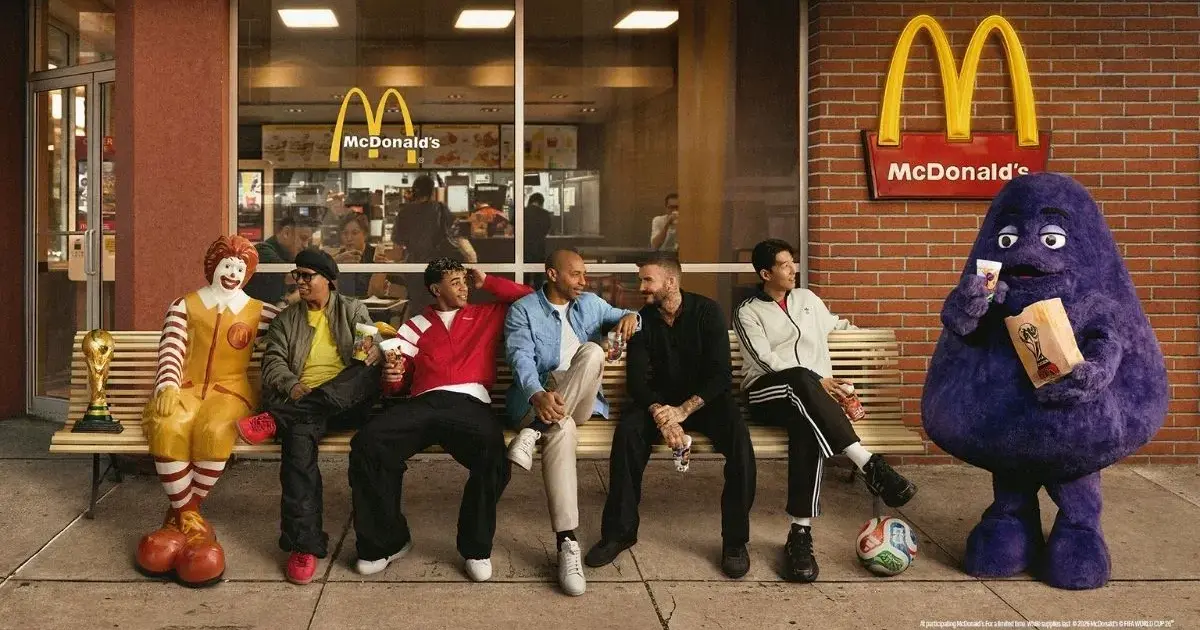
The final chapter of the 32-year alliance materialized during the summer of 2026. Billed internally and externally as the brand’s most ambitious marketing undertaking to date, the 2026 World Cup push was designed to dominate global cultural consciousness. Spearheaded by creative agency Wieden+Kennedy New York, the campaign deployed a multi-platform strategy across more than 110 countries, utilizing beloved brand characters like Grimace alongside high-octane football imagery, immersive digital activations, and localized experiential events.
At the outset, the campaign was championed as a masterclass in global creative execution. Yet, beneath the veneer of widespread cultural engagement, underlying pressures were mounting. The global fast-food landscape was facing severe macroeconomic headwinds, inflationary pressures, and shifting consumer expectations regarding value, health, and digital convenience.
The Q2 2026 Reality Check
The friction between creative output and financial return came to a head during McDonald’s Q2 2026 earnings report. While addressing investors and analysts, CFO Ian Borden offered a candid post-mortem of the summer’s activations.
Borden noted that while the massive World Cup campaign successfully "provided a lift to the business and generated excellent system excitement," it ultimately "underperformed versus our expectations." This admission coincided with reports of decelerating growth within the critical U.S. domestic market, where persistent economic strain and disappointing consumer reception to specific value-meal rollouts failed to draw the expected foot traffic. The realization that capital outlays of this unprecedented magnitude were yielding diminishing incremental returns served as the catalyst for the ultimate decision: walking away from FIFA.
Supporting Context & Metrics: The Anatomy of a Modern Marketing Overhaul
To understand why McDonald’s is stepping away from the crown jewel of international soccer, one must examine the broader financial and strategic ecosystem in which the corporation currently operates.
The Economics of Mega-Sponsorships
Sponsoring the FIFA World Cup is an exceptionally capital-intensive endeavor. Official Partner status requires hundreds of millions of dollars in rights fees alone, before factoring in the staggering production costs of global ad campaigns, media buys, local franchise-level activations, and hospitality programs.

In recent years, the return on investment (ROI) for such broad-stroke, top-of-funnel sponsorships has faced intense scrutiny from chief marketing officers across industries. Unlike targeted digital media, which offers precise attribution and behavioral tracking, traditional sports sponsorships rely heavily on brand affinity and long-term equity metrics—qualitative measures that are increasingly difficult to justify to Wall Street shareholders demanding immediate, measurable business growth.
McDonald’s Pivot Toward a $1 Billion Ad Business
The decision to drop FIFA is not happening in a vacuum; it aligns directly with McDonald’s aggressive internal restructuring of its commercial and media strategies. As previously reported by industry analysts, McDonald’s has set its sights on building a proprietary $1 billion advertising business.
Rather than funneling hundreds of millions of dollars into third-party mega-events where rights are owned and controlled by governing bodies like FIFA, the fast-food giant is increasingly focusing on building its own media channels:
- The MyMcDonald’s Rewards App: Cultivating a massive, direct-to-consumer digital database with tens of millions of active loyalty members.
- First-Party Data Monetization: Leveraging purchase histories, app engagement, and localized behavioral insights to serve hyper-targeted promotions and partner ads directly to consumers’ devices.
- In-Store and Drive-Thru Digital Media Networks: Transforming physical restaurants and digital menu boards into dynamic, programmatic advertising inventory.
By redirecting capital away from legacy sports sponsorships and toward owned digital infrastructure, McDonald’s is transforming from a traditional brick-and-mortar restaurant chain into a sophisticated tech-enabled media platform.
Official Statements and Industry Reactions
The termination of a 32-year corporate partnership has sent shockwaves through the sports marketing and advertising industries, prompting varied responses from corporate leadership, agency insiders, and sports economists.
Financial and Corporate Insights
Financial analysts have largely viewed the move through a pragmatic, if stark, lens. In an era marked by cautious consumer spending and volatile quick-service restaurant (QSR) sales, C-suite executives are under immense pressure to prune low-efficiency expenditures.
"The era of spending hundreds of millions purely for brand halo effects is facing a severe reckoning," noted one retail marketing strategist. "McDonald’s is signaling that every single dollar spent must pull its weight in direct sales conversion or measurable ecosystem growth. If a campaign across 110 countries fails to clear internal hurdles, no amount of legacy heritage is enough to save it."
Agency and Creative Perspectives
From a creative standpoint, the exit marks the end of a golden era where agencies could rely on global sporting events as the ultimate canvas for epic, borderless storytelling. Wieden+Kennedy’s work on the 2026 campaign was widely praised within creative circles for its scale, wit, and cultural resonance. However, agency leaders are increasingly tasked with proving that high-concept global creativity can directly interface with programmatic data, app-download metrics, and localized value propositions.
Future Outlook: What’s Next for McDonald’s and FIFA?
The Post-FIFA Strategy for McDonald’s
As McDonald’s turns the page on its 32-year association with soccer’s governing body, its marketing playbook is undergoing a radical decentralization and digitization:
- Hyper-Localized and Cultural Relevance: Instead of one-size-fits-all global tournaments, McDonald’s is expected to lean into agile, regional cultural moments, gaming partnerships, and localized music and entertainment collaborations that resonate deeply with Gen Z and millennial demographics.
- Value and Utility: With consumer wallet fatigue remaining a dominant theme in the fast-food sector, marketing budgets will likely prioritize clear value messaging, loyalty app incentives, and frictionless digital ordering experiences over prestige sponsorships.
- Scaling the Retail Media Network: Expect accelerated investment in McDonald’s emerging ad business, positioning the company as both an advertiser and an advertising platform for third-party CPG brands seeking access to fast-food consumers.
The Impact on FIFA’s Sponsorship Model
For FIFA, losing a cornerstone partner of 32 years presents both a challenge and an opportunity. As the organization looks toward future tournaments, it must navigate a rapidly evolving sports marketing marketplace where brands are increasingly demanding flexible, performance-based partnerships rather than rigid, multi-decade Tier-1 packages.
FIFA will undoubtedly seek to fill the void left by McDonald’s, likely targeting emerging global sectors—such as fintech, cryptocurrency, tech giants, or massive e-commerce platforms—that possess the capital required to secure top-tier rights. However, the departure of such a historic anchor brand serves as a definitive warning shot: the traditional rules of sports sponsorship no longer apply in a data-driven, efficiency-obsessed corporate world.
Conclusion
McDonald’s decision to walk away from the FIFA World Cup after more than three decades is more than just the end of a corporate contract; it is a watershed moment for the global advertising and sports industries. It underscores a fundamental shift in how multinational corporations evaluate value, ROI, and consumer engagement.
As McDonald’s charts a course toward building its own billion-dollar ad business and prioritizing owned digital ecosystems over rented stadium pitch-boards, the message to the market is clear: heritage and scale are no longer enough. In the modern marketing arena, accountability, agility, and direct-to-consumer data reign supreme.