

Executive Overview
Switzerland’s majestic alpine landscapes are undergoing a profound, irreversible transformation. According to the latest comprehensive annual report published by the Swiss Academy of Sciences (SCNAT)—drawing upon decades of rigorous data collection by the Glacier Monitoring Network (GLAMOS)—the country’s glaciers shed more than 5 percent of their total remaining ice volume in the single year of 2026.
While this staggering figure narrowly avoids the catastrophic historical benchmark set during the unprecedented melt of 2022, it underscores a deeply alarming trajectory of rapid and accelerating climatic decline. Across the nation, glaciers thinned by an average of 2.5 to 4 meters, while lower-altitude sections in particularly vulnerable microclimates suffered localized ice level collapses of up to 10 meters.
The consequences of this rapid retreat are no longer distant theoretical projections; they are visible, permanent alterations to the geography of the Swiss Alps. Iconic rivers of ice, which have shaped valleys and sustained ecosystems for millennia, are disintegrating before our eyes. Several smaller glaciers, including the Bella Tola in the canton of Valais and the Griessfirn in the canton of Glarus, have vanished entirely, transitioning from active glacial bodies to barren expanses of rock and gravel.
At the same time, the broader macro-trend reveals a compounding crisis: over the past half-decade alone, Switzerland has lost nearly 20 percent of its total glacier ice volume. This sheer velocity of loss has stunned glaciologists and climatologists alike, signaling that the window for meaningful stabilization of alpine cryospheres is narrowing rapidly. As extreme weather events become the baseline rather than the anomaly, the cascading ecological, economic, and hydrological repercussions of a glacier-free Switzerland are moving to the forefront of national and international concern.
Detailed Chronology: The Anatomy of the 2026 Melt Season
To understand how Switzerland lost over a twentieth of its remaining ice volume in a single year, researchers must look closely at the chronological progression of the 2025–2026 hydrological cycle. The disaster was not the result of a single catastrophic weather event, but rather a relentless, multi-seasonal compounding of adverse climatic conditions that left glaciers entirely defenseless against the onslaught of summer.
The Winter Deficit: A Fragile Foundation
The crisis began long before the first heatwaves of summer arrived. The winter of 2025 to 2026 ranked decisively among the ten least snowy winters in Switzerland since systematic record-keeping began. Across the alpine ranges, precipitation fell predominantly as rain rather than snow, even at moderately high elevations, while prolonged dry spells restricted fresh accumulations.
Snow cover is the primary defense mechanism for a glacier. Fresh white snow boasts a high albedo effect, reflecting the majority of incoming solar radiation back into the atmosphere and shielding the darker, denser glacial ice beneath from thermal absorption. Without this critical winter blanket, Swiss glaciers entered the spring of 2026 severely exposed. The protective shield that nature typically provides had already been compromised before the first true warmth of the year touched the peaks.
Spring Transition and the Early Thaw
As spring yielded to early summer in May 2026, the lack of an insulating snowpack meant that the seasonal melt began weeks ahead of schedule. Normally, solar energy during late spring is first consumed by the arduous process of melting the accumulated winter snow before it can impact the core ice body. In 2026, this buffering phase was virtually nonexistent.
By late May, many mid-to-high elevation glaciers had already shed their meager winter snow layers. This prematurely exposed the underlying ablation zones—the lower parts of the glaciers where ice loss typically outpaces accumulation during the warmer months. Consequently, the glaciers were left entirely vulnerable to the punishing summer months that lay ahead.
The Summer Apex: Records Broken at 4,000 Meters
The period between May and September 2026 will be remembered in climatological annals as a period of relentless, punishing thermal stress. Persistent high-pressure systems parked over Western Europe, driving prolonged heatwaves and exceptionally dry weather across the Swiss Confederation.
The most alarming indicator of this extreme thermal regime was the freezing level height. During the summer months of 2026, the zero-degree isotherm—the altitude at which atmospheric temperatures drop to freezing—climbed above 4,000 meters for an unprecedented 76 days. This figure is more than double the historical average and shatters previous Swiss records.
To put this into perspective, altitudes that should naturally remain locked in sub-freezing conditions throughout much of the summer were instead subjected to continuous above-freezing temperatures, accelerating surface melting across virtually the entire vertical profile of the Alps. By September, snow had completely vanished even at extreme elevations of 3,500 meters, exposing ancient, dark glacier ice that had remained buried beneath protective layers for centuries. Stripped of all defenses, the ice underwent profound ablation, driving the staggering volumetric losses documented by the SCNAT report at the close of the hydrological year.
Supporting Context & Metrics: The Science of Accelerated Decline
The quantitative data compiled by the Glacier Monitoring Network (GLAMOS)—a collaborative scientific endeavor headquartered at ETH Zurich, alongside the universities of Fribourg and Zurich—provide an empirical backbone to the visual realities observed in the field.
The Five-Year Precipice: 20 Percent Gone
While individual extreme years capture public attention, the macro-metrics reveal a systemic, accelerating crisis. When evaluated over a five-year window, the data become truly sobering: Switzerland has surrendered nearly 20 percent of its total glacier ice volume in this brief span.
For context, the amount of ice lost in just the last five years exceeds the total cumulative loss recorded during entire preceding decades of the 20th century. This exponential curve demonstrates that glacial retreat is not proceeding at a linear rate. As glaciers shrink, they descend to lower, warmer altitudes where ambient temperatures are higher, creating a destructive feedback loop that accelerates their demise. Furthermore, as the surface area of glaciers diminishes, their capacity to survive future climatic shocks is severely compromised.
Iconic Giants on the Brink: Rhône, Aletsch, and Clariden
The impact of the 2026 melt season was felt acutely across Switzerland’s most famous and historically studied glacial landmarks:
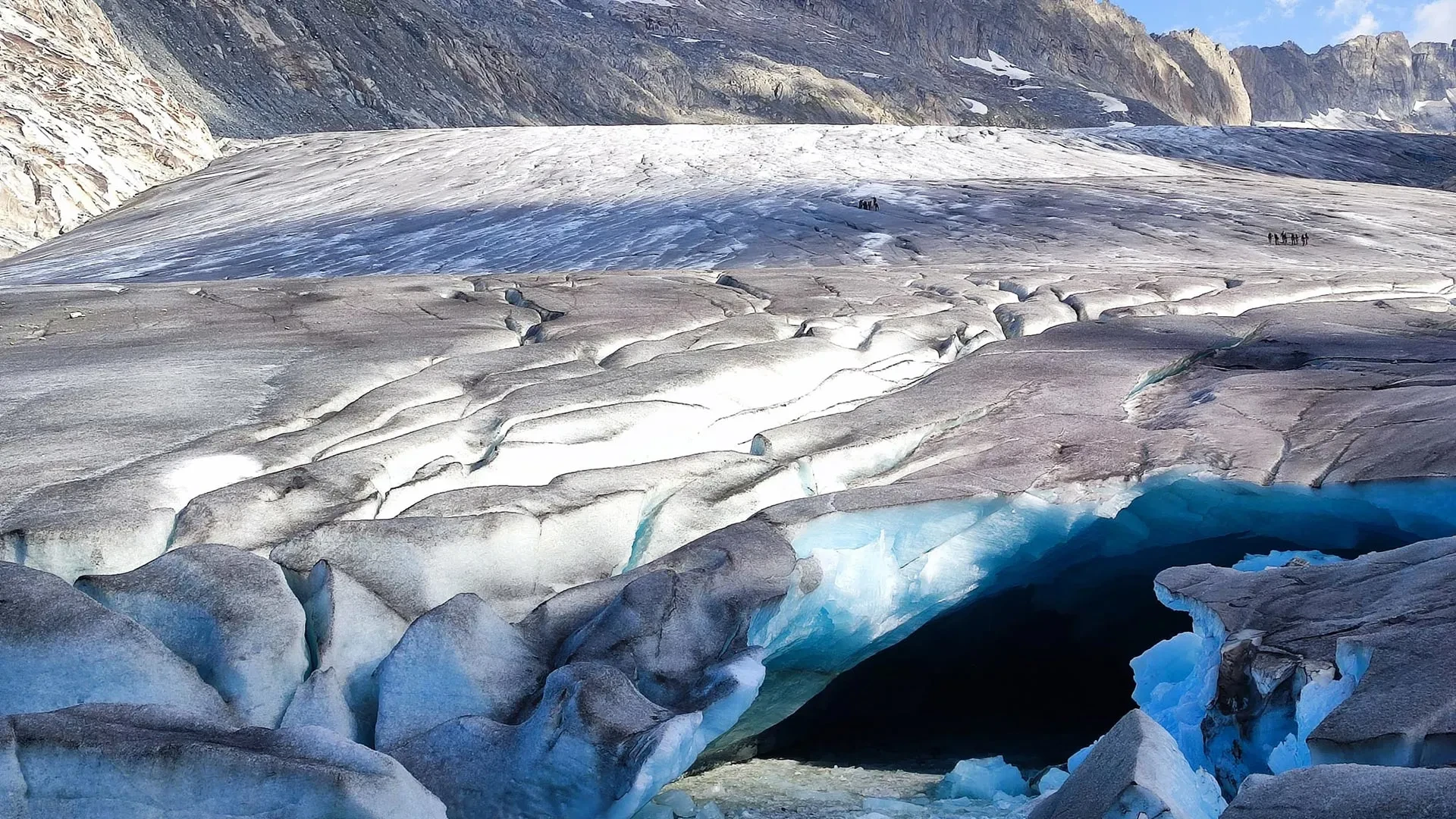
- The Rhône Glacier: Famed as the source of the mighty Rhône River and a major tourism hub, this glacier suffered catastrophic retreat. Its lower tongue experienced severe thinning and accelerated detachment from its upper accumulation basin, registering its most severe single-year volumetric loss on record.
- The Aletsch Glacier: As the largest glacier in the Alps, the Aletsch is often viewed as the ultimate barometric indicator of alpine health. In 2026, even this colossal river of ice—stretching over 20 kilometers long—recorded unprecedented rates of surface lowering and accelerated recession at its snout.
- The Clariden Glacier: Situated in the Glarus Alps, the Clariden glacier experienced intensive melting that pushed it past a critical tipping point, joining the ranks of sites undergoing terminal collapse.
The Total Vanishing of Minor Glaciers
While the giants recede, smaller glaciers are disappearing entirely. In 2026, the Bella Tola glacier in the canton of Valais and the Griessfirn glacier in the canton of Glarus crossed the threshold from severely degraded ice masses to complete extinction. These formations have now vanished permanently from topographic maps, leaving behind barren mountain cirques. Their disappearance serves as a grim preview for dozens of other small- and medium-sized glaciers across Switzerland that currently lack the mass balance required to survive another decade of similar climatic conditions.
Official Statements and Scientific Consensus
The release of the SCNAT annual report prompted urgent statements from the scientific community, government advisors, and environmental bodies, all stressing the gravity of the 2026 findings.
Dr. Matthias Huss, head of GLAMOS and a leading voice in Swiss glaciology, expressed profound concern over the velocity of the changes. "What we are witnessing is not a temporary fluctuation or a normal cyclical retreat," Dr. Huss noted during the briefing of the annual report. "The speed at which our alpine cryosphere is unraveling is unprecedented in human history. Glaciers are the most sensitive barometers of our global climate system, and right now, they are screaming an emergency warning."
Climatologists emphasize that the 2026 metrics align precisely with worst-case scenario modeling developed in previous decades, yet the psychological impact of seeing these projections realized in real-time remains profound. Researchers point out that even if global greenhouse gas emissions were to halt immediately today, a significant proportion of Switzerland’s remaining glaciers are already committed to extinction due to the thermal inertia locked into the global climate system.
Environmental policy experts have underscored that the loss of Switzerland’s glaciers represents more than a visual tragedy for tourism and alpine heritage; it signals a fundamental disruption to Central Europe’s hydrological systems, with far-reaching consequences for agriculture, energy production, and biodiversity across the continent.
The Hydrological Paradox: A Dwindling Torrent
One of the most complex and counterintuitive findings of the 2026 melt crisis relates to water resources. While melting glaciers are universally recognized as a symptom of a warming planet, the immediate physical consequence of extreme ablation is an enormous, localized surplus of water.
The 2.2 Trillion Liter Surge
During the peak dry months between July and September 2026, Switzerland’s rapidly shrinking glaciers released an estimated 2.2 trillion liters of water as they melted away. To put this astronomical volume into perspective, it equates to more than four times the total annual drinking water consumption of every Swiss household combined.
This massive influx of meltwater temporarily mitigated what otherwise would have been catastrophic summer water shortages across parts of Switzerland and neighboring European river basins. As agricultural sectors faced severe drought conditions and precipitation hit historical lows, glacial runoff fed major river arteries, keeping hydroelectric power plants operational and sustaining downstream ecosystems through the hottest weeks of the year.
The Looming Deficit: Borrowing from the Future
However, scientists are eager to correct the dangerous misperception that this meltwater surplus represents a sustainable resource. The release of 2.2 trillion liters in 2026 is, in reality, a liquidation of natural capital.
Glaciers function as long-term strategic water storage reservoirs, capturing winter precipitation and releasing it slowly over decades during dry summer months. By rapidly melting this accumulated ice reserve, Switzerland is consuming its water savings account all at once.
As glaciers continue to shrink toward eventual extinction, the volume of meltwater they can generate during dry summers will inevitably decline, ultimately turning into a mere trickle. When these natural reservoirs are entirely gone, Central Europe will lose its primary seasonal buffer against drought. This impending water deficit poses profound long-term challenges for downstream navigation, cross-border river management, agricultural irrigation, and the cooling systems required for continental energy infrastructure.
Future Outlook: Adapting to a Post-Glacial Alps
The revelations of the 2026 SCNAT report force a stark realization: the Swiss Alps of the mid-21st century will look radically different from those inherited by previous generations. The physical transformation of the landscape is now unstoppable on any timescale relevant to human society.
Ecological and Geotechnical Hazards
Beyond water security and aesthetic loss, the rapid retreat of glaciers unleashes severe geotechnical instability. As massive bodies of ice melt and recede, they leave behind millions of cubic meters of unstable moraine—loose rock, gravel, and sediment—that was previously supported by the glacier walls.
Triggered by heavy rainfall or the thawing of underlying permafrost, these unstable slopes increasingly give way to catastrophic rockfalls, massive debris flows, and sudden glacial lake outburst floods (GLOFs). Mountain communities, alpine infrastructure, hiking trails, and transit corridors face escalating risks, requiring billions of francs in defensive engineering, continuous monitoring, and strategic relocation.
Economic and Cultural Repercussions
Switzerland’s identity is inextricably linked to its glaciers. The tourism industry, which generates billions of francs annually through winter sports, summer hiking, and glacier-adjacent sightseeing, faces an existential adaptation challenge. Ski resorts situated at lower and medium elevations are already investing heavily in artificial snowmaking, all-weather terrain modification, and diversifying into year-round mountain tourism.
Yet, the symbolic loss of iconic natural landmarks risks diminishing the global allure of the Swiss alpine experience, impacting local economies that have thrived on glacial tourism for over a century.
The Global Imperative
Ultimately, glaciologists and international policy experts agree that while the fate of Switzerland’s glaciers is largely sealed for the coming decades, the ultimate destination of the alpine environment beyond 2050 remains entirely dependent on global climate action.
If global greenhouse gas emissions can be stabilized in alignment with the Paris Agreement targets, a fraction of the high-altitude ice—particularly on the massive peaks of the Valais and Bernese Alps—might be preserved into the next century. If emissions continue on their current trajectory, however, the report from 2026 will be remembered not as an aberration, but as a standard milestone on the road toward a virtually glacier-free Switzerland.
The 2026 melting crisis is a clear, unambiguous message from the high mountains: the climate emergency is actively rewriting the geography of Europe, and the time for passive observation has long since passed.