

Executive Overview
Artificial intelligence has fundamentally disrupted the digital product lifecycle, promising rapid prototyping, accelerated delivery, and lowered barriers to entry for complex user interfaces. Yet, design teams adopting AI-powered prototyping tools frequently encounter a frustrating plateau: inconsistent outputs, fragmented aesthetics, recurring accessibility violations, and subtle regressions scattered across generated components.
The root cause of these failures is rarely an inherent limitation of modern large language models (LLMs) or generative diffusion models. Rather, it is an infrastructure problem. When AI is asked to construct a prototype from visual mock-ups or vague prompt text, it is forced to hallucinate missing context, improvise arbitrary design tokens, and guess at inaccessible interaction states.
Drawing from pioneering insights by Atlassian’s Hardik Pandya and modern context engineering frameworks, this article explores how design systems must evolve from static style guides into dynamic, LLM-readable infrastructure. By implementing a structured three-tier architecture—comprising machine-readable Markdown spec files, rigid token layers, and automated linting scripts—organisations can eliminate ambiguity, enforce consistency, and fundamentally elevate the quality of AI-generated prototypes.
Detailed Chronology of the Shift Toward AI-Ready Infrastructure
The Mirage of "Zero-Shot" Prototyping
When generative UI tools first emerged, the industry anticipated a plug-and-play future where designers could feed static Figma frames into an LLM and instantly receive production-ready code. Early experiments proved this approach highly volatile.
Without explicit guidance, AI models treated every generation as a blank slate. A button generated in prompt iteration A might use a padding value of 12px, while the same button generated in iteration B would drift to 14px. Color palettes drifted, typography scales fractured, and accessibility considerations—such as contrast ratios and focus rings—were routinely omitted.
The Realization: Design Decisions as Infrastructure
As teams scaled their use of generative prototyping, industry leaders recognized that AI cannot bridge the gap left by undocumented institutional knowledge. Design decisions could no longer be treated as ephemeral Slack threads, tribal knowledge, or static PDFs sitting unread in a drive.

Instead, forward-thinking organizations began shifting toward treating design decisions as foundational infrastructure. Every rule governing spacing, color application, typography hierarchy, and accessibility compliance had to be codified into structured text files capable of being ingested directly by LLM context windows. This marked the transition from human-readable design systems to machine-readable, AI-ready frameworks.
The Rise of Programmatic Guardrails
With spec files established, the next evolutionary hurdle involved validation. How could teams ensure that an LLM actually adhered to the provided guidelines?
The introduction of specialized automation tools—such as FigmaLint for auditing design tokens and custom scripts for checking hard-coded values—provided the necessary feedback loop. By combining pre-generation text specs with post-generation automated linting, development and design teams successfully closed the loop, creating a self-correcting ecosystem where AI output is continuously measured against strict system compliance criteria.

Supporting Context & Metrics: The Anatomy of an AI-Ready Design System
To transition a legacy design system into an AI-ready asset, teams must restructure how they document, distribute, and validate design assets. According to Pandya’s framework, this requires a cohesive approach built upon three distinct operational layers.
+-----------------------------------------------------------------+
|                    LLM CONTEXT & PROMPTING                      |
+-----------------------------------------------------------------+
                                 |
                                 v
+-----------------------------------------------------------------+
| 1. SPEC FILES LAYER (Markdown Specs, Rules, Do's & Don'ts)       |
+-----------------------------------------------------------------+
                                 |
                                 v
+-----------------------------------------------------------------+
| 2. TOKEN LAYER (Closed Set of Named Variables, No Ad-Hoc Values)|
+-----------------------------------------------------------------+
                                 |
                                 v
+-----------------------------------------------------------------+
| 3. AUDITING & LINTING LAYER (FigmaLint, Automated Flagging)      |
+-----------------------------------------------------------------+
Layer 1: Structured Spec Files
Traditional design systems rely on visual galleries that humans interpret intuitively. AI, however, thrives on structured, semantic text.
- Markdown Implementation: Design rules, spacing matrices, component behaviors, and layout priorities are organized into hierarchical Markdown files within a dedicated repository folder.
- Context Efficiency: Providing explicit text instructions is significantly more cost-effective and token-efficient than forcing an LLM to parse sprawling visual mock-ups.
- Extension Over Generation: Rather than instructing an AI to build a layout from scratch, modern workflows feed the AI existing codebases alongside updated spec files, instructing it to extend the system rather than invent it.
Layer 2: The Rigid Token Layer
One of the most persistent issues in AI-generated code is the introduction of arbitrary values—such as margin: 13px or #f4f4f4 instead of design token aliases.
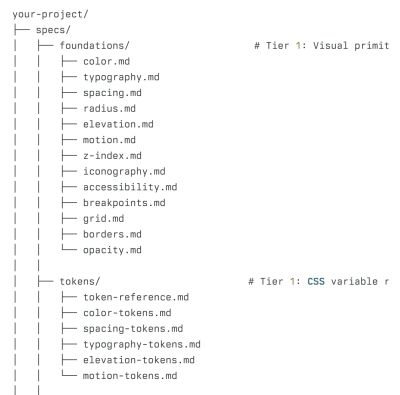
- Closed-Set Variables: An AI-ready design system enforces a strict constraint: the LLM must choose exclusively from a defined dictionary of semantic design tokens.
- Elimination of Ad-Hoc Styling: By locking down the token layer, teams ensure that generated prototypes inherit brand compliance automatically, drastically reducing the cleanup burden for front-end engineers.
Layer 3: Automated Auditing and Linting
No matter how precise the prompt or how structured the spec file, LLMs will occasionally drift or hallucinate non-compliant code.
- Programmatic Feedback Loops: Utilizing tools like FigmaLint, teams can run automated audits across design files and generated prototypes.
- Catching Regressions: These utilities scan for detached instances, missing interactive states, unbound tokens, and hard-coded values. When violations are detected, they are flagged for human review or fed back into the LLM as corrective prompts.
- Sync Routines: As design systems evolve and ship updates, synchronization scripts ensure that spec files are updated in tandem, preventing AI models from referencing deprecated documentation.
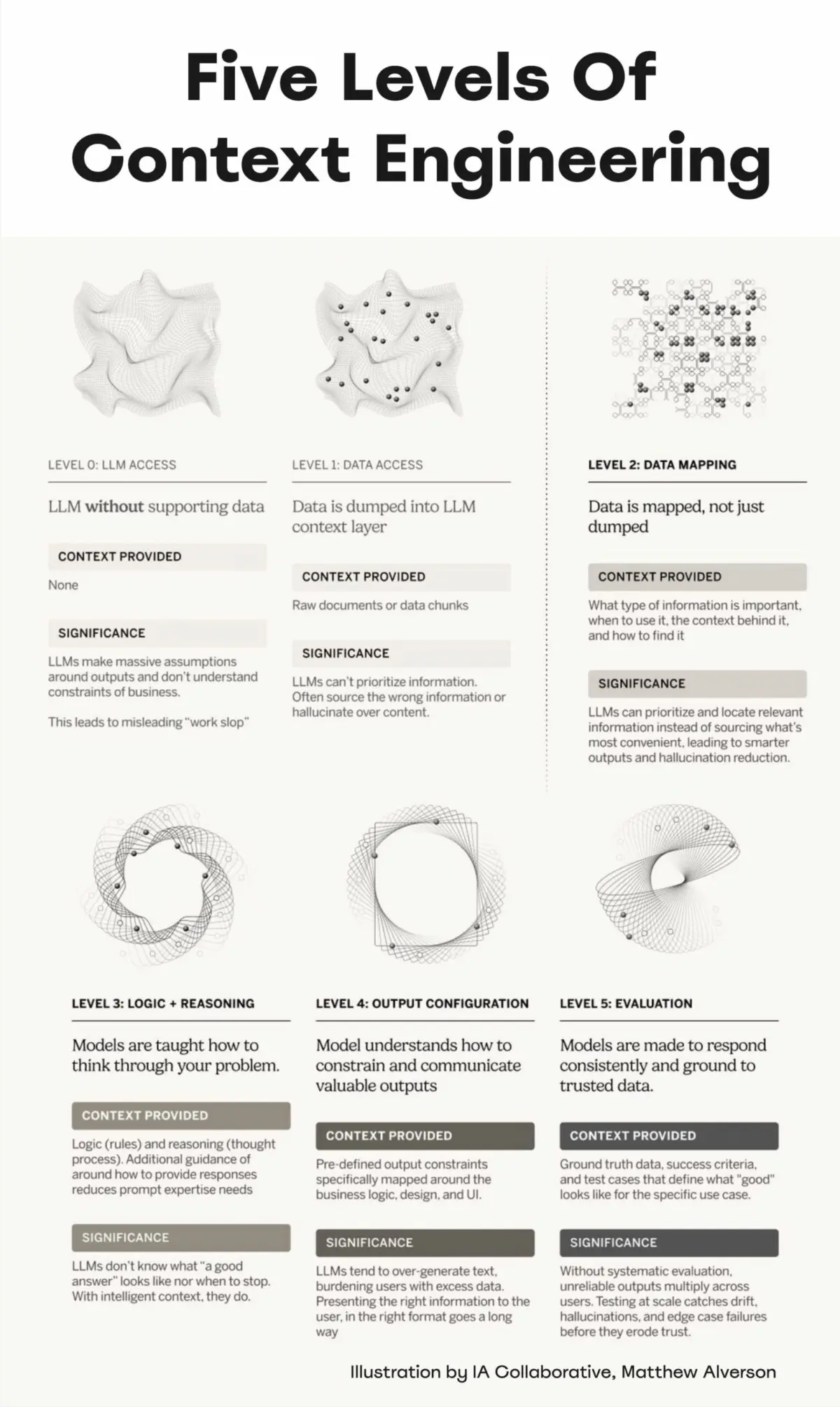
Context Engineering: The Five Levels of Maturity
To fully grasp how modern design systems integrate with AI, industry experts often reference the Five Levels of Context Engineering, popularized by engineering leaders like Matthew Alverson and Addy Osmani:
- Ad-Hoc Prompting: Copy-pasting raw snippets into chat interfaces with minimal background context. Highly prone to drift and inconsistency.
- Static System Prompts: Injecting basic brand guidelines or system instructions into global model settings. Better, but lacks dynamic project awareness.
- Project-Level Spec Integration: Connecting LLMs directly to structured Markdown specification files and token dictionaries (as championed by modern design system workflows).
- Automated Feedback & Linting Loops: Utilizing automated code linters and design auditors (such as FigmaLint) to catch regressions and feed error reports back into the generation pipeline.
- Autonomous Design Infrastructure: Fully closed-loop systems where design system updates automatically propagate through specs, tokens, and automated testing suites without manual human intervention.
Moving an organization from Level 1 to Level 3 or 4 represents the current frontier of product design operations (Ops).

Future Outlook: The Long-Term Horizon for Design Systems
The integration of artificial intelligence into product design does not signal the obsolescence of human designers; rather, it elevates their role from manual production workers to infrastructure architects.
The Evolution of Design Debt
Technical and design debt has historically accumulated through uncoordinated decisions, undocumented overrides, and rushed hotfixes. In an AI-driven workflow, unaddressed debt acts as poison to the model. If a design system is messy, the AI will amplify that mess across dozens of generated prototypes in seconds. Consequently, maintaining pristine design system hygiene will become a core business priority.
The Multi-Year Road Ahead
As organizations grapple with the realities of scale, teams will spend the coming years building and refining machine-readable design infrastructure. Vendors and third-party component library suppliers will increasingly be expected to ship their assets packaged with LLM-ready spec files and token mappings.

Ultimately, the success of AI in product development hinges on a simple maxim: The more deliberate and precise human guidance is, the higher the fidelity of the machine’s output. By treating design decisions as rigorous, living infrastructure, the design community can finally bridge the chasm between human creativity and autonomous execution.