

Executive Overview
Every digital product team knows the intoxicating high of launch day. The final Git branch merges seamlessly, the production environment goes live exactly as prototyped, and for a brief, shining moment, the website is an unblemished masterpiece of modern engineering, typography, and UX design.
Inevitably, however, that perfection begins a slow, invisible descent. It rarely happens because code breaks or servers crash. Instead, entropy sets in: competitor landscapes shift, target audiences evolve, core messaging pivots, and the pristine ecosystem built months ago gradually falls out of alignment with the living, breathing company it is meant to represent. A year down the line, that website has effectively become a digital period piece—fully functional, yet fundamentally behind.
For decades, the software development and design industries have treated this digital decay as an immutable law of nature. Maintaining a website requires constant, manual vigilance—bug fixes, asset compression, accessibility audits, design system synchronizations, and content refreshes. Because human engineering hours are finite, websites inevitably stagnate between major redesign cycles.
Enter the era of autonomous web architecture. Driven by advances in multi-agent artificial intelligence systems, a new wave of platforms—exemplified by products like Fimo—aims to rewrite this dynamic entirely. The promise is alluring: websites that continuously optimize themselves in the background, adapting to market conditions and infrastructural drifts while human teams sleep.
Yet, when engineering teams take this premise to its logical extreme, they encounter a paradox rooted not in computational limitations, but in human psychology and organizational structure: almost nobody actually wants a website that changes entirely on its own.
In this deep-dive analysis, we explore the structural decay plaguing modern web development, the lessons learned from deploying full-site autonomy in production environments, and how the future of web management relies not on removing humans from the loop, but on redefining where the boundary of human judgment truly lies.
Detailed Chronology: The Evolution of Web Maintenance and the Birth of Agentic Autonomy
To understand why autonomous websites represent a fundamental philosophical break from the past, it is instructive to trace how website management has evolved over the past three decades.
Phase One: The Static Era and Manual Upkeep (1990s–2000s)
In the early days of the World Wide Web, updates were strictly manual. Webmasters pushed raw HTML files via FTP. If a typo needed fixing or a new product page needed to be added, a developer manually edited the file and redeployed it. Maintenance was sporadic, labor-intensive, and entirely reactive.
Phase Two: The Content Management System (CMS) Revolution (2000s–2010s)
The rise of platforms like WordPress, Drupal, and later, headless CMS architectures, democratized publishing. Non-technical stakeholders could finally update copy, publish blog posts, and swap out imagery without direct intervention from engineering teams. However, while content creation accelerated, infrastructural maintenance—such as CSS design token propagation, responsive image compression, accessibility (a11y) compliance, and SEO metadata hygiene—remained trapped in developer queues.
Phase Three: The CI/CD and Headless Boom (2010s–2020s)
Modern frontend frameworks (React, Vue, Svelte) paired with continuous integration and continuous deployment (CI/CD) pipelines dramatically improved site performance and developer velocity. Yet, these tools introduced a new form of friction. Design systems drifted as components were updated locally without rippling across enterprise pages. Technical debt accumulated silently in production codebases.
Phase Four: The Agentic Frontier (Present Day)
The current paradigm shift introduces autonomous AI agents capable of executing complex, multi-step engineering and design workflows. Rather than simply waiting for a human to trigger a build or write a patch, modern autonomous platforms embed agents directly into the deployment lifecycle. These agents monitor live production environments, detect infrastructural or design discrepancies, draft corrective actions, and—depending on pre-configured trust thresholds—either execute the fixes autonomously or surface them to human reviewers.
Supporting Context & Metrics: The Hidden Cost of Digital Decay
The operational burden of maintaining a modern website is rarely captured accurately on corporate balance sheets. Industry analysts and platform telemetry reveal striking insights regarding where engineering hours vanish post-launch.
- The Maintenance Tax: Internal telemetry from enterprise web platforms suggests that up to 78% of post-launch engineering and design requests involve rule-bound, repetitive tasks—such as updating broken internal links, regenerating uncompressed media assets, patching missing
alttags for accessibility compliance, or propagating minor design token shifts. - The Decay Curve: Usability and conversion metrics often peak within the first 30 days post-launch. Without continuous multivariate content optimization and UX tuning, conversion rates drop by an average of 1.4% month-over-month due to creeping misalignment with user intent and browser standards.
- The Bottleneck Effect: In traditional organizations, website updates face severe internal friction. A simple request to update a pricing tier or shift a default color theme often requires cross-departmental alignment between product managers, brand designers, copywriters, and frontend engineers, turning what should be a micro-decision into a multi-week ticket cycle.
Autonomous agents address this friction by targeting the vast reservoir of "chores" that bog down creative talent, effectively reclaiming hundreds of productive hours per year per engineering organization.
Official Insights: The Anatomy of Autonomy and the "Line of Trust"
Pierre Burgy, co-founder of Fimo, has chronicled the friction encountered when attempting to build a fully autonomous website ecosystem. The initial hypothesis was straightforward: build powerful AI agents, hand them total control over writing, editing, optimizing, and publishing, and step out of the way.
According to Burgy, reality quickly intervened.
"We set out to make websites fully autonomous, assumed that was the goal, and then watched what people actually did with it. What they did was hesitate. Not because they distrusted the agents, but because a website has no single owner. Different parts belong to different people, and each one wants a different amount of autonomy."
This realization led to a fundamental restructuring of how autonomous systems must be designed. Workloads within an enterprise website generally fall into three distinct categories:
1. The Rule-Bound Chores (The 80%)
The vast majority of website upkeep is entirely algorithmic. Ensuring contrast ratios meet WCAG accessibility guidelines, propagating a design-system update after a core CSS token changes, catching broken meta tags, or optimizing oversized images shipped in a rushed release share a common trait: they are defined by rules, not subjective taste.
No software engineer or designer was hired for their unique talent in spotting missing alt attributes or broken hyperlinks. Offloading this tedious 80% to autonomous agents is universally welcomed because it preserves human energy for higher-order work.
2. The Untouchable Core of Taste (The 5%)
At the opposite end of the spectrum lies work that human creators will never willingly delegate at any price. An agent can verify that a newly generated landing page complies with brand typography guidelines, passes automated contrast checks, and adheres to a predefined style guide.
However, an agent cannot inherently decide what a page should feel like, nor can it evaluate whether a piece of creative direction is genuinely good in an intuitive, aesthetic sense. This core judgment is the exact reason creative professionals exist. Recognizing and fiercely protecting this boundary is essential; treating the entire website as fully automatable is a fast track to sterile, uninspired digital experiences.
3. The Gray Zone: Per-Person, Per-Task Boundaries (The 15%)
Between rote chores and untouchable creative judgment lies a vast gray area where no universal product setting can suffice. The boundary of autonomy is not determined by the task itself, but by who is looking at it.
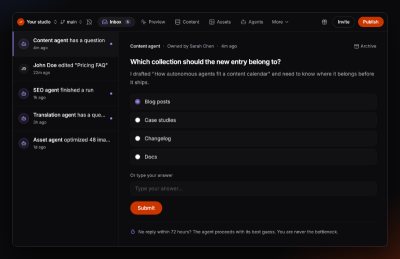
Consider a practical, highly common web adjustment: changing the default landing theme from light mode to dark mode.
- To a frontend developer, this is a one-line configuration change supported by clear user telemetry and rationale. They are typically more than happy to let an automated agent apply the patch and move on.
- To a brand designer, however, the default theme is not a trivial setting—it is a foundational statement about how the brand wishes to present its identity to first-time visitors. They demand direct, manual control over that decision.
The same task, executed on the same site, carries entirely different weights of judgment depending on the stakeholder. Consequently, rigid binary toggles ("Full Manual" vs. "Full Auto") fail. Effective autonomous systems must allow granular, per-person, and per-task composition.
Building the Agent: Shifting from Settings to Composable Workflows
Because the boundary of trust is deeply personal and context-dependent, modern autonomous website platforms are moving away from static configuration dashboards. Users do not simply toggle a switch; they compose agents.
In platforms like Fimo, teams construct specialized digital operators tailored to specific operational domains:
- The Accessibility Agent: Configured with high autonomy to continuously audit and patch DOM structures, contrast ratios, and ARIA attributes without human bottlenecks.
- The Localization/Translation Agent: Configured with medium autonomy, automatically translating copy into target regional markets while flagging idioms for human editorial review.
- The Content/Brand Agent: Kept on a short leash, restricted to drafting copy variations while requiring explicit human sign-off for any customer-facing messaging changes.
Crucially, these agents are dynamic. Trust is not a static checkbox granted on day one; it is earned over time through transparent execution logs, historical performance metrics, and side-by-side comparisons of before-and-after states. As an agent repeatedly demonstrates accuracy in handling edge cases, human supervisors naturally widen its operational scope, gradually reducing their own maintenance overhead.
Future Outlook: The Frozen Site as the Ultimate Risk
As artificial intelligence agents mature and integrate deeper into web infrastructure, industry perceptions regarding risk are undergoing a fundamental inversion.
Historically, the primary fear voiced by stakeholders adopting automation was the fear of loss of control—the anxiety that an AI agent might alter a production element without explicit pre-approval. Yet, as digital markets accelerate, a more insidious danger has emerged: the frozen site.
A static website that never changes does not remain safe; it slowly decays. It falls behind shifting browser standards, evolving accessibility mandates, changing customer expectations, and dynamic competitor positioning. Over time, it ossifies into a digital facade that no longer represents the living organization behind it.
The ultimate promise of website autonomy is not to alienate creators from their digital properties, but to liberate them from the tyranny of digital decay. By delegating rule-bound chores to tireless agents and reserving human ingenuity strictly for moments of authentic creative judgment, digital teams can ensure their web presence remains as vibrant, agile, and ambitious as the day it first launched.