

Executive Overview
Few brands carry the distinct nostalgic weight of LimeWire. In the early 2000s, the peer-to-peer (P2P) file-sharing software was a household name, synonymous with the wild west of the early internet and the digital music revolution. Today, however, the brand has completed one of the most radical pivots in technological history. Transformed from a legal battleground into a cutting-edge, decentralized generative artificial intelligence (AI) studio and publishing platform, LimeWire is carving out a unique niche in the modern digital economy.
In its current iteration, LimeWire is no longer just a vessel for media distribution; it is a full-scale AI content creation engine. By marrying state-of-the-art generative neural networks—such as Stable Diffusion and DALL-E—with Web3 infrastructure, the platform empowers artists, designers, musicians, and everyday creators to conceptualize, mint, distribute, and monetize digital media. The platform’s ecosystem is anchored by automated blockchain minting on networks like Polygon and Algorand, a built-in subscription model for exclusive fan access, and its native utility token, LMWR.
This deep-dive investigation explores the architecture of the modern LimeWire. We will dissect its image-generation capabilities, examine its novel revenue-sharing and tokenomics models, evaluate its subscription and tiered pricing structures, and analyze how well-known cultural figures are utilizing the platform to redefine audience engagement in the generative AI era.
Detailed Chronology: From Underground File-Sharing to Decentralized AI Studio
To understand LimeWire’s current market position, one must trace its journey across two distinct eras of internet history.
Phase 1: The P2P Pioneer (2000–2010)
Launched in 2000 by Mark Gorton, LimeWire quickly became the dominant Java-based P2P client, rivaling and eventually surpassing Napster and Kazaa in user adoption. At its peak, millions of users worldwide utilized the software to share music, movies, and software. However, the platform’s decentralized nature made it a primary target for the Recording Industry Association of America (RIAA). Following a protracted legal battle that culminated in a landmark 2010 federal court ruling finding LimeWire liable for copyright infringement and inducement, the original application was forced to shut down permanently.
Phase 2: The Web3 Renaissance and Brand Acquisition (2022)
More than a decade after its forced demise, the intellectual property was acquired by new leadership—specifically Austrian entrepreneurs Julian and Paul Zehetmayr. Initially envisioned as a digital collectibles marketplace for music and art, the platform quickly recognized that the future of digital assets lay in generative creation. The leadership team strategically positioned LimeWire not merely as a marketplace for static NFTs, but as an interactive creation studio powered by machine learning.
Phase 3: The Integration of Generative AI (2023–Present)
By incorporating advanced open-source and proprietary AI models, LimeWire rebranded itself as an AI studio. This pivot allowed anyone—from novice creators to established celebrities—to bypass complex digital design workflows. Users could simply type a text prompt and receive high-fidelity, commercially viable digital art in seconds. Furthermore, the platform automated the transition from creation to blockchain minting, seamlessly integrating Web3 economics into an intuitive, user-friendly SaaS (Software-as-a-Service) model.
Supporting Context & Metrics: The Mechanics of LimeWire AI Studio
LimeWire’s resurgence is underpinned by a robust technical framework that balances ease-of-use with advanced customization. The platform is designed to cater to both casual hobbyists and professional digital artists.
Advanced AI Image Generation Tools
At its core, LimeWire AI Studio serves as a unified wrapper for some of the industry’s most powerful generative image models. Creators can effortlessly toggle between different neural network architectures depending on their artistic goals:
- Stable Diffusion (Versions 2.1 and XL): Known for its open-source versatility, high photorealism, and robust handling of complex compositional prompts.
- DALL-E 2: Renowned for its conceptual intelligence, creative synthesis, and ability to blend disparate objects into cohesive artistic visions.
Users are not limited to simple text prompts. The platform offers a granular suite of controls, including samplers, negative prompts, prompt guidance scales, and style selectors. Whether a creator wants to output hyper-realistic cinematic stills, retro pixel art, expressive anime, or classic analog film grain, LimeWire’s modular styling engine provides immediate visual translation. Furthermore, the platform is actively developing its own proprietary AI model, signaling a transition from third-party reliance to bespoke, platform-exclusive neural architecture.
Automated NFT Minting and Blockchain Integration
One of LimeWire’s most frictionless innovations is its approach to digital ownership. Once a user generates an image, music track, or video, they are given the option to publish it directly to LimeWire Studio.
Upon publication, the platform automatically mints the creation as a Non-Fungible Token (NFT) on eco-friendly, high-speed blockchains—primarily Polygon and Algorand. This automated minting process eliminates the traditional hurdles of Web3 onboarding (such as manual gas fee estimation, smart contract deployment, and decentralized storage management).
Once minted, the content exists as an ownable, tradable digital asset. Creators retain ultimate control over distribution:
- Public Access: Content is discoverable by the entire LimeWire community, allowing casual viewers to admire, collect, and trade the NFTs on secondary markets.
- Subscriber-Only Exclusivity: Creators can lock specific posts behind a paywall, ensuring that only dedicated fans who subscribe to their channels gain access. This fosters an intimate creator-to-fan relationship akin to Patreon or OnlyFans, but supercharged with blockchain provenance.
Official Statements and Creator Adoption
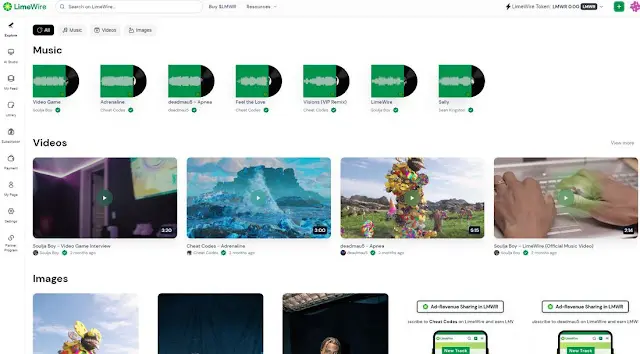
LimeWire’s strategic pivot has attracted significant attention not just from retail users, but from mainstream entertainment icons. High-profile artists and musicians—including Deadmau5, Soulja Boy, and Sean Kingston—have utilized LimeWire Studio to publish exclusive drops, multimedia content, and digital collectibles.
In statements accompanying the platform’s rollout, leadership emphasized the democratization of creative tools. The underlying thesis of the platform is that artificial intelligence should not replace human artists, but rather serve as a force multiplier for their creativity. By lowering the technical barrier to entry, individuals who lack traditional illustration or music-production skills can now bring complex imaginative concepts to life.
Moreover, the platform’s community-centric economic model ensures that creators are continually compensated for their work. When a digital collectible minted on LimeWire is traded on secondary markets, the original creator automatically receives a 2.5% royalty on the transaction. This creates a perpetual passive income stream tied directly to the appreciation and circulation of their digital art.
Monetization, Tokenomics, and Tiered Pricing Structures
Unlike traditional content platforms that retain the vast majority of ad revenue or platform fees, LimeWire has structured its business model around aggressive creator payouts and decentralized utility.
The Ad Revenue Sharing Model
When creators publish content to LimeWire Studio, they become eligible to earn a substantial share of the ad revenue generated when other users view their images, music, or videos. Depending on the creator’s subscription tier, they can earn anywhere from 50% to 70% of all ad revenue attributed to their content views. This hybrid model—combining AI generation, social discovery, and ad-monetized engagement—provides a steady financial baseline for active publishers.
LMWR Tokens: The Utility Engine
All earnings on LimeWire are distributed in LMWR tokens, the platform’s native ERC-20/native cryptocurrency. LMWR functions as the financial lifeblood of the ecosystem:
- Payouts: Creators receive their monthly revenue shares directly in LMWR tokens.
- Exchange Liquidity: LMWR is listed on several major centralized and decentralized cryptocurrency exchanges, including Kraken, ByBit, and Uniswap, allowing users to easily convert their digital earnings into fiat currency or other digital assets.
- Platform Utility: Users can utilize LMWR tokens to purchase additional credits for generative AI tools, pay for premium creator subscriptions, and participate in platform governance.
Comprehensive Pricing Tiers
LimeWire operates on a freemium model designed to accommodate users across all budget ranges.
-
Free Plan:
- Cost: $0 / month
- Credits: 10 free credits (allowing up to 20 AI image generations per day)
- Ad Revenue Share: 50%
- Ideal for casual experimenters looking to test the platform’s generative capabilities.
-
Basic Plan:
- Cost: $9.99 / month
- Credits: 1,000 credits per month (up to 2,000 image generations)
- Perks: Early access to new AI models, 50% ad revenue share, Pro profile badge, faster generation speeds, and ad-free browsing.
-
Plus Plan:
- Cost: $29 / month
- Credits: 3,750 credits per month (up to 7,500 image generations)
- Perks: Early access to new models, 60% ad revenue share, Pro badge, full creation history, and faster generations.
-
Advanced Plan:
- Cost: $49 / month
- Credits: 5,000 credits per month (up to 10,000 image generations)
- Perks: 70% ad revenue share, early model access, Pro profile, priority queue processing.
-
Pro Plan:
- Cost: $99 / month
- Credits: 11,250 credits per month (up to 22,500 image generations)
- Perks: Maximum 70% ad revenue share, highest credit allowance, maximum generation speed, and full enterprise-level access to all platform features.
Future Outlook: Beyond Images into Music and Video
As generative AI continues to evolve at an exponential pace, LimeWire is positioning itself as a multi-modal powerhouse. While the platform’s current infrastructure is heavily optimized for high-end AI image generation and editing, its roadmap includes significant expansions.
In the near future, LimeWire plans to roll out dedicated AI music generation and video creation tools. Given the brand’s historic roots in the music industry—and its current roster of musician-creators like Deadmau5 and Soulja Boy—the introduction of generative audio tooling could prove to be a watershed moment. Artists will soon be able to prompt original instrumental loops, vocal harmonies, and cinematic video backdrops directly within the Studio interface, instantly minting them as tradeable multimedia NFTs.
Furthermore, as the platform refines its proprietary AI models and expands its integration with cross-chain decentralized protocols, LimeWire is transitioning from a simple web application into a comprehensive decentralized autonomous ecosystem for digital creators.
Conclusion
LimeWire’s evolution from a controversial 2000s P2P file-sharing client into a sophisticated, AI-driven creator studio is a masterclass in technological reinvention. By successfully bridging generative artificial intelligence, automated blockchain minting, subscription-based fan engagement, and transparent crypto-economic revenue sharing, LimeWire has built a compelling ecosystem for the modern digital creator.
For artists, designers, and musicians seeking an all-in-one platform to create, distribute, and monetize their work without wrestling with technical complexities, LimeWire Studio offers an accessible yet powerful toolkit. Whether users are leveraging the free tier to experiment with Stable Diffusion prompts or scaling up to the Pro tier for maximum revenue yields and high-volume generation, LimeWire stands out as a democratizing force in the rapidly expanding universe of generative AI.