

Executive Overview
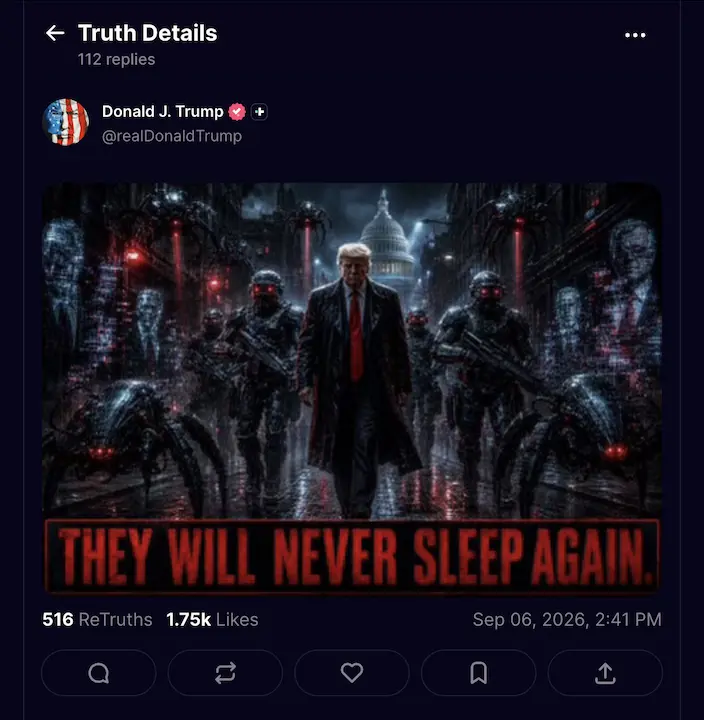
Over the course of the 2026 Labor Day weekend, President Donald Trump’s official social media presence underwent a surreal and unprecedented transformation. Eschewing traditional political messaging or standard holiday well-wishes, the president flooded his Truth Social feed with dozens of artificial intelligence-generated images and videos. The content veered sharply into dystopian science fiction, featuring menacing robot armies, apocalyptic battle scenes, futuristic military uniforms inspired by Hollywood cinema, and whimsical geopolitical alternate histories.
The digital barrage—which included imagery of glowing-eyed mechanical soldiers patrolling a dark Washington, D.C., and explicit threats of psychological warfare—immediately ignited a firestorm across the political landscape. While critics and digital watchdogs raised urgent concerns regarding presidential fitness, mental acuity, and the normalization of AI-generated misinformation, defenders and administration officials largely brushed off the posts as unconventional political theater or symbolic message-sending.
Compounding the spectacle, the official White House social media accounts amplified the surrealism, broadcasting a video that cast the president as a comic book superhero. This weekend-long display highlights a growing, alarming trend in modern political communication: the blurring lines between digital fantasy, official state messaging, and the psychological impact of unchecked generative AI in the hands of the commander-in-chief.
Detailed Chronology of a Digital Binge
The digital campaign began in earnest on Sunday, September 7, 2026, unfolding across several hours of rapid-fire posting that caught political observers and tech analysts off guard. Within a span of roughly ten minutes, the president’s Truth Social account became a repository for high-concept, highly polished digital art generated by text-to-image AI tools.
Among the earliest posts were stylized maps depicting a restructured American geography, including the speculative renaming of New Mexico, alongside graphics self-laudatory of his administration’s economic performance and foreign policy achievements in Iran. However, the tone quickly darkened, transitioning from standard political boasting into the realm of speculative military science fiction.
The Robot Army Sequence
The centerpiece of the weekend’s digital output was a grim sequence of AI-rendered images depicting autonomous robotic combatants:
- "THEY WILL NEVER SLEEP AGAIN": One image showed a towering, metallic red-eyed humanoid robot standing alongside the president as he strode through a shadowy, desolate version of Washington, D.C.
- "THEY WILL DREAM OF US FOREVER": A second graphic featured a similar cadre of lethal-looking machines paired with an ominous text overlay aimed at unspecified adversaries.
- "GIVE THEM NIGHTMARES": A third post featured Trump seated amidst a sprawling, regimented phalanx of armed, autonomous mechanical soldiers, accompanied by a direct call for psychological intimidation.
Sci-Fi Fashion and Alternate Realities
As the afternoon progressed, the imagery shifted from battlefield dystopia to bizarre aesthetic exercises. Trump shared a concept image showcasing a "next generation" Space Force service dress uniform. Unlike the actual ceremonial uniform unveiled by the branch earlier in the year following a multi-year development cycle, this AI-generated variant bore an unmistakable resemblance to the fascist-leaning, utilitarian military garb featured in Paul Verhoeven’s satirical sci-fi film Starship Troopers.
The posting spree also featured time-bending flights of fancy, including imagined roundtable discussions with Founding Father George Washington and altered geopolitical maps of the Middle East. By Monday morning, however, the digital landscape on the president’s account pivoted back to conventional political grievances. Trump issued a holiday text post railing against "Radical Left Lunatics, Communists, and Dumocrats," while predicting a sweeping Republican victory in the upcoming midterm elections.
Supporting Context & Metrics: The Convergence of AI and Geopolitics
The events of Labor Day weekend did not occur in a vacuum; rather, they represent an escalating escalation of the administration’s reliance on generative artificial intelligence to communicate national security and political messaging.
Blurring Lines in the Middle East
Just weeks prior to the Labor Day posting spree, the administration utilized similar synthetic media tactics regarding the ongoing U.S. conflict with Iran. In late August 2026, Trump shared an AI-generated video depicting the complete destruction of Iran’s strategic Kharg Island. Despite official confirmations from military and intelligence analysts that no such kinetic strike had taken place, the video circulated widely, forcing the administration to defend its utility.
Vice President JD Vance later defended the post, asserting that the president was intentionally "sending a message" to Tehran through symbolic digital displays. Critics, however, pointed out the inherent dangers of a nuclear-armed state utilizing deepfake-style war imagery for psychological posturing, arguing it risks catastrophic miscalculation and degrades the credibility of official state communications.
The White House Amplification
The fantasy narrative was not confined to the president’s personal social media ecosystem. In an unprecedented move, the official White House X (formerly Twitter) account joined the fray overnight. The institutional account published a cinematic video casting President Trump as the DC Comics superhero Green Lantern. Set to the character’s classic oath—“In brightest day, in blackest night, no evil shall escape my sight…”—the video utilized generative imagery to superimpose the president’s face onto the hero, conjuring glowing green energy constructs of the southern border wall, domestic manufacturing facilities, and advanced military hardware.
The integration of partisan campaign aesthetics and comic book fantasy into official government communications marks a profound departure from historical norms of institutional decorum.
Official Statements and Public Reaction
The sheer volume and bizarre nature of the Labor Day posts provoked an immediate and polarized response from lawmakers, political commentators, and the public.
Calls for the 25th Amendment
Prominent critics and progressive digital commentators expressed deep alarm over the psychological state of the commander-in-chief, with several high-profile figures openly calling for the invocation of the 25th Amendment. The constitutional mechanism, which allows for the peaceful transfer of presidential powers to the vice president if the president is deemed "unable to discharge the powers and duties of his office," became a trending topic across social media platforms as analysts questioned the judgment required to broadcast images of terminator-style robots and psychological terror to the American public.
Despite the online outcry, neither Vice President JD Vance nor members of the presidential Cabinet gave any indication that such drastic measures were under consideration, treating the digital outburst as standard Trumpian media manipulation.
Defense and Dismissal
Defenders of the president and conservative commentators framed the criticism as a lack of cultural and digital literacy on the part of the political opposition. Proponents argued that the images were clearly satirical, harmless internet memes designed to troll critics and project strength, rather than literal policy proposals or indications of cognitive decline. From this perspective, the embrace of AI-generated art is viewed as a masterclass in modern digital dominance, keeping political adversaries perpetually off-balance and dominating the news cycle.
Future Outlook: The New Frontier of Synthetic Governance
As artificial intelligence technology becomes more accessible, sophisticated, and difficult to distinguish from reality, the events of this Labor Day weekend serve as a critical case study in the future of political communication.
The willingness of a sitting U.S. president—backed by official state communication channels—to deploy synthetic, dystopian, and comic-book-inspired imagery signals a permanent shift in how political narratives are constructed. When reality and digital fabrication merge on the official feeds of the world’s most powerful government, the implications extend far beyond a momentary social media spectacle.
Moving forward, the normalization of "AI slop" and dystopian posturing in presidential communications raises profound questions regarding institutional trust, the security of democratic discourse, and the potential for synthetic media to exacerbate international tensions. As the midterm elections approach, it is clear that the digital battleground has evolved past simple text-based rhetoric into an era where synthetic reality dictates the terms of political engagement.