The promise of artificial intelligence in design and prototyping has always outpaced its practical execution. For every breathtaking demonstration of an LLM generating a fully functional user interface from a simple text prompt, there are dozens of real-world workflows where AI-generated prototypes fall short, plagued by visual drift, accessibility failures, and architectural inconsistencies.
The root cause of these failures is rarely the underlying model’s capability. Instead, it lies in the fragmented nature of modern design systems. Tiny inconsistencies scattered across a repository—undocumented design decisions, residual hard-coded values, and a systemic reliance on AI to intuitively decode complex, unstructured mockups—inevitably lead to compounding errors.
Recent industry insights, notably a practical guide published by Atlassian’s Hardik Pandya, suggest a fundamental paradigm shift: AI cannot magically resolve technical or design debt without explicit, structured human guidance. To bridge the gap between generative AI and production-grade product design, organizations must treat design systems not merely as visual libraries, but as robust, machine-readable infrastructure.
This article explores a comprehensive methodology for preparing design systems for the age of AI. By implementing structured spec files, centralized token layers, automated auditing pipelines, and rigorous context engineering, design teams can dramatically minimize hallucinations, reduce design drift, and establish a scalable framework for AI-assisted prototyping.
Detailed Chronology & Industry Evolution
The Shift from Visual Mockups to Machine-Readable Specs
For years, the design industry operated on a visual-first contract. Designers crafted high-fidelity mockups in tools like Figma, relying on human developers to translate those pixels into code while bridging gaps in logic, states, and accessibility on the fly. When generative AI entered the landscape, workflows initially attempted to mimic this paradigm: feed an image or a Figma frame to an LLM and expect production-ready code.
However, this approach hit an immediate ceiling. Vision-based models struggle with subtle design system constraints, often misinterpreting component hierarchies, inventing arbitrary spacing values, or missing crucial interactive states (such as hover, focus, and disabled).
The industry is currently transitioning into a text-driven, specification-first era. Rather than forcing LLMs to reverse-engineer intent from raw pixels, forward-thinking teams are packaging design tokens, component guidelines, and design principles into structured Markdown files ("spec files"). This evolution mirrors the software engineering world’s transition toward infrastructure-as-code (IaC), where machine-readable documentation acts as the single source of truth.
The Rise of Specialized Tooling and Auditing
As the demand for AI-ready design infrastructure grows, a new category of tooling has emerged to automate the cleanup and maintenance of design systems. Tools like FigmaLint have gained traction by addressing the foundational hygiene required for AI consumption. By scanning design files for detached instances, unbound tokens, unlabelled layers, and hard-coded values, these plugins act as a crucial bridge between messy human design files and strict machine-readable requirements.
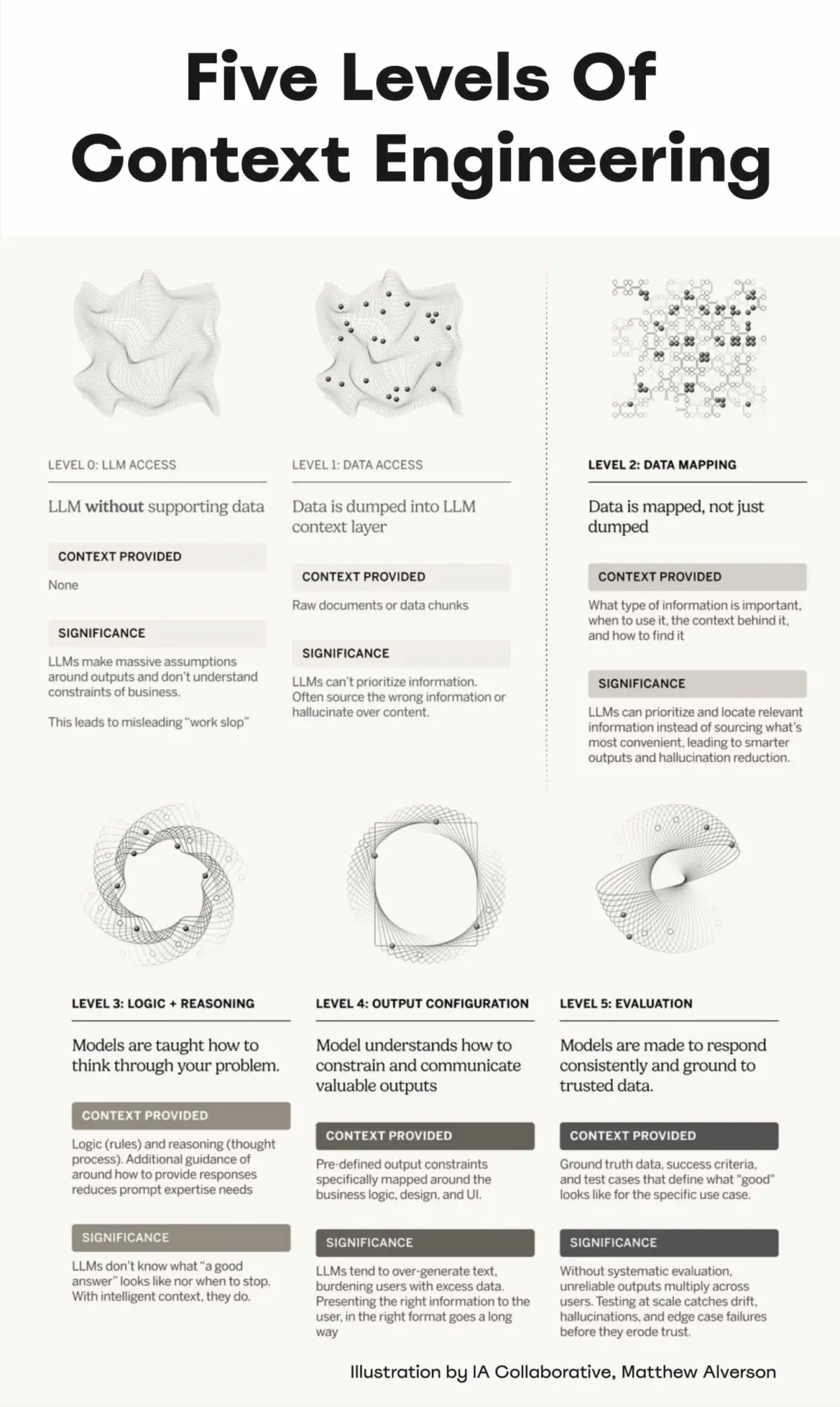
Concurrently, the concept of context engineering—championed by engineering leaders and popularized through frameworks like the "Five Levels of Context Engineering"—has redefined how designers communicate intent to AI agents. Rather than treating prompts as isolated events, teams are building cyclical ecosystems where design decisions immediately update spec repositories, ensuring that any AI-driven prototype consumed downstream is built on the most current version of the truth.
Supporting Context & Metrics: The Mechanics of AI-Ready Design
To successfully integrate AI into the prototyping and development lifecycle, organizations must master a three-layered architectural approach: Spec Files, Token Layers, and Automated Auditing.
Design decisions are no longer fleeting choices made in Slack threads or buried in design critique notes. In an AI-augmented environment, every choice regarding layout rules, color usage, typography scales, and prioritization must be codified.
When a design decision is made, it must follow a strict path into a structured specification file. By removing ambiguity, designers prevent LLMs from guessing or hallucinating plausible values ad hoc. Furthermore, extending existing code via precise textual specifications has proven vastly more cost-effective and accurate than generating code entirely from scratch based on visual interpretations.
2. The Three-Layer Architecture
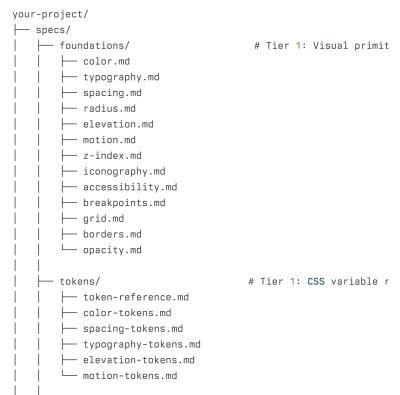
The Spec Files Layer: These are structured Markdown repositories containing spacing rules, component usage guidelines, accessibility mandates, and priority matrices. Every time an AI agent is tasked with generating a prototype, it queries these spec files to maintain absolute contextual alignment.
The Token Layer: A strictly maintained, centralized dictionary of design tokens. By restricting the AI to a closed set of named variables (e.g., using --color-primary-surface instead of a raw hex code like #0052CC), teams eliminate visual drift and ensure brand consistency across every generated screen.
The Auditing & Sync Layer: Automated linting scripts act as an aggressive quality-assurance gatekeeper. If an AI-generated prototype introduces a hard-coded value or violates a component rule, the audit script flags the error. The AI then processes this feedback loop to self-correct before human review even begins. Additionally, sync routines ensure that when design systems ship updates, downstream spec files are automatically updated so the AI never references deprecated guidelines.
3. The Power of Automated Auditing
For organizations that rely on third-party vendors and external design system libraries, maintaining quality control is an uphill battle. Manual code reviews are time-consuming, and catching accessibility regressions or detached token bindings across thousands of lines of AI-generated code is nearly impossible without automation.
Integrating tools that parse token bindings, detect missing interactive states, and flag hard-coded styles saves hundreds of engineering hours. This shifts human oversight from micro-managing pixel placements to directing high-level architectural strategy.
Official Industry Perspectives & Expert Insights
Industry leaders are increasingly vocal about the need for systemic discipline in AI integration.
"To get better results, AI needs better guidance that minimizes assumptions and reduces ambiguity. Design decisions are infrastructure—every choice must find a path into the spec file consumed by AI."
— Hardik Pandya, Atlassian
Pandya’s framework highlights a fundamental truth that many product teams overlook: generative AI is a reflection of the documentation it consumes. If a design system is plagued by tribal knowledge, undocumented spacing rules, and legacy workarounds, the AI will faithfully reproduce those flaws at scale.
Adding to this perspective, design educator and strategist Vitaly Friedman emphasizes that the future of product design lies in mastering structured interaction models and context management:
"Ultimately, AI cannot magically resolve technical debt or design debt without proper guidance. The more deliberate and precise designers are in guiding AI, the better the overall outcomes will be. This requires not just cleaning up and improving design systems, but maintaining them over time."
As organizations deploy AI features into production, the differentiator between chaotic, disjointed AI prototypes and enterprise-grade user experiences will not be the model’s parameter count, but the rigor of the underlying design infrastructure.
Future Outlook: What Lies Ahead for AI-Driven UX
The integration of artificial intelligence into product design is not a transient trend; it is a fundamental restructuring of how digital products are conceptualized, built, and maintained. Looking toward the next three to five years, several key developments will shape the landscape:
1. From Visual Editors to Spec-Driven Authorship
While visual layout tools like Figma will remain essential for human creativity and high-level exploration, their output will increasingly be optimized for machine readability. We will see the maturation of automated compilers that translate visual components directly into structured Markdown spec files and token registries, eliminating the manual friction of documentation.
2. Autonomous Design System Guardians
The role of the Design Systems Engineer will evolve into that of an AI Supervisor. Rather than manually updating component documentation, engineers and designers will build autonomous agents and linting pipelines that continuously monitor codebase health, check accessibility compliance against evolving WCAG standards, and automatically patch UI drifts across multi-platform applications.
3. Democratized, Brand-Safe Prototyping
As closed-set token layers and spec repositories become standardized, cross-functional stakeholders—product managers, copywriters, and QA engineers—will be able to generate fully compliant, brand-safe prototypes using natural language. This democratization of prototyping will accelerate product discovery while ensuring that design integrity is never compromised by speed.
Conclusion
Preparing a design system for the age of AI requires patience, discipline, and a willingness to treat documentation as code. By shifting from implicit assumptions to explicit context engineering, design teams can harness the true velocity of artificial intelligence without sacrificing quality, accessibility, or brand consistency. The work is complex and ongoing, but the foundation laid today will define the digital products of tomorrow.
Explore Further: "Design Patterns For AI Interfaces"
For product designers and developers looking to deepen their expertise in crafting intuitive, human-centered AI systems, Design Patterns For AI Interfaces offers a comprehensive video course created by Vitaly Friedman. Featuring hundreds of real-life examples and practical UX guidelines, the curriculum is designed to help teams build AI features that users genuinely trust and adopt.