


Executive Overview
In the rapidly evolving landscape of digital product design, User Experience (UX) research has long relied on traditional "general population" (gen pop) participant pools to validate interfaces, workflows, and content. However, a groundbreaking exploratory study conducted in mid-2024 challenges this longstanding paradigm. Spearheaded by experts in accessibility innovation—including teams from Fable and the University of California, Irvine—new research reveals that participants with cognitive disabilities uncover 1.8 times more usability issues and offer 1.8 times more actionable suggestions than general population participants.
Cognitive disabilities—an umbrella term encompassing conditions that affect memory, focus, and information processing—represent the most prevalent disability category in the United States, impacting nearly 14% of the population, with incidence rates continuing to rise. By evaluating three distinct AI-prototyped websites with varying levels of complexity, this study provides empirical evidence that designing for cognitive inclusion is not merely an act of compliance or niche accommodation. Instead, it serves as a powerful catalyst for uncovering critical cognitive-load bottlenecks, improving digital clarity, and delivering a universally superior product experience that ultimately drives business value and customer retention.
Detailed Chronology of the Study
The journey toward understanding how to effectively integrate cognitive testers into UX research began long before the formal study was executed.
Phase 1: Foundation and Pilot Testing (Summer 2024)
In the summer of 2024, a specialized working group of expert researchers convened to determine best practices for performing accessibility testing with individuals with cognitive disabilities. Working through Fable, where innovation leadership set out to solve this exact problem, the team established four core learning goals:
- Recruit individuals who self-identified as having challenges with memory, focus, and learning using a carefully designed screener.
- Review existing literature and published studies involving cognitive testers to identify proven methodologies.
- Test these best practices in a pilot study involving an initial group of 25 testers.
- Iteratively refine the approach, culminating in a standardized guide for conducting user interviews and a quantitative survey to measure digital product experiences.
After successfully documenting these pilot learnings, researchers noted a strong hunch: testers with cognitive accessibility needs possessed a heightened sensitivity to interface friction, suggesting they would unearth far deeper usability insights than traditional gen pop participants.
Phase 2: Experimental Design and Setup
To validate this hypothesis empirically, a joint study was designed in collaboration with the University of California, Irvine (featuring Syed Fatiul Huq and Fable researchers Pranav Pidathala, Ali Brown, and Michael Fagan).
To test a diverse range of user goals, contents, and tasks, researchers utilized an AI prototyping tool to generate three distinct websites:
- Strong Snacks: A minimalist, brutalist, image-heavy site dedicated to three-ingredient high-protein recipes, blog posts, and newsletter sign-ups.
- Turning Pages: A moody, content-rich bookstore featuring extensive filtering, a book-matching swiping feature, custom book lists, and a full shopping cart and checkout workflow.
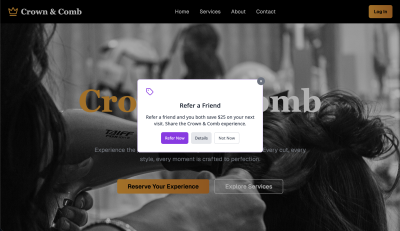
- Crown & Comb: A bold, clean hair salon website featuring appointment bookings, VIP programs, and complex membership packages, with intentionally difficult navigation paths for specific tasks (such as locating a hidden bridal package).
Phase 3: Execution and Data Collection
Researchers deployed a unified screener evaluating memory, focus, and learning challenges, dividing 30 participants evenly across the three websites (10 participants per site, split 50/50 between cognitive and gen pop groups).
Each participant completed all tasks for a designated website during a facilitated online interview. Afterward, every participant completed the Accessible Usability Scale (AUS) survey—a free, 10-question evaluation tool designed to quantify digital product usability on a scale from 0 to 100.
Following data collection, transcripts and recordings were systematically analyzed. Every instance of user hesitation, confusion, missed task elements, or interface friction was logged as an "issue," alongside any participant-generated suggestion for improvement.
Supporting Context & Metrics: Quantitative and Qualitative Findings
The study’s quantitative results confirmed the research hypothesis: cognitive participants consistently identified significantly more pain points across all tested environments. Across all three websites, cognitive accessibility testers surfaced 197 total issues and made 93 suggestions, compared to 113 issues and 54 suggestions from the general population group.
Website-by-Website Breakdown
| Website | Participant Group | Total Issues | Average Issues | Total Suggestions | Average Suggestions | Average AUS Score | Median AUS Score |
|---|---|---|---|---|---|---|---|
| Strong Snacks (Simple) | Gen Pop | 32 | 6.4 | 13 | 2.6 | 90.5 | 97.5 |
| Cognitive | 49 | 9.8 | 24 | 4.8 | 76.8 | 73.0 | |
| Turning Pages (Complex) | Gen Pop | 55 | 11.0 | 26 | 5.2 | 78.0 | 80.0 |
| Cognitive | 86 | 17.0 | 42 | 8.4 | 60.8 | 58.0 | |
| Crown & Comb (Intentional Friction) | Gen Pop | 26 | 5.0 | 15 | 3.0 | 49.5 | 35.0 |
| Cognitive | 62 | 12.0 | 27 | 5.4 | 63.8 | 68.0 |
Categorical Issue Distribution
When issues were categorized by domain, cognitive participants surfaced disproportionately higher numbers of problems related to content, buttons and links (affordance and function), icons or visual elements, and media (such as animations). Interestingly, navigation issues were nearly tied between the two groups (45 for gen pop vs. 46 for cognitive), indicating that architectural navigation challenges affect users universally, while cognitive load and interface clarity disproportionately burden neurodivergent and cognitively diverse users.

Qualitative Impact: Beyond Frustration to Well-Being
Qualitative analysis revealed a profound psychological distinction in how different user groups experience poor UX. While a general population participant typically described interface flaws as "frustrating" or "not engaging," cognitive participants frequently reported feeling drained, overwhelmed, and less able to focus.
For example, when evaluating the complex booking flows on Crown & Comb, a general population participant noted:
"As soon as you have a name of a treatment and a little explanation… as soon as you click onto that, it should be that you can interact with that service straight away… This feels not particularly engaging."
In contrast, a cognitive participant articulated a deeper toll on mental energy:
"For example, like, the mental energy aspect of it, like, sometimes there’s, like, okay, cookies, and then ads, pop-ups, or maybe the website or service has too many options to look through… It makes me, like, feel drained and less able to focus."
This highlights a vital threshold in UX design: minor usability flaws compound into severe accessibility barriers when the cumulative cognitive load becomes overwhelming.

Official Statements and Industry Perspectives
The implications of these findings extend far beyond academic research, striking at the heart of commercial digital strategy. Industry leaders have increasingly recognized that centering accessibility yields outsized dividends for operational efficiency.
A UX Manager at Bell Media encapsulated the value of inclusive testing succinctly:
"2 sessions with cognitive users feel like 200 because of the volume of insights we get."
Experts emphasize that cognitive accessibility testing acts as an invaluable diagnostic tool. By addressing the cognitive load, layout predictability, and content clarity demanded by users with cognitive access needs, organizations inherently safeguard their products against customer churn. When interaction models are ambiguous—such as confusing "Add to bag" states or obscure recommendation algorithms—users lose confidence. Over time, compounded friction in transactional pathways directly translates to lost revenue and weakened customer loyalty.
Future Outlook: Preparing for an Aging and Diverse Population
As digital ecosystems grow increasingly complex, the imperative to prioritize cognitive inclusion becomes undeniable. Macro-demographic shifts point toward an urgent need for adaptive design frameworks. According to U.S. Census projections, the percentage of Americans aged 65 and older is expected to rise from 17% to 25%, meaning that one in four Americans will be an older adult by 2060.
As populations age, naturally occurring cognitive decline becomes a universal human experience. Companies that fail to design for simpler information processing, predictable interactions, and minimized cognitive load will struggle to serve an aging demographic.
Furthermore, cognitive accessibility serves as an optimal entry point for organizations looking to mature their inclusive research practices. While testing with screen reader and screen magnifier users remains essential, many development teams struggle with where to begin. Focusing first on cognitive load, plain language, and visual hierarchy provides a robust foundational bridge. It demystifies inclusive research, making subsequent technical accessibility initiatives far more approachable.
Ultimately, cognitive inclusion in UX research is no longer optional. It is a strategic necessity that elevates research efficiency, streamlines content, simplifies user flows, and ultimately ships superior digital products for everyone.
