

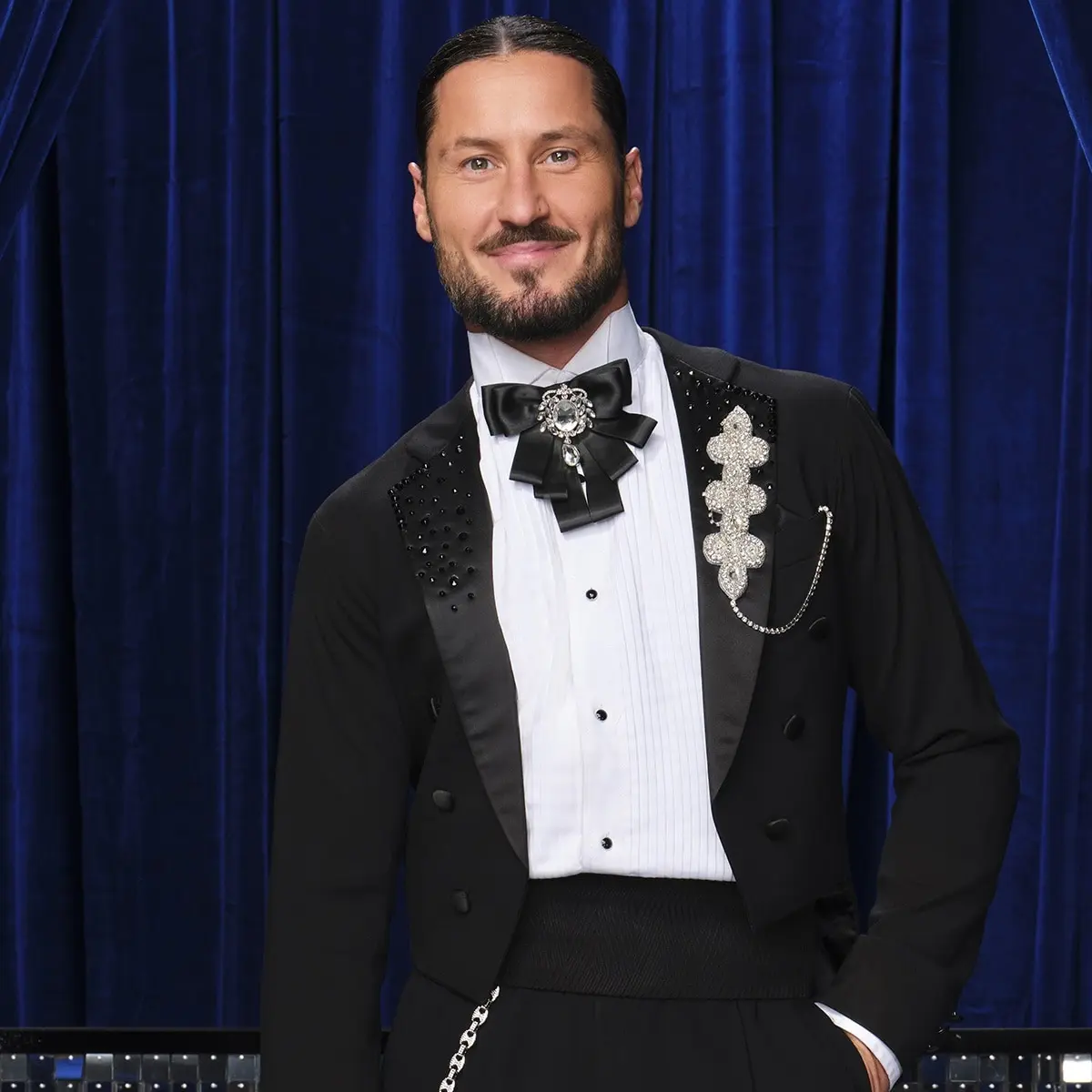
The ballroom floors of ABC’s flagship reality competition series, Dancing with the Stars (DWTS), are rarely devoid of tension, but the fallout from the season’s recent episodes has transcended ordinary competition rivalry. In a decisive disciplinary move, BBC Studios—the production company behind Dancing with the Stars—has handed professional dancer Val Chmerkovskiy a one-week suspension following a controversial social media post that referenced Will Smith’s infamous 2022 Academy Awards slap.
The controversy erupted after judge Carrie Ann Inaba critiqued a samba routine performed by Chmerkovskiy’s wife and fellow DWTS pro, Jenna Johnson, alongside her partner Harry Shum Jr. The judges cited what they deemed to be an illegal lift, sparking immediate debate within the ballroom. Chmerkovskiy, acting out of a self-described impulse to defend his wife, took to TikTok to post a thinly veiled allusion to the historic Oscars altercation.
The backlash was swift. Citing a zero-tolerance stance on workplace well-being and professional decorum, BBC Studios benched the three-time champion for the upcoming "Dedication Night" episode. While Chmerkovskiy has issued public and private apologies, accepting full accountability for what he termed a "poor decision," the incident has ignited a broader conversation regarding the boundaries of social media conduct for public figures, the intense psychological pressures of reality television competition, and the inner mechanics of one of television’s most grueling franchises.
Detailed Chronology of Events
The Inciting Incident: The Samba Routine and Judges’ Critique
The friction began during the live broadcast of the October 13 episode of Dancing with the Stars. Jenna Johnson and her celebrity partner, actor Harry Shum Jr., took to the floor for a high-energy samba routine designed to showcase fast footwork and intricate rhythm. However, the performance drew immediate scrutiny from the judges’ panel, particularly from veteran judge Carrie Ann Inaba.
Inaba called out the pair for incorporating what she evaluated as an illegal lift—a technical violation under traditional Latin dance rules that can incur point deductions. The critique created an instant wave of palpable tension inside the studio audience and among the cast members backstage. While critiques are a standard element of the competition format, the boundary between professional critique and personal defense began to blur once the cameras stopped rolling.
The Social Media Escalation
Friction that originates in the ballroom frequently spills onto digital platforms, but Chmerkovskiy’s digital retort crossed lines that production executives deemed unacceptable. On October 14, screenshots captured by eagle-eyed social media users revealed that Chmerkovskiy had updated his TikTok status to read: "You almost saw Fresh Prince enter the ballroom last night."
The reference was an unmistakable nod to the March 27, 2022 Oscars ceremony, when Will Smith—famed for his starring role on The Fresh Prince of Bel-Air—strode onto the Dolby Theatre stage and slapped presenter Chris Rock across the face after the comedian made a joke about Jada Pinkett Smith. Smith subsequently shouted at Rock to "Keep my wife’s name out of your f–king mouth!"
By invoking the physical altercation on a public platform in response to a dance judge’s professional critique, Chmerkovskiy imported an unsettling dynamic of real-world physical aggression into the discourse surrounding a family-oriented entertainment program.
The Disciplinary Action and Immediate Aftermath
Realizing the gravity of the public reaction, Chmerkovskiy moved quickly to mitigate the damage. On October 15, he published a statement via his Instagram Stories offering an unreserved apology:
"I want to apologize from the bottom of my heart for my recent post," he wrote. "I have reached out to Carrie Ann to apologize directly and personally, and I also want to apologize publicly as I understand my words affect so many outside of our internal DWTS family."
Despite the public contrition, BBC Studios determined that the infraction warranted formal administrative action to preserve the safety, comfort, and professional integrity of the workplace. On October 17, the studio released an unambiguous statement announcing the dancer’s temporary benching:
"The well-being of everyone who works on Dancing with the Stars is non-negotiable. Val’s social media post was inappropriate and does not reflect the values or standards expected of anyone connected with the show. As a result, he will not participate in next week’s show."
Hours later, Chmerkovskiy addressed the suspension head-on via Instagram:
"As you may have seen in the news, I won’t be in the ballroom this week. In a moment where my instinct was to defend my wife, I made a poor decision to reference a meme to ‘keep my wife’s name’ out of the conversation, without stopping to think through what else that reference could imply, which was genuinely never my intention. Carrie Ann certainly didn’t deserve to get caught in the middle of my bad judgment, and I hate that she was."
With Chmerkovskiy sidelined for the October 20 "Dedication Night" episode—where celebrity partners honor deeply personal figures in their lives—production scrambled to reconfigure the pairings. Sources close to production confirmed that Jenna Dewan will perform alongside pro dancer Alan Bersten for the evening, dancing a tribute dedicated to her mother.
Supporting Context & Metrics: The Economics and Realities of DWTS
The high-stakes drama surrounding Val Chmerkovskiy’s suspension highlights the immense pressures embedded within the operational structure of Dancing with the Stars. To understand why emotions run so high in the ballroom, it is essential to examine the financial incentives, strict time commitments, and professional hierarchies that govern the franchise.
Compensation Structures for Celebrities and Professionals
While the glamour of the ballroom suggests boundless riches, financial revelations from former contestants and professional dancers shed light on a tightly regulated compensation scale.
According to industry reports cited by Variety and insights shared by alumni on podcasts like Jason Tartick’s Trading Secrets, celebrity contestants typically receive a base guarantee of $125,000 covering the initial rehearsal period and the first two weeks of live shows. Progressing further into the season unlocks incremental weekly bonuses, with historic maximums hovering near $295,000—though outliers like season 27 winner Bobby Bones have claimed higher figures based on later-stage per-episode payouts.
Professional dancers navigate a similarly tiered system. While precise contractual figures remain closely guarded secrets, veteran pros have noted that their compensation is tied to longevity in the competition. Jenna Johnson, speaking on the Morning After podcast, explained that pros are guaranteed contracts extending across a set number of weeks. Crucially, winning the coveted Len Goodman Mirrorball Trophy does not trigger a massive cash bonus or a share of a million-dollar prize pool; rather, it yields bragging rights, professional prestige, and the security of full-season salary distribution.
The Grueling Demands of the Ballroom Schedule
The physical and psychological toll of the show helps explain why interpersonal friction occasionally boils over. Life as a Dancing with the Stars professional is a year-round commitment disguised as a seasonal gig.
Current and former pros, including Rylee Arnold and Lindsay Arnold, have detailed the exhaustive nature of production blocks. Rehearsals routinely demand four to six hours per day, running across six-day weeks. This is stacked on top of mandatory camera-blocking days on Mondays and live-broadcast days on Tuesdays. Beyond physical training, pros manage the emotional vulnerabilities of their celebrity partners, who are often thrust into an unfamiliar, intensely public arena with zero prior dance experience.
The Casting and Pairing Apparatus
Adding to the internal pressure is the lack of autonomy granted to professional dancers regarding their assignments. Cast pairings are decided entirely by executive producers and showrunners, utilizing a formula based on physical stature, personality matching, and narrative potential. As Lindsay Arnold noted in interviews, pros are handed their partners with minimal consultation: "Here’s your partner. Make it work."
When partnerships struggle on the dancefloor—whether through technical deductions or mismatched chemistry—the stress cascades directly onto the professional choreographers whose reputations hang in the balance each Tuesday night.
Official Statements and Industry Reactions
The swift intervention by BBC Studios underscores a broader industry trend: television networks and production houses are adopting zero-tolerance postures toward public behavior that undermines workplace safety or invokes imagery of real-world violence.
By framing Chmerkovskiy’s online remark not merely as a "joke gone wrong" but as an infraction against the "well-being" of the production environment, BBC Studios has set a high compliance bar for its cast and crew. The statement serves as a preemptive warning to all franchise participants that personal grievances aired on social media will face swift corporate consequences.
Meanwhile, Chmerkovskiy’s transparent acceptance of accountability has garnered mixed reactions from fans and industry observers. By explicitly stating that his intent was not to promote violence or malicious intimidation, but rather an uncalculated reflex to protect his spouse, he attempted to contextualize the error without offering excuses.
Carrie Ann Inaba has not publicly commented on the suspension, maintaining professional decorum as the show prepares for its upcoming broadcast. Peers within the dance community have largely rallied around the principle of maintaining emotional restraint, acknowledging the high-stress environment of live television while validating the necessity of organizational boundaries.
Future Outlook
As Dancing with the Stars marches toward the mid-point of its current season, the immediate challenge for production is to manage the logistical disruption caused by Chmerkovskiy’s absence.
- The October 20 Episode: All eyes will be on Alan Bersten and Jenna Dewan as they step onto the floor for Dedication Night. The emotional weight of the evening—dedicated to honoring Dewan’s mother—provides an ideal narrative vehicle to pivot audience attention back to the inspirational core of the program.
- Chmerkovskiy’s Return: Val Chmerkovskiy is slated to return to the ballroom following his mandatory one-week cooling-off period. How he navigates his reintegration into the cast, alongside his interactions with the judges’ panel, will be closely monitored by both production executives and viewers.
- Cultural Shifts in Reality TV: This incident marks a watershed moment for Dancing with the Stars, signaling that the invisible wall between personal social media expression and professional conduct has permanently dissolved. As reality television continues to adapt to digital age sensitivities, networks will likely institutionalize stricter social media guidelines for talent contracts moving forward.
Ultimately, the ballroom will recover its rhythm, the glitter will settle, and the competition will resume its pursuit of the Mirrorball Trophy. However, the temporary benching of one of the show’s most tenured professionals serves as a permanent reminder that in the high-stakes theater of modern television, words carry weight—and the safety of the workspace remains paramount.