

Executive Overview
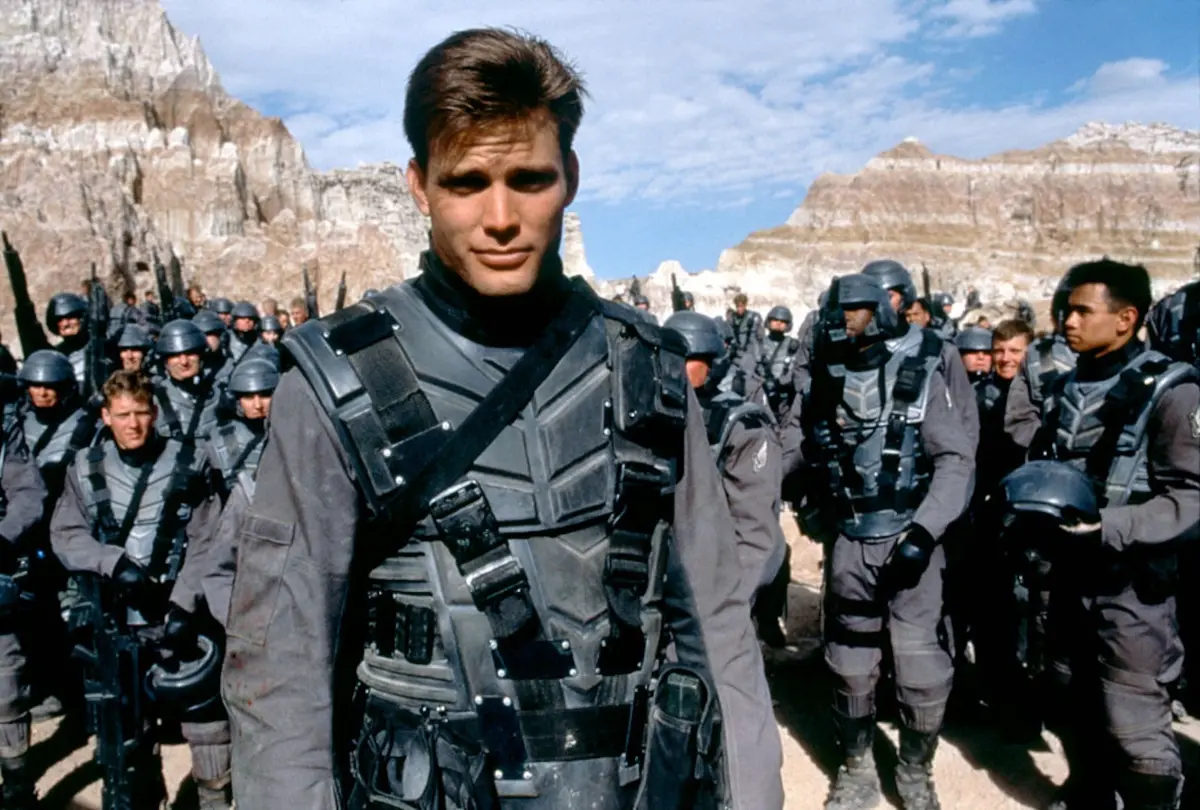
When Dutch filmmaker Paul Verhoeven released Starship Troopers in November 1997, the satirical sci-fi epic was largely misunderstood by domestic audiences and critics alike. Framed as a high-budget action flick about an interstellar war between humanity and an arachnid species, the R-rated feature tanked at the North American box office, though it developed a cult following among teenagers. Yet, beneath the surface-level explosions and bug-hunting gore lay a biting, subversive critique of fascism, heavily cribbed from the visual lexicon of Nazi Germany and the propaganda films of Leni Riefenstahl.
Decades later, the line between cinematic satire and real-world political signaling has blurred in astonishing ways. This past weekend, Donald Trump shared an artificial intelligence-generated mockup of futuristic Space Force uniforms on Truth Social. While the sleek black designs bore a striking resemblance to the SS uniforms of Adolf Hitler’s regime, the accompanying text made an explicit, self-aware nod to Verhoeven’s 1997 film.
This digital missive is far from an isolated incident. Over recent years, political discourse and official communication channels within right-wing spheres have increasingly flirted with, or outright adopted, authoritarian aesthetics, "fashwave" visual motifs, and historically charged symbols like the upside-down pink triangle. As commentators and political analysts parse these developments, a critical question emerges: Is the modern political right inadvertently echoing totalitarian iconography, or is it a calculated, deliberate embrace of fascist messaging dressed up in the armor of pop-culture camp?
Detailed Chronology: From Verhoeven’s Set to the Age of Generative AI
To understand the weight of contemporary political imagery, one must retrace the lineage of how totalitarian aesthetics crossed over into popular media and, eventually, into modern political communications.
1987–1997: Verhoeven’s Triduum of American Satire
Paul Verhoeven carved out a unique niche in Hollywood by smuggling radical, subversive critiques of American culture into high-gloss, commercial studio pictures.
- 1987 (RoboCop): Verhoeven targeted the hyper-policing of urban environments and unchecked corporate greed during the Reagan administration.
- 1995 (Showgirls): The director took aim at the entertainment industry and American cultural prudishness, a film that similarly floundered critically before undergoing radical critical re-evaluation.
- 1997 (Starship Troopers): Based loosely on Robert Heinlein’s unironically militaristic and authoritarian 1959 novel, Verhoeven sought to expose how easily a democratic society could slip into unwitting fascism. By weaponizing the visual style of Leni Riefenstahl’s Triumph of the Will—notably in the film’s propaganda newsreels and the hero-worshipping framing of its co-ed soldiers—Verhoeven believed the subtext would be unmistakable. Instead, audiences took the fascist mobilization straight, and critics missed the joke.
2018: The Director Speaks Out
Two decades after the film’s release, Verhoeven reflected on his cinematic gambit in an interview with The Guardian. He admitted that playing the propaganda entirely straight without winking at the audience was a calculated risk that backfired. He noted that the film’s most blatant visual clue—Neil Patrick Harris stepping onto the set as a military intelligence officer clad in an ankle-length black trench coat clearly styled after Hugo Boss’s historical SS designs—was meant to act as a sledgehammer to the audience’s sensibilities. "I don’t know whether or not the actors realised—we never discussed it," Verhoeven remarked. "I thought Neil Patrick Harris arriving onting the set in an SS uniform might clear it up."
2025–2026: The Shift in Political Communications
As digital communication tools evolved, the boundary between internet subculture, pop culture memes, and official political branding eroded. In 2025, the digital ecosystem surrounding right-wing political messaging saw a marked acceleration in the use of historically fraught iconography.
- The Pink Triangle Controversy: In late 2025, an op-ed regarding military recruitment and a cultural shift away from inclusivity was paired with an explicit piece of fascist agitprop: an upside-down pink triangle—historically used by the Nazi regime to identify gay men in concentration camps—encircled by a red "no" symbol.
- The "Fashwave" Aesthetic: As documented by national security and media researchers, social media output from various political and governmental branches began featuring vaporwave-adjacent, neon-soaked totalitarian aesthetics known colloquially as "fashwave." Slogans emphasizing the reclamation of "the homeland"—a term central to Nazi blood-and-soil propaganda—became recurrent fixtures.
- The September 2026 Space Force Mockup: Culminating this trajectory, Donald Trump shared an AI-generated image depicting futuristic Space Force dress uniforms clearly modeled after dark historical archetypes, explicitly linking the imagery back to Starship Troopers.
Supporting Context & Metrics: Decoding the Visuals of Power
The intersection of generative AI, social media algorithms, and historical fascism creates a potent propaganda machine. Scholars of media and authoritarianism point out that visual tropes operate on a subconscious level, bypassing critical scrutiny to evoke feelings of strength, order, and national supremacy.
| Era / Medium | Primary Visual Reference | Core Subtext / Intended Message | Real-World Reception |
|---|---|---|---|
| 1930s Nazi Germany | Leni Riefenstahl (Triumph of the Will); Hugo Boss Uniforms | Supremacy, obedience, hyper-nationalism, racial purity | Totalitarian political mobilization |
| 1997 Starship Troopers | Riefenstahl framing; SS-inspired intelligence coats | Satirical critique of American militarism and latent fascism | Misunderstood by 90s audiences as unironic action cinema |
| 2025–2026 Digital Era | AI-generated "Space Force" attire; "Fashwave" motifs | Projecting technological dominance, historical dog-whistling, cultural reclamation | Polarizing online reception; debated as intentional vs. ignorant |
The use of AI-generated assets compounds the ambiguity, allowing political actors to test boundary-pushing imagery under the plausible deniability of algorithmic generation or "meme culture." If criticized, the framing can be dismissed as harmless sci-fi fandom or digital camp. However, media critics argue that the cumulative weight of these visual choices—from the Department of Homeland Security’s rhetoric to Space Force conceptual art—paints a consistent picture.
Official Statements and Analytical Reactions
The convergence of military branding and authoritarian aesthetics has sparked intense debate among political scientists, national security journalists, and cultural critics.
- Media Analysts on Plausible Deniability: Commentators note that modern political movements frequently utilize a strategy of "strategic ambiguity." By deploying imagery rooted in totalitarian history, proponents can appeal to radicalized fringe bases who recognize and celebrate the historical callbacks, while simultaneously maintaining mainstream deniability by claiming the references are merely pop-culture homages to franchises like Starship Troopers.
- Defenders and Supporters: Proponents of the administration’s messaging routinely reject accusations of fascism, framing such criticisms as partisan hyperbole. From this perspective, the utilization of sci-fi concepts, AI-generated art, and strong nationalist themes are viewed as expressions of patriotic enthusiasm, futuristic ambition, and a rejection of sterile, conventional political correctness.
- The Cultural Critique: Cultural historians emphasize that unlike the audiences of 1997, contemporary observers possess a vastly more sophisticated literacy regarding media manipulation, internet subcultures, and digital propaganda. Consequently, when modern political figures lean into the exact visual vocabulary that Paul Verhoeven satirized, the public is far better equipped to recognize the underlying ideology—whether the creators intend it as a joke or not.
Future Outlook: The Normalization of Authoritarian Chic
As generative artificial intelligence continues to democratize the creation of hyper-realistic, highly stylized imagery, the political landscape faces a new frontier of aesthetic battles. The ease with which historical dog-whistles, science-fiction dystopias, and nationalist propaganda can be synthesized and distributed via social media platforms suggests that these visual collisions will only accelerate.
The transition of Starship Troopers aesthetics from a misunderstood Hollywood warning into an unironic digital mood board for modern political messaging highlights a grim irony. Paul Verhoeven designed his cinematic universe to mock the ease with which citizens could embrace totalitarianism wrapped in glossy, patriotic packaging. Nearly thirty years later, the real-world application of those very designs—whether driven by calculated intent or historical amnesia—suggests that the director’s dark punchline has finally caught up with reality.
Moving forward, the critical challenge for media consumers, journalists, and democratic institutions will be piercing through the fog of camp and plausible deniability. When political leaders adopt the visual language of the Third Reich—even under the guise of cinematic sci-fi—treating it merely as internet fodder or harmless irony risks normalizing the very authoritarian impulses that generations of filmmakers and historians have sought to warn against.