

Published: November 3, 2026, 9:48 PM EST
Dateline: ATLANTA, Ga.
Author: Political Desk Staff
Executive Overview
In a seismic political realignment that reverberated across the United States, Democrat Keisha Lance Bottoms captured the Georgia governorship on Tuesday, defeating Republican billionaire businessman Rick Jackson. With this landmark victory, Bottoms shatters a formidable glass ceiling, etching her name into the history books as the first Black woman ever elected governor in American history.
Beyond its historic social milestones, the election marks a monumental turning point for the American South. Bottoms’ triumph officially shatters more than two decades of unbroken Republican control over Georgia’s highest executive office—a streak that began when Sonny Perdue assumed the governorship in January 2003 following Roy Barnes’ 1998 victory and subsequent 2002 defeat.
The high-stakes race served as a definitive test of political momentum in one of the nation’s premier and most fiercely contested battleground states. It pitted Bottoms—a seasoned public servant, former Mayor of Atlanta, and former senior adviser to President Joe Biden—against Jackson, a political newcomer and healthcare executive who funneled an astonishing $200 million of his personal fortune into an unprecedented self-funded campaign.
Despite Jackson’s colossal financial advantage, which flooded Georgia airwaves and digital platforms with non-stop political advertising, Bottoms’ grassroots coalition, deep administrative experience, and a broader demographic shift propelled her across the finish line. Compounding Republican losses on Tuesday, incumbent Democratic Senator Jon Ossoff handily won his reelection bid, further cementing Georgia’s status as a dynamic, competitive purple state where neither party holds an immutable monopoly.
Detailed Chronology: The Battle for the Peach State
The pathway to November 3, 2026, was forged over years of intense political mobilization, shifting population dynamics, and a high-intensity campaign season triggered by the departure of term-limited Republican Governor Brian Kemp. For eight years, Kemp steered the state’s executive branch, maintaining a conservative stronghold that national Republicans viewed as essential to their Southern strategy. When Kemp’s final term drew to a close, it opened the floodgates for what would become one of the most expensive and bitterly fought gubernatorial contests in modern American history.
The Primaries and the Rise of Two Visions
Earlier in the election cycle, both parties coalesced around distinct visions for Georgia’s future. Keisha Lance Bottoms entered the Democratic primary carrying a reputation forged during her tenure leading the capital city through civil unrest, a global pandemic, and fierce national debates over civil rights. Her executive pedigree and close ties to the national Democratic apparatus made her an immediate frontrunner.
On the Republican side, Rick Jackson leveraged his immense wealth as a healthcare executive to bypass traditional political pathways. Pledging to run as a business-minded outsider, Jackson framed his lack of prior political experience as an asset, promising to bring corporate efficiency to state agencies and slash bureaucratic red tape.
The General Election Sprint
As the summer of 2026 transitioned into the grueling fall campaign season, the race transformed into a study in contrasts. Bottoms campaigned aggressively on a platform centered on economic relief for working families, pledging to expand healthcare access under the Affordable Care Act, increase state funding for public education, and address skyrocketing housing and cost-of-living pressures facing urban and rural Georgians alike.
Conversely, Jackson’s strategy leaned heavily on his personal financial firepower. Pouring more than $200 million into the race, his campaign saturated television screens, billboards, and digital feeds with messaging focused on cutting state income taxes, curbing government spending, and championing private-sector solutions.
The inflection point of the campaign arrived in late October. During high-profile debates and rallies—such as Bottoms’ energized October 28 rally in Morrow, Georgia—voters were presented with a stark choice: maintain the conservative economic trajectory charted by Kemp and supercharged by Jackson’s corporate ethos, or pivot toward a progressive-leaning, equity-focused administration helmed by a proven crisis manager.
On Tuesday night, as returns trickled in from urban centers like Atlanta and Savannah, alongside rapidly shifting suburban counties, election analysts confirmed that Bottoms had successfully built a winning cross-racial and urban-suburban coalition. By late evening, major networks projected her as the victor, setting off celebrations across the state and drawing national acclaim.
Supporting Context & Metrics: Breaking Down the Numbers
To fully grasp the magnitude of Keisha Lance Bottoms’ victory, one must examine the unprecedented financial, demographic, and historical metrics that defined the 2026 cycle.
The $200 Million Self-Funded War Chest
Rick Jackson’s decision to self-fund his campaign to the tune of over $200 million places his bid in the upper echelon of the most expensive political campaigns in U.S. history. By leveraging his personal wealth as a healthcare executive, Jackson attempted to out-organize and out-broadcast the Democratic infrastructure. However, the outcome serves as a stark reminder of the limits of financial saturation in a polarized electorate. While Jackson’s spending ensured high name recognition and omnipresent messaging, it ultimately collided with a motivated Democratic electorate energized by reproductive rights, healthcare access, and democratic preservation.
A 28-Year Drought Ended
Before Tuesday, the legacy of Georgia gubernatorial politics was defined by long stretches of single-party dominance:
- 1998: Democrat Roy Barnes wins election as governor.
- 2002: Republican Sonny Perdue defeats Barnes, capturing the office and initiating a 24-year Republican gubernatorial dynasty.
- 2010–2018: Nathan Deal maintains Republican control for two consecutive terms.
- 2018–2026: Brian Kemp secures and holds the office through two terms.
Bottoms’ victory marks the first time a Democrat has won the state’s highest office in nearly three decades, signaling a profound realignment in Georgia governance.
The Purple State Paradox
Georgia’s political identity has been in a state of rapid evolution. Long viewed as a bedrock of the Southern "Red Wall," the state demonstrated its shifting colors when it narrowly voted for Joe Biden in the 2020 presidential election. Although Donald Trump carried the state back into the Republican column in the 2024 presidential cycle, down-ballot trends have consistently shown robust Democratic competitiveness.
This duality was underscored on Tuesday night. While Bottoms secured the executive mansion, incumbent Democratic Senator Jon Ossoff easily fended off his Republican challenger to win reelection, complementing the earlier senatorial victories of Raphael Warnock in 2021 and 2022. Georgia is no longer a predictable monolith; it is a battleground where candidate quality, local issues, and demographic shifts dictate outcomes.
Official Statements & Reactions
The historic nature of the election prompted an immediate outpouring of statements from political leaders, civil rights organizations, and national figures.
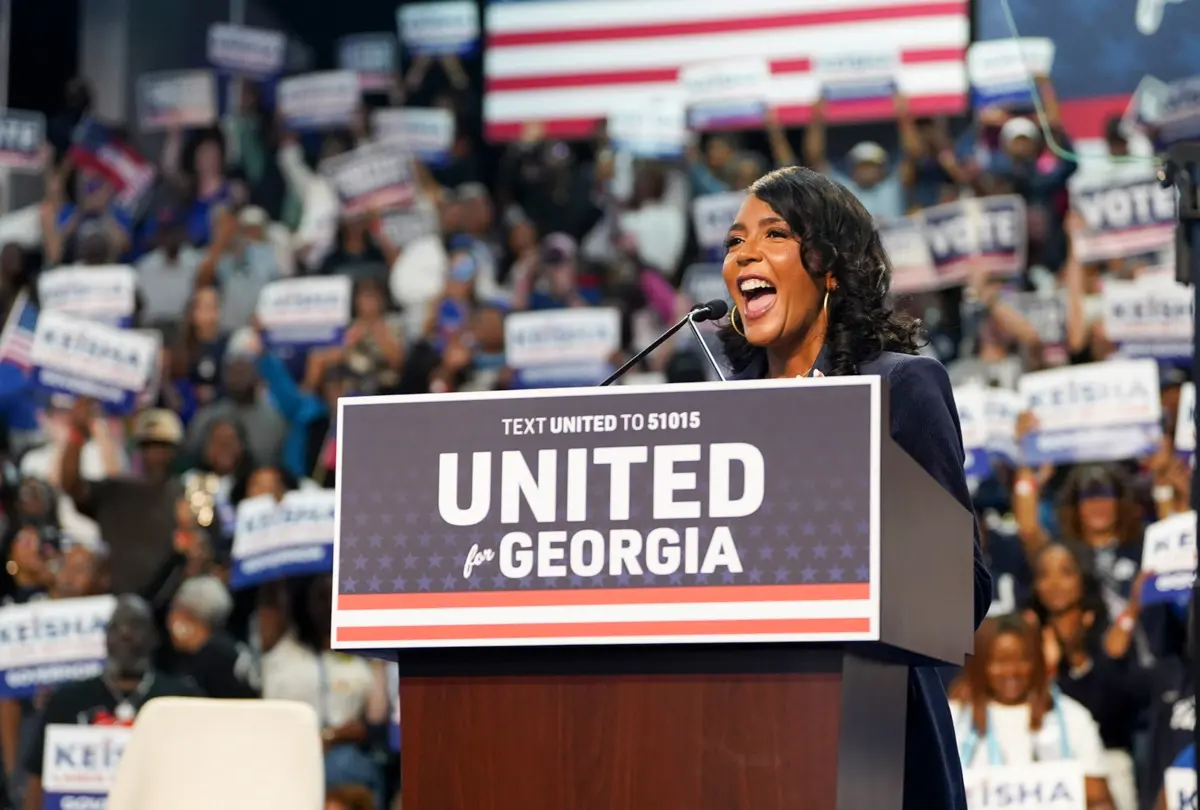
In her victory speech before a rapturous crowd in Atlanta, Governor-elect Keisha Lance Bottoms reflected on the weight of the moment:
"Tonight, the people of Georgia have chosen a path forward that leaves no one behind. We have proven that our state’s promise belongs to all of us—regardless of zip code, background, or bank account. This historic victory does not belong to me alone; it belongs to every working family, every young girl who has dared to dream past traditional boundaries, and every Georgian who believes our best days are still ahead of us."
Reflecting on the grueling nature of the contest and the historic milestones achieved, civil rights advocates and national Democratic figures praised the resilience of the campaign. President Joe Biden released a statement highlighting Bottoms’ administrative capability:
"Keisha Lance Bottoms is a leader of unmatched integrity, vision, and strength. As Atlanta’s mayor and as a trusted partner in my administration, she has always put the people first. Tonight, Georgia has made history, and the entire nation is inspired by the courage and determination of its voters."
On the opposing side, Rick Jackson addressed his supporters following the concession, defending his campaign’s focus on economic growth and fiscal conservatism:
"While the outcome is not what we hoped for, I am deeply proud of the campaign we ran—one focused on economic opportunity, lower taxes, and unleashing the potential of Georgia’s private sector. I congratulate Governor-elect Bottoms on her historic victory and wish her success as she takes the helm of our great state."
Outgoing Governor Brian Kemp issued a brief statement pledging a smooth and orderly transition of power:
"Serving the people of Georgia as governor has been the honor of a lifetime. Marty and I offer our sincere congratulations to Governor-elect Bottoms, and we are committed to ensuring a seamless transition so that the work of state government continues without interruption for all Georgians."
Future Outlook: What Bottoms’ Victory Means for Georgia and the Nation
As Keisha Lance Bottoms prepares to take the oath of office, her administration will face immediate structural, legislative, and economic challenges. Her policy agenda—focused on expanding healthcare access, reforming public education systems, and mitigating cost-of-living pressures—will have to navigate a state legislature where Republicans retain significant influence. Bridging the partisan divide in the Gold Dome will require the same deft negotiation skills that defined her tenure as Mayor of Atlanta.
National Political Implications
Nationally, Bottoms’ victory resets the strategic calculus for both major political parties heading toward the 2028 election cycle. For Democrats, Georgia remains the crown jewel of their Sun Belt strategy, proving that sustained voter mobilization, demographic shifts, and compelling gubernatorial candidates can crack traditionally conservative executive strongholds. For Republicans, the loss of the Georgia governorship—despite a historic financial investment by a self-funding billionaire—signals an urgent need to reevaluate how conservative messaging resonates with rapidly growing suburban and diverse urban populations.
A Historic Legacy
Above all, the election of Keisha Lance Bottoms stands as a watershed moment in American political evolution. By breaking the dual barriers of race and gender in the American South, she steps into office not only as the chief executive of the nation’s eighth-most populous state, but as a living symbol of progress. As she assumes the mantle of leadership, all eyes will be on Atlanta to see how the state’s first Black female governor shapes the future of the Peach State and inspires generations to come.
