

Executive Overview
For centuries, the fire salamander (Salamandra salamandra) has captivated naturalists, artists, and scientists alike. Boasting a high-contrast pattern of striking black and vibrant yellow, this iconic European amphibian has long served as a textbook example of aposematism—nature’s flashing billboard signaling toxicity to potential predators. Yet, despite being one of the most thoroughly studied and recognizable terrestrial vertebrates in Europe, the fire salamander has managed to keep a profound physiological secret.
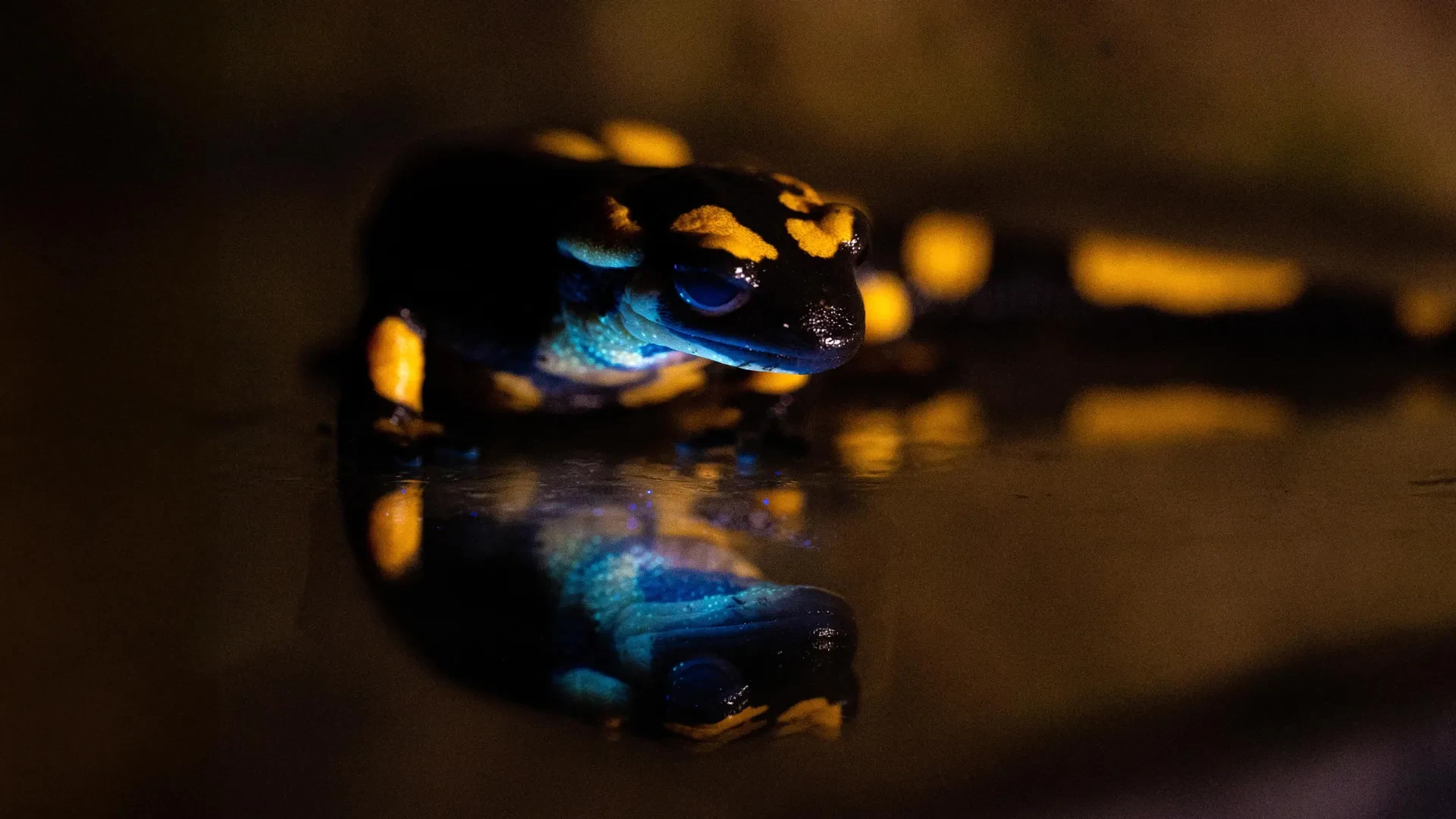
In a recent scientific breakthrough, an international team of researchers discovered that fire salamanders possess a hidden, striking capability: they biofluoresce. When exposed to ultraviolet (UV) light, these amphibians emit a vivid, glowing green and cyan luminescence, most intensely along their sides and across their yellow ventral surfaces. Even more remarkably, this luminous quality extends to their toxic skin secretions, which can remain actively fluorescent for more than 24 hours after leaving the animal’s body.
This unexpected revelation shatters long-held assumptions regarding the distribution of biofluorescence in the natural world. Historically cataloged as a phenomenon almost exclusively restricted to marine organisms—with terrestrial scorpions serving as a notable, rare exception—modern biology is rapidly rewriting this narrative. Over recent years, researchers have identified biofluorescent traits across a diverse array of land-dwelling creatures, including reptiles, birds, and now, amphibians.
Classified as "vulnerable" on the International Union for Conservation of Nature (IUCN) Red List of Threatened Species, fire salamanders are increasingly imperiled by habitat destruction, fragmentation, and anthropogenic pressures. This newly discovered biological trait not only deepens our fundamental understanding of amphibian physiology and nocturnal ecology, but it also injects fresh urgency into broader conservation frameworks. As scientists race to identify the mystery chemical compound responsible for the glow, the discovery stands as a testament to a humbling biological truth: even the most familiar organisms can conceal astonishing secrets, waiting only for the right scientific tools to bring them to light.
Detailed Chronology
The discovery of fire salamander biofluorescence is the culmination of modern investigative herpetology intersecting with advanced optical technologies. While the timeline of scientific curiosity surrounding amphibian skin chemistry spans well over a century, the specific uncovering of this glowing phenomenon represents a rapid, modern evolution in research methodology.
The Historical Backdrop of Salamander Chemistry
For generations, the scientific community has deeply scrutinized the physiological defenses of the fire salamander. More than a century ago, pioneering chemists successfully isolated and identified samandarines—a class of highly toxic steroidal alkaloids synthesized by the animal from cholesterol precursors. These potent toxins, secreted through specialized granular skin glands, provide the salamander with robust chemical protection against predators, complementing their unmistakable black-and-yellow warning coloration.
Despite decades of exhaustive chemical analysis, chromatographic testing, and pharmacological research into these exact skin secretions, the existence of a fluorescent compound went entirely unnoticed. Generations of herpetologists handled, studied, and analyzed fire salamanders under standard daylight and conventional laboratory illumination, remaining entirely oblivious to the glowing signatures hidden within the animal’s skin.
The Breakthrough Observation
The paradigm shifted when researchers from the Museum of Natural Sciences in Barcelona, the Max Planck Institute for Chemical Ecology, the Institute of Subtropical Biology, and the Catalan Society of Herpetology—operating as part of a pioneering amphibian conservation project in Catalonia supported by the Barcelona Zoo Foundation—began examining the animals under alternative light spectra.
Utilizing UV light sources, the research team observed an unmistakable, vibrant green and cyan luminescence emanating from the salamanders. The glow was not uniformly distributed across the body; rather, it was most pronounced along the lateral sides and the brilliant yellow patches of the animal’s ventral anatomy. Further investigation yielded an even more astonishing finding: when the salamanders released their defensive skin secretions as a stress response, the secreted mucus retained its bright fluorescence for upwards of 24 hours post-secretion.
Current Research and Next Steps
Following the initial identification of the phenomenon, the collaborative research team immediately pivoted toward mechanistic and chemical analyses. Currently, scientists are working to isolate and chemically characterize the exact molecule responsible for the biofluorescence. Preliminary evidence strongly suggests that the substance is a previously unrecognized molecule within the Salamandra salamandra species. By decoding the chemical structure and origin of this glowing compound, the researchers hope to unlock its true evolutionary purpose, transitioning the discovery from an intriguing optical anomaly to a fully understood biological mechanism.
Supporting Context & Metrics
To fully appreciate the significance of this discovery, it is essential to examine the biophysical mechanics of biofluorescence, the environmental context of the fire salamander’s habitat, and the conservation metrics defining the species’ current status.
Biofluorescence Versus Bioluminescence
A common point of confusion in popular science is the distinction between bioluminescence and biofluorescence. While both phenomena result in the emission of visible light from living organisms, their underlying biochemical pathways are fundamentally different:
- Bioluminescence: Organisms such as fireflies, deep-sea anglerfish, and certain fungi produce their own light internally through enzyme-mediated chemical reactions (typically involving luciferin and luciferase). They do not require an external light source to shine.
- Biofluorescence: Organisms exhibiting biofluorescence cannot generate light independently. Instead, specialized chemical compounds within their skin, tissues, or shells absorb light energy from an outside source (such as ultraviolet or blue light), which human eyes cannot perceive directly, and instantly reemit that energy at a lower energy state, producing visible wavelengths (such as green, cyan, or red).
In the case of the fire salamander, UV light is absorbed by unknown skin compounds and transformed into the vivid green and cyan hues recorded by the researchers.
The Nocturnal Lightscape and Optic Ecology
Fire salamanders are predominantly nocturnal or crepuscular creatures, spending their daylight hours hidden beneath damp leaf litter, rotting logs, or subterranean rock crevices. They emerge primarily during damp, rainy nights to forage for earthworms, slugs, and insects.
In their natural forest habitats, nocturnal illumination is driven entirely by starlight and moonlight. Photobiological analyses reveal a fascinating nuance regarding moonlight: full moonlight contains a significantly higher proportion of ultraviolet and violet wavelengths compared to harsh, direct sunlight, which features a much more evenly distributed spectrum.
Under these specific nocturnal conditions, natural UV radiation interacts with the salamanders’ skin. This interaction could potentially create subtle, glowing green and cyan highlights against their dark body markings. While human eyes require specialized UV lamps to witness this phenomenon, animals equipped with highly sensitive night vision—including potential predators, prey, or conspecifics—may be natively equipped to perceive these luminous cues in the dim forest understory.
Conservation Metrics and Red List Status
The ecological backdrop of this discovery is sobering. The fire salamander (Salamandra salamandra) faces mounting pressures across its native European range, stretching from the Iberian Peninsula through central Europe and into the Balkans.
- IUCN Red List Classification: Vulnerable.
- Primary Threats: Widespread habitat destruction, deforestation, and severe habitat fragmentation driven by agricultural expansion and urbanization.
- Additional Pressures: Climate change altering precipitation and humidity patterns, alongside emerging infectious diseases such as the deadly amphibian chytrid fungus (Batrachochytrium salamandrivorans or Bsal), which poses an existential threat to European urodeles.
The integration of advanced biological research, such as this biofluorescence discovery, provides critical momentum for ongoing conservation frameworks, including pioneering regional initiatives in Catalonia backed by the Barcelona Zoo Foundation.
Official Statements
The discovery has generated substantial excitement within the international herpetological and chemical ecology communities. Key members of the research consortium shared their perspectives on the findings:
"It is fascinating that such a well-studied species still harbors unknown phenomena like this. It reminds us that even the most familiar organisms can hide secrets that are only revealed when they are observed with new tools."
— Bernat Burriel, Researcher at the Museum of Natural Sciences in Barcelona and Study Lead Author."Fluorescence meets several criteria that suggest a communicative function. It could help salamanders detect each other in nocturnal or particularly dense environments, or act as an additional defense signal."
— Martin Kaltenpoth, Director of the Department of Insect Symbiosis at the Max Planck Institute for Chemical Ecology and Study Co-Author."The presence of this fluorescent compound was surprising because salamander skin secretions have been studied chemically for decades, and we were unaware of any published reports on fluorescence."
— Andrés Brunetti, Researcher at the Max Planck Institute for Chemical Ecology and Co-First Author."We still don’t know what the compound responsible for this fluorescence is, but everything indicates that it is a molecule unknown until now in this species. Identifying it will be key to understanding its origin and function."
— Salvador Carranza, Researcher at the Institute of Evolutionary Biology (IBE, CSIC-UPF) and Study Co-Author.
Future Outlook
The uncovering of biofluorescence in fire salamanders opens up expansive new avenues for biological research, evolutionary theory, and wildlife conservation. As the scientific community digests these findings, several key questions remain on the horizon.
Solving the Chemical Puzzle
The immediate priority for the research consortium—involving the Museum of Natural Sciences in Barcelona, the Max Planck Institute for Chemical Ecology, the Institute of Subtropical Biology, and the Catalan Society of Herpetology—is the precise biochemical isolation of the fluorescent molecule. Until the compound is fully synthesized, mapped, and categorized, its exact provenance within the salamander’s physiological framework will remain speculative. Determining whether the fluorophore is derived directly from the animal’s diet, synthesized de novo, or bound to existing samandarine alkaloids will provide vital clues to its evolution.
Behavioral and Ecological Trials
Beyond chemistry, researchers must design robust behavioral experiments to test the primary hypotheses regarding the function of the glow:
- Conspecific Communication: Testing whether fire salamanders use biofluorescent signaling for mate selection, territorial recognition, or social navigation in absolute darkness.
- Enhanced Aposematism: Investigating how nocturnal predators (such as certain owls, small carnivores, or mustelids) react to biofluorescent warning displays compared to non-fluorescent controls under simulated moonlight conditions.
Implications for Amphibian Conservation
Ultimately, this discovery underscores the vital importance of continued, multi-disciplinary funding for fundamental biodiversity research. As habitats fragment and amphibian populations decline globally due to disease and climate change, comprehensive ecological profiles are mandatory for effective conservation management. Understanding the sensory ecology of fire salamanders ensures that conservationists can better protect their micro-habitats, secure damp corridors for migration, and support regional preservation projects—such as those underway in Catalonia.
The fire salamander’s unexpected glow is more than just a biological curiosity; it is a vivid reminder of the hidden complexities of the natural world, urging humanity to look closer, utilize innovative tools, and redouble efforts to protect the fragile biodiversity that remains.