In the modern digital landscape, visibility is the ultimate currency. For brands, publishers, and e-commerce enterprises alike, organic search engine optimization (SEO) remains the most sustainable and cost-effective channel for driving qualified acquisition. Yet, the foundation of any successful organic growth campaign rests on a single, critical discipline: keyword research. Without a precise understanding of what target audiences are searching for—and the intent behind those queries—marketing budgets are wasted on content that fails to rank or convert.
Enter Semrush, one of the industry’s most robust, data-dense, and widely utilized SEO suites. Boasting a massive database comprising over 24 billion keywords, Semrush provides digital marketers with an institutional-grade toolkit designed to decode search behavior, analyze competitor architecture, and construct high-yielding topical maps.
This comprehensive guide serves as an authoritative masterclass in leveraging Semrush’s core keyword research modules—specifically the Keyword Manager, the Keyword Magic Tool, and the Keyword Gap tool. Whether you are seeking quick organic wins from your existing content footprint, conducting aggressive competitor subfolder analysis, or building sophisticated topical clusters from scratch, this manual outlines the precise frameworks, filters, and strategic execution steps required to elevate your enterprise SEO strategy.
Detailed Chronology & Framework for Keyword Research Execution
Executing a successful keyword research campaign requires a structured, multi-phased approach. Rather than blindly chasing high-volume terms, modern SEO demands a methodical sequence that prioritizes immediate revenue opportunities, evaluates competitor dominance, expands topical authority, and organizes terms into actionable content clusters.
Phase 1: Capitalizing on Existing Keyword Footprints (Quick Wins)
For websites that already possess an established content history, the absolute best starting point is not brainstorming new topics, but rather optimizing the ground you have already covered. Google frequently rewards established pages by pushing them to the cusp of page one—specifically ranking them between positions 4 and 15. These represent low-hanging fruit: keywords with proven search demand where minor optimizations can yield rapid organic traffic surges.
To extract these opportunities using Semrush:
Navigate to the Semrush SEO Toolkit and open the Organic Research >> Positions report. This will generate an expansive list of every keyword your domain currently ranks for within Google’s top 100 positions.
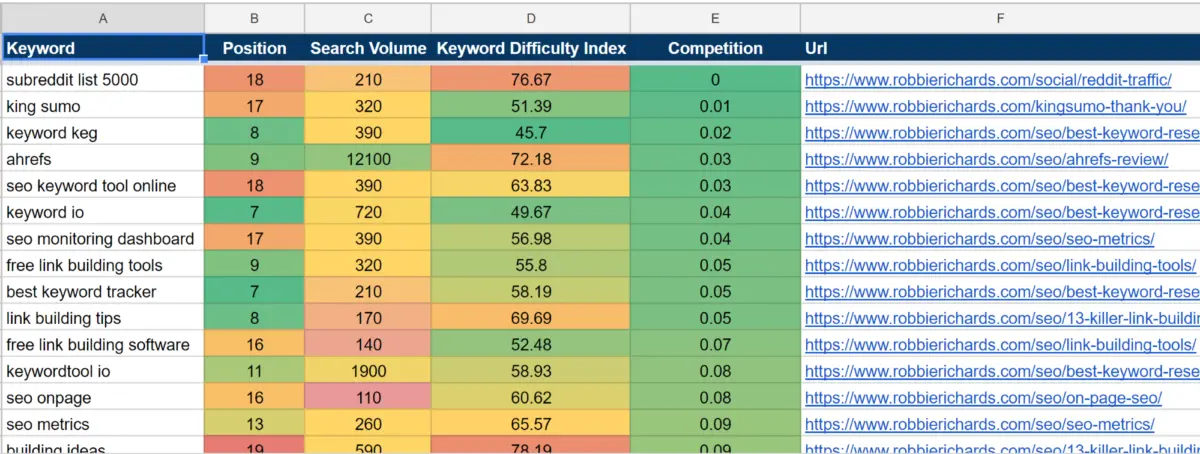
Apply advanced filtering to isolate your ideal targets. While exact parameters will vary depending on your business model, effective filters typically include a Position range of 4 to 15, a minimum Search Volume threshold aligned with your market, and a controlled Keyword Difficulty (KD) percentage.
Review the filtered results and export them into a dedicated list inside Semrush (segmented clearly into "Existing" and "New" lists) or push them into an automated Google Sheets template for out-of-platform evaluation. By organizing these terms by descending search volume and low SERP competition, you can rapidly identify which pages require immediate title tag optimization, content expansion, or internal linking reinforcement.
If you want to outpace your rivals, you must first study their playbook. Competitor keyword research allows you to shortcut the brainstorming phase and borrow high-intent keyword targets from industry leaders who have already invested heavily in trial and error.
The Top Pages Report Strategy
To execute this, identify a primary competitor in your niche—for instance, an e-commerce brand like Beardbrand or a legal firm like Dolman Law Group. Enter their domain into the SEO Toolkit and access the Organic Research >> Pages report.
This view highlights the exact subfolders and URLs driving the highest percentage of organic traffic. To narrow your focus:
For E-commerce: Apply a URL filter containing /products/ to isolate direct revenue-generating product pages.
For Legal and Professional Services: Filter by service-specific subfolders (such as /legal-services/) to uncover the exact high-value service terms driving qualified client acquisition.
Keyword Modifiers for Niche Targeting
If your competitors do not utilize clean subfolder architectures, you can substitute URL filters with keyword modifiers. For affiliate and content-driven sites, applying filters that contain commercial intent modifiers—such as "best," "vs," "review," or "software"—will immediately surface bottom-of-the-funnel keywords capable of driving high-converting referral traffic and commissions.
Phase 3: Advanced Gap Analysis & Missing Keyword Extraction
One of Semrush’s most powerful differentiators is its Keyword Gap tool, which allows you to cross-reference your domain against multiple competitors simultaneously.
Missing Keywords: Identifies high-value terms that your competitors rank for, but your site does not touch.
Weak Keywords: Highlights queries where your domain currently ranks lower than your competitors, signalling pages that require strategic content updates.
By deploying strict filters (such as maximum KD ceilings and minimum search volume thresholds) alongside subfolder-specific gap analyses, digital marketers can uncover hundreds of localized or niche-specific service keywords that competitors are successfully monetizing. Furthermore, Semrush’s unique PPC-Organic Gap analysis allows brands to identify keywords where they rank poorly in organic search, enabling them to "provide paid aircover" by bidding on those exact terms via paid search (PPC) until their organic rankings secure top-three positions.
Phase 4: Topical Expansion via the Keyword Magic Tool
Once existing opportunities and competitor gaps have been cataloged, you must expand your semantic footprint using the Keyword Magic Tool. By entering broad seed terms into Semrush’s 24-billion+ keyword database, you can generate thousands of topical variations.
Rather than manually sorting through overwhelming data sets, leverage Semrush’s built-in Intent filters (Informational, Navigational, Commercial, and Transactional) and Grouping features. For instance, filtering for consideration-stage modifiers or competitor comparison terms (e.g., “Competitor A vs Competitor B”) allows you to capture mid-funnel users who are actively evaluating solutions and ready to convert. Similarly, filtering for Question-based keywords (“how to,” “what is,” “why do”) unlocks low-competition informational queries that build top-of-funnel brand awareness.
Phase 5: Constructing Topical Clusters in Keyword Manager
Publishing isolated, disjointed articles is an outdated SEO strategy. Modern search engines reward topical authority—the comprehensive coverage of a subject across an interconnected network of pages.
Using the Semrush Keyword Manager, marketers can either create topical clusters from scratch using seed keywords or upload an existing raw list of hundreds of keywords. Semrush’s automated clustering algorithm groups related search terms together based on SERP overlap.
When reviewing these clusters:
Pay close attention to Semrush’s “High Ranking Potential” flags, which denote terms with solid search volume and manageable keyword difficulty.
Thoroughly examine the Content References section within each cluster. This tells you whether your competitors are ranking for those terms using a single broad page or if they have deployed dedicated, highly targeted sub-service landing pages. If the latter is true, your strategy must involve building out dedicated, optimized URLs for those specific clusters to capture peak search intent.
Supporting Context & Metrics: The Power of Ecosystem Integration
In evaluating enterprise-grade SEO software, fragmentation has historically been a major pain point for digital marketing teams. Relying on one tool for keyword discovery, another for rank tracking, and a third for on-page content optimization introduces friction, inefficiencies, and data silos.
A core advantage of the Semrush architecture is its deep, frictionless tool integration. As demonstrated throughout advanced workflows, once a strategist builds, filters, and refines a target keyword list within the Keyword Manager or Keyword Magic Tool, those keywords do not remain trapped in a static spreadsheet. With a single click, users can:
Transfer keywords directly to the Position Tracking Tool, initiating automated daily or weekly rank monitoring without manual data re-entry.
Send targeted keyword lists straight to the SEO Writing Assistant (SWA), empowering content writers with real-time semantic recommendations, readability scores, and target word counts during the actual content production phase.
This seamless pipeline transforms keyword research from a preliminary, one-off research task into an ongoing, scalable content operations workflow. By keeping research, tracking, and content creation unified within a single ecosystem, marketing teams significantly reduce overhead and accelerate their time-to-market for new search assets.
Official Statements & Industry Perspective
Industry experts and veteran SEO practitioners continuously emphasize the necessity of moving beyond rudimentary search volume metrics. Robbie Richards, a prominent digital marketing strategist and educator who frequently documents advanced Semrush workflows, notes the paramount importance of strategic filtering:
"When working with a website that has an existing content footprint, the absolute best place to start is your existing keyword data. By extracting keywords where you are already ranking on pages one or two (positions 4-15), you bypass the painful sandbox phase and unlock rapid, high-impact organic traffic gains with minimal resource expenditure."
Furthermore, industry consensus highlights that modern keyword research is no longer just about matching exact-match strings; it is about mapping user intent and establishing semantic dominance. Semrush’s integration of machine-learning-driven intent classification and automated SERP-based clustering represents a paradigm shift from manual data manipulation to automated, data-backed strategic execution.
Future Outlook: The Evolution of Keyword Research in an AI-Driven Search Era
As the digital marketing ecosystem undergoes rapid transformation driven by generative artificial intelligence (AI), Search Generative Experiences (SGE), and evolving natural language processing models, the role of keyword research is evolving—not diminishing.
While AI tools can rapidly draft content, they cannot inherently divine market demand, buyer intent, or competitive blind spots without underlying data. Platforms like Semrush will continue to serve as the empirical bedrock of digital strategy. Future iterations of keyword research will increasingly rely on:
Cross-Channel Intent Mapping: Blending organic search, paid search, and social listening data to predict emerging consumer trends before search volumes spike.
Granular Semantic Clustering: Moving beyond broad category keywords to hyper-targeted, entity-based topical authority maps that satisfy complex, multi-layered user queries.
Automated Workflow Optimization: Deepening the automated handshakes between keyword discovery tools, AI-assisted content generation assistants, and automated performance tracking.
Conclusion
Mastering Semrush for keyword research is an indispensable skill for any digital marketer, agency owner, or enterprise SEO professional seeking to dominate organic search. By systematically executing the workflows outlined in this guide—mining existing quick wins, dissecting competitor subfolders, closing keyword gaps, generating targeted topical ideas, and building tightly structured keyword clusters—organizations can transform raw data into a predictable, high-yielding revenue engine.
For those ready to implement these methodologies firsthand, utilizing a comprehensive trial framework allows practitioners to stress-test these advanced filters and integrations directly within their own business environments, setting the stage for sustainable, long-term organic growth.