

Executive Overview
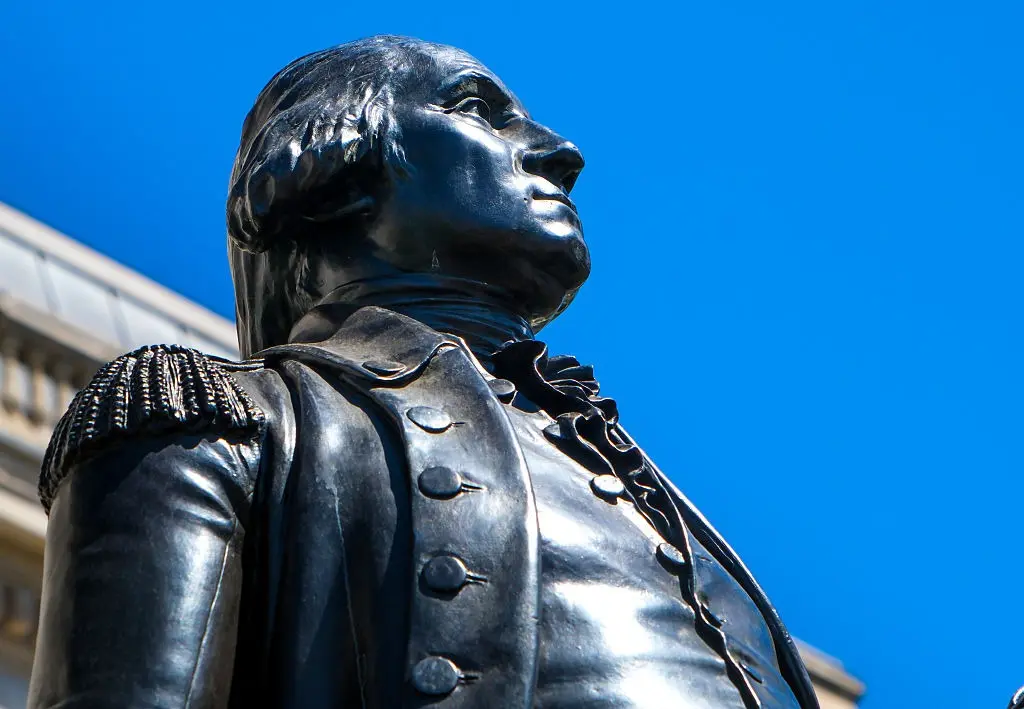
In a late-night social media declaration that has once again ignited fierce national debates over historical representation, President Donald Trump has proposed a sweeping overhaul of the Smithsonian Institution’s National Museum of American History. At the center of the administration’s latest cultural initiative is a demand to erect a towering, 30-foot monument—dubbed the "Washington Colossus"—directly outside the museum’s primary entrance.
If realized, the massive likeness of the nation’s first president would replace "Infinity," an abstract stainless-steel sculpture by artist José de Rivera that has occupied the prominent plaza space since 1967. Dismissing the modernist installation as something that "tells visitors nothing about America," Trump’s proposal extends far beyond a single architectural swap. The administration is pushing for a rapid acceleration of patriotic exhibitions, the introduction of a secondary 11-foot Washington statue inside the building’s Flag Hall by Constitution Day, and a wholesale restructuring of the museum’s educational programming leading up to the nation’s 250th anniversary and the Tricentennial of Washington’s birth in 2032.
This bold intervention arrives amid a volatile climate of mounting tensions between the executive branch and America’s premier museum and research complex. It follows closely on the heels of Smithsonian Secretary Lonnie Bunch’s announcement that he will retire at the end of the year, a departure preceded by months of high-stakes ideological clashes over how museums curate narratives concerning slavery, race, and the nation’s foundational figures.
While the White House frames the initiative as a long-overdue return to honoring traditional American heroes, art historians, cultural preservationists, and legal scholars are raising urgent questions about executive overreach, the politicization of independent cultural institutions, and the enduring battle over who gets to define the American story.
Detailed Chronology
The latest escalation in the ongoing struggle over the nation’s cultural narrative unfolded rapidly through a series of late-night announcements and a backdrop of mounting institutional friction.
- March 2025: Signaling an aggressive approach to federal cultural properties, President Trump signs an executive order targeting what the administration defines as "improper ideology" within the Smithsonian Institution. The directive tasks administration officials with auditing historical exhibitions and placing heightened scrutiny on institutional governance.
- Summer 2025: White House officials and conservative lawmakers publicly criticize various Smithsonian exhibits—particularly those featured across the National Museum of American History and the National Museum of African American History and Culture—for placing excessive emphasis on historical injustices, including the institution of slavery.
- August 22, 2025: Amid escalating public pressure, Smithsonian leadership steps up its defense of institutional autonomy. Secretary Lonnie Bunch and the Board of Regents reaffirm their commitment to curatorial independence, pushing back against political mandates that seek to alter historical frameworks.
- Early September 2026: Secretary Lonnie Bunch shocks the cultural heritage community by announcing his retirement, effective at the end of the year. While Bunch maintains that the departure is unrelated to the relentless political pressure from the executive branch, his exit is widely interpreted by observers as a watershed moment in the administrative battle over the Smithsonian’s future.
- September 11–12, 2026: Taking to Truth Social late Friday evening, President Trump issues a flurry of posts detailing a comprehensive restructuring plan for the National Museum of American History. The proposal calls for the immediate removal of José de Rivera’s abstract sculpture "Infinity" and its replacement with a 30-foot George Washington monument. Additionally, the president demands an 11-foot likeness of Washington inside Flag Hall by September 17 (Constitution Day) and mandates a five-year exhibition cycle culminating in Washington’s 2032 tricentennial.
- Mid-September 2026 and Beyond: Cultural organizations, preservation societies, and legal analysts grapple with the feasibility of the presidential directives, setting the stage for a high-stakes constitutional and administrative showdown regarding the boundaries of executive authority over independent federal trusts.
Supporting Context & Metrics
To fully understand the magnitude of President Trump’s proposal, one must examine both the physical scale of the planned monuments and the institutional governance structures that protect the Smithsonian’s independence.
Architectural Scale and Spatial Context
The proposed "Washington Colossus" would drastically alter the visual landscape of the National Mall. At 30 feet tall, the monument would dwarf several iconic representations of American leaders already embedded in the nation’s capital:
- The Lincoln Memorial: The seated statue of Abraham Lincoln inside the monument measures 19 feet in height. Trump’s proposed Washington would tower 11 feet above it.
- The Martin Luther King Jr. Memorial: The statue honoring Dr. Martin Luther King Jr., located near the Tidal Basin, stands approximately 28 feet tall. The proposed Washington would surpass it by two feet.
- The Existing Plaza: "Infinity," the 1967 abstract sculpture by José de Rivera that currently occupies the site, is celebrated by modernists for its kinetic, looping stainless-steel design. Its removal would mark a decisive architectural pivot from mid-century abstract expressionism toward monumental classical heroism.
Governance and Institutional Independence
Legally and structurally, the Smithsonian Institution occupies a unique space within the American federal landscape. Established in 1846 through an act of Congress using a bequest from British scientist James Smithson, the institution is neither a traditional executive agency nor a private foundation.
- The Board of Regents: The Smithsonian is governed by a 17-member Board of Regents comprising the Chief Justice of the United States, the Vice President of the United States, three members of the U.S. Senate, three members of the House of Representatives, and nine citizen members appointed by joint resolution of Congress.
- Executive Authority Limitations: Unlike cabinet-level departments, the executive branch possesses no direct statutory authority to unilaterally order structural modifications, dictate curatorial content, or remove installations from Smithsonian grounds. Any major physical alteration typically requires rigorous review processes, municipal approvals (such as from the National Capital Planning Commission and the Commission of Fine Arts), and authorization from the Board of Regents.
Official Statements & Institutional Reactions
The president’s directives have elicited sharp polarization across the political and cultural spectrum, drawing stark lines between advocates of traditional patriotic education and defenders of institutional pluralism.
In his social media announcements, President Trump left little room for ambiguity regarding his motivations, framing the intervention as an urgent rescue mission for national pride:
"That strange modernist sculpture tells visitors nothing about America, inspires no one, and honors none of our Great American Heroes," Trump wrote. "George Washington does. Replace a sculpture that says nothing about America with the man who, more than anyone else, says everything about America."
Furthermore, the administration has proposed dismantling the museum’s recently concluded Center for Restorative History—which sought to illuminate stories of marginalized and historically underrepresented communities—and replacing it with a newly minted "Center for American Heroes."
In stark contrast, representatives from arts organizations, historical preservation groups, and museum associations have expressed deep alarm. Speaking anonymously to avoid immediate political retaliation, several curators and Smithsonian insiders pointed out the chilling effect such directives have on academic freedom.
"Museums exist to preserve the multifaceted, complex truth of human history—not to serve as a canvas for transient political mandates," noted a prominent Washington-based cultural historian. "When monument-building becomes a tool of executive enforcement, we risk trading historical literacy for state-sanctioned myth-making."
While outgoing Secretary Lonnie Bunch has publicly downplayed direct links between his departure and the administration’s aggressive policy stances, his legacy remains anchored in his steadfast defense of inclusive historiography. Throughout his tenure, Bunch consistently argued that acknowledging the nation’s historic failures—including the realities of slavery and systemic inequality—does not diminish American greatness, but rather highlights the continuous, hard-fought journey toward fulfilling the nation’s founding ideals.
Future Outlook
As the Smithsonian Institution navigates the impending departure of Secretary Lonnie Bunch and confronts the White House’s aggressive restructuring demands, the coming months will serve as a critical test for the independence of America’s cultural institutions.
- The Board of Regents’ Response: All eyes will be on the 17-member Board of Regents as they prepare to vet the administration’s demands. Whether the board chooses to stand firm on procedural protocols and curatorial independence—or yields to mounting political pressure—will set a powerful precedent for the future administration of federal educational trusts.
- Legal and Bureaucratic Hurdles: Navigating federal review boards like the Commission of Fine Arts will present significant operational roadblocks for the proposed 30-foot monument. Legal scholars anticipate potential challenges regarding the limits of executive power over independent trusts established by acts of Congress.
- The Battle for the Narrative: Beyond the physical placement of bronze and stone, the underlying battle remains philosophical. As the nation approaches its 250th anniversary, the cultural friction between two competing visions of American history—one prioritizing classical foundational heroism, the other embracing an inclusive, comprehensive examination of the past—will continue to define the ideological battlegrounds of contemporary American politics.