Over the past few weeks, tech blogs, legal roundtables, and product design Slack channels have been abuzz with panic over "drastic measures," "massive financial penalties," and "sweeping new AI regulations" rolling out across the European Union. Headlines have painted a picture of an imminent regulatory apocalypse for anyone building or deploying artificial intelligence.
However, a closer examination reveals a far more nuanced, practical, and targeted reality. Far from an outright ban or a bureaucratic chokehold, the EU’s newly enforced AI transparency mandates—which took full effect on August 2, 2026—focus on a singular, foundational objective: making artificial intelligence unmistakably transparent precisely when clarity matters most.
Under Article 50 of the EU AI Act and its accompanying Codes of Practice, any company serving EU citizens must clearly label artificially generated or manipulated content. Much like the European Accessibility Act (EAA) or the General Data Protection Regulation (GDPR), these rules are extraterritorial. They apply not only to businesses headquartered within the EU but to any organization worldwide that deploys AI outputs destined for European audiences.
For product designers, UX engineers, and compliance officers, the transition requires moving past generalized sparkle icons and hidden footer notes. This article breaks down what the regulations actually demand, where the fine lines between human edits and machine generation lie, why UI symbols must evolve, and how global compliance is rapidly becoming the industry standard.
Detailed Chronology: The Road to the August 2026 Mandates
Understanding the current landscape requires looking back at how regulatory frameworks have matured. The journey toward mandatory AI labelling has been methodical, driven by rising concerns over deepfakes, misinformation, and consumer deception.
April 2021: The European Commission first tables the landmark Artificial Intelligence Act, proposing a risk-based framework for regulating AI systems.
December 2023: After intense negotiations, EU lawmakers reach a provisional political agreement on the AI Act, establishing preliminary guardrails for general-purpose AI and systemic risk models.
March 2024: The European Parliament formally adopts the AI Act, setting the wheels in motion for phased implementation timelines spanning across 2024, 2025, and 2026.
Late 2024 – 2025: Industry stakeholders, UX researchers, and legal experts debate the practicalities of transparency requirements, particularly regarding how user interfaces should communicate machine-generated content without overwhelming users.
July 2026: The European Commission validates the final Code of Practice on AI-generated content, publishing official guidelines and standardized icon sets under Article 50.
August 2, 2026: Transparency and labelling obligations under the EU AI Act officially take effect. Organizations found non-compliant now face rigorous enforcement actions and substantial fines.
What Actually Needs Labelling?
The core intention of the EU’s AI labelling mandate is straightforward: help users instantly recognize—in a clear, distinguishable manner—when content has been artificially generated or altered.
According to Article 50(4) of the AI Act, specific categories of AI interactions and outputs require explicit disclosure. Both providers (the entities that build or supply the underlying AI models) and deployers (the businesses and organizations integrating those models into customer-facing products) share legal responsibility. Mirroring GDPR structures, a company cannot evade compliance simply by licensing an off-the-shelf third-party AI tool.
Yet, a common misconception is that every piece of AI-assisted work must feature a prominent warning label. That is far from the truth. The vast majority of everyday AI-assisted workflows—such as using an LLM to brainstorm corporate strategy outlines, clean up code snippets, or draft internal memos—fall entirely outside the scope of these transparency rules.
The Scope of Public Interest
Where rules tighten is within contexts affecting the "public interest." This broadly encompasses health, safety, environmental protection, economic and financial stability, politics, science, and culture. If an AI-generated product claim, commercial asset, or informational piece intersects with these domains, mandatory disclosure rules kick in.
Legal experts advising advertising and public relations teams recommend an abundance of caution: any realistic AI-generated illustrations, photos, or video elements used in marketing and commercial campaigns must display clear disclosures if they resemble real people, places, objects, or events.
The Fine Line Between "Edited" and "AI-Generated"
One of the most pressing questions for product teams is determining the precise threshold where human editing nullifies the requirement for an AI label. If a form is pre-filled using AI, but a user subsequently modifies the text, is the final output still considered AI-generated?
The European Commission’s guidance on this matter is granular:
Exemptions (Assistance vs. Generation): Minor, assistive edits—such as automated spellcheck, grammar correction, formatting adjustments, cropping, basic color balancing, and AI-powered translations—do not trigger AI generation status.
Triggers (Substantive Generation): Conversely, AI-generated summaries, composite imagery, structural rewrites, or the automated addition/removal of objects within a photograph are legally classified as AI generation. Fine-tuning a sentence written by a human is permissible; publishing a sentence generated entirely by a machine requires explicit disclosure.
Crucially, the defense of "a human skimmed it before publishing" does not satisfy editorial review requirements. The Commission insists that human oversight must be substantive, with a named person or entity explicitly taking formal editorial responsibility.
Why AI Sparkles Are No Longer Enough
For years, the tech industry has relied on the ubiquitous sparkle icon ($mathcal✨$) as a universal shorthand for AI features. However, under the newly established EU guidelines and the official Code of Practice, sparkles are likely insufficient.
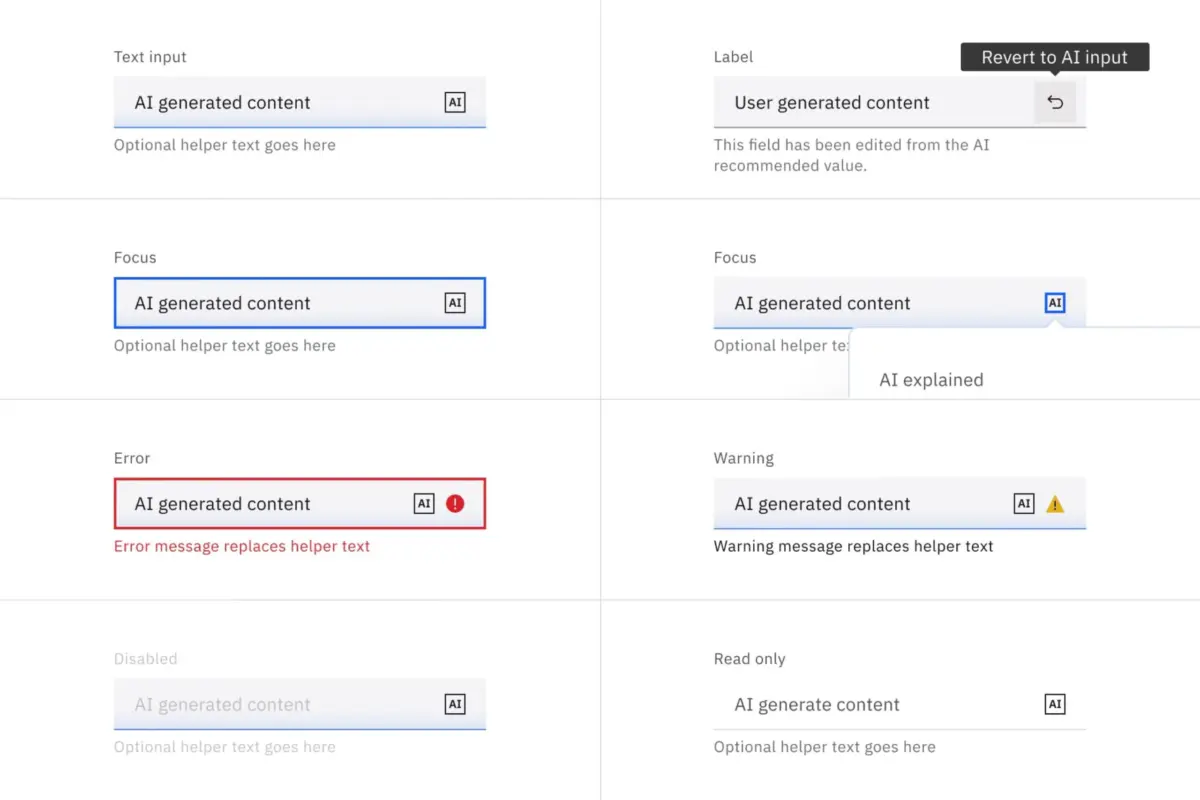
The European Commission has published an official set of EU AI icons designed to offer a standardized, unmistakable "AI" mark. The primary issue with the traditional sparkle symbol is its ambiguity: it is frequently used to designate AI-powered functionality (e.g., "enhance your photo with AI") rather than explicitly stating this specific content was generated by a machine.
[ Traditional Approach ]               [ EU Compliant Approach ]
       ✨ Sparkles                             [AI] Label + Plain Text
(Ambiguous: Feature or Output?)        (Explicit: Unambiguous Output Notice)
Furthermore, the Commission explicitly stresses that simply dropping an icon onto a page does not guarantee legal compliance. A barely discernible icon, a hidden disclaimer buried in a terms-of-service footer, or a label that flashes for a brief second before disappearing will fail regulatory scrutiny.
Best Practices for Compliant UI Labels
To meet the "clear and distinguishable" threshold, product designers should adopt the following patterns:
Pair Icons with Plain Text: Combine official AI icon marks with unambiguous plain-text labels, such as "AI-Generated" or "AI-Assisted Content."
Ensure Accessibility: Labels must be fully accessible to screen readers and assistive technologies.
Persistency: When AI-generated media is downloaded, exported, or reshared across platforms, the metadata or visual label must persist where technically feasible.
Supporting Context & Metrics: A Global Regulatory Wave
While the EU AI Act has dominated headlines, it is far from an isolated legislative event. Rather, it represents the crest of a global wave of regulatory harmonization focusing on synthetic media transparency:
United States: State-level laws are rapidly expanding, focusing heavily on synthetic human performers (digital replicas), political advertising disclosures, and automated decision-making in employment and finance.
China: The Cyberspace Administration of China enforces strict provisions requiring deep synthesis service providers to clearly label generated text, images, and audio to prevent public confusion.
South Korea & Japan: Regulatory bodies are actively establishing guidelines for AI watermarking and content provenance to protect copyright and counter disinformation campaigns.
This shared global trajectory signals a clear pattern: building unlabelled, opaque AI features into consumer products is no longer a viable long-term strategy. Product teams must treat transparency not as a localized EU compliance checkbox, but as a foundational pillar of modern UX design.
Official Statements and Industry Insights
Regulatory bodies and design authorities have weighed heavily on the transition. In its official release accompanying the August 2026 enforcement date, the European Commission emphasized:
"Transparency obligations are designed to foster trust and protect citizens from deception. When artificial intelligence mimics human creativity or alters reality, people have a fundamental right to know. Clarity is not an obstacle to innovation; it is the bedrock of ethical technology."
Meanwhile, UX research institutions, such as the Nielsen Norman Group (NNGroup), have consistently highlighted the dangers of vague interface signaling. Their research demonstrates that users frequently misinterpret minimalist AI indicators, leading to misplaced trust in unverified machine outputs. By moving toward explicit labeling standards, both regulators and designers aim to eliminate "AI slop" and establish a healthier digital ecosystem.
Future Outlook: Building for Transparency
The implementation of the EU’s AI transparency rules marks the end of the wild-west era of generative AI product design. As we look toward the future, product managers and designers must integrate compliance into the earliest stages of the design thinking process.
By embracing clear UI patterns, adopting standardized icon sets, and establishing rigorous internal review workflows, companies can turn regulatory compliance into a competitive advantage. Transparent products build deeper trust with users, shielding organizations from legal penalties while elevating the overall quality of digital experiences.
Meet "Design Patterns For AI Interfaces"
To help product teams navigate these complex UI challenges, industry expert Vitaly Friedman has released Design Patterns For AI Interfaces—an extensive video course featuring practical, real-world examples from production-ready products.
Whether you are designing data dashboards, conversational interfaces, or generative media tools, this course provides actionable UX patterns to solve modern interface dilemmas.