

Executive Overview
In a strategic maneuver that bridges the gap between consumer-facing generative artificial intelligence and enterprise brand management, OpenAI has officially unveiled the ChatGPT Business Hub (currently rolling out in beta). This milestone development introduces a suite of self-service tools explicitly designed to empower organizations of all sizes to curate, govern, and monitor their digital identities within the sprawling ecosystem of the world’s most popular conversational AI.
For the better part of three years, brands have found themselves in a reactive posture regarding large language models (LLMs). Companies have watched passively as ChatGPT synthesized information about their products, policies, and leadership—often relying on web crawls, user prompts, and probabilistic hallucinations that left corporate communications teams scrambling. The launch of the Business Hub marks the definitive end of this passive era.
By offering a centralized interface where verified entities can directly inject accurate product catalogs, brand narratives, and operational details, OpenAI is fundamentally redefining how commerce and discovery intersect within conversational interfaces. Furthermore, the inclusion of granular engagement analytics and dedicated conversational agents signals a robust push toward enterprise monetization. This move transforms OpenAI from a novelty chat interface into an indispensable digital storefront and customer service layer.
This comprehensive report examines the anatomy of the ChatGPT Business Hub, detailing its features, strategic implications, official executive commentary, and the broader macroeconomic context reshaping the artificial intelligence landscape.
Detailed Chronology: The Evolution of Brand Presence in Generative AI
To understand the weight of the Business Hub’s launch, one must contextualize the evolutionary arc of how conversational engines interact with commercial entities.
Phase 1: The Wild West of Web Crawling (2022–2023)
When OpenAI initially introduced ChatGPT to the public in late 2022, the model’s knowledge base was bound to its training data, supplemented by periodic web browsing tools. During this period, businesses had little to no agency over their digital representation inside the model. If a user asked ChatGPT to compare two enterprise software platforms or recommend a local service provider, the AI relied entirely on indexed third-party reviews, news articles, and scraped website text. This created significant vulnerabilities: outdated pricing models, defunct product features, and mischaracterizations could be served to millions of prospective customers with zero recourse for the affected brands.
Phase 2: The Rise of Opt-Out Mechanics (2023–2024)
As enterprise anxiety mounted over intellectual property, data scraping, and brand safety, OpenAI and competing LLM developers introduced defensive countermeasures. Web crawlers like GPTBot were given robots.txt compliance protocols, allowing webmasters to block OpenAI from indexing their sites entirely. While this protected proprietary data, it was a blunt instrument. Businesses were forced to choose between total visibility—complete with potential hallucinations—or digital obscurity. There was no middle ground for constructive engagement or verified data syndication.
Phase 3: The Paradigm Shift to Active Curation (Late 2024–Present)
Recognizing that conversational AI was rapidly usurping traditional search engines as the primary discovery engine for consumers, OpenAI initiated pilot programs to bridge the chasm between brands and algorithms. The culmination of these internal tests is the Business Hub beta. By shifting the paradigm from passive scraping to active curation, OpenAI is establishing a standardized protocol for brand representation within generative workflows.
Under the new beta framework, organizations can register, verify ownership, and continuously update their digital profiles. This ensures that when a user queries ChatGPT for product recommendations, troubleshooting advice, or logistical details, the response is anchored in verified, first-party data rather than probabilistic speculation.
Core Features and Architecture of the Business Hub
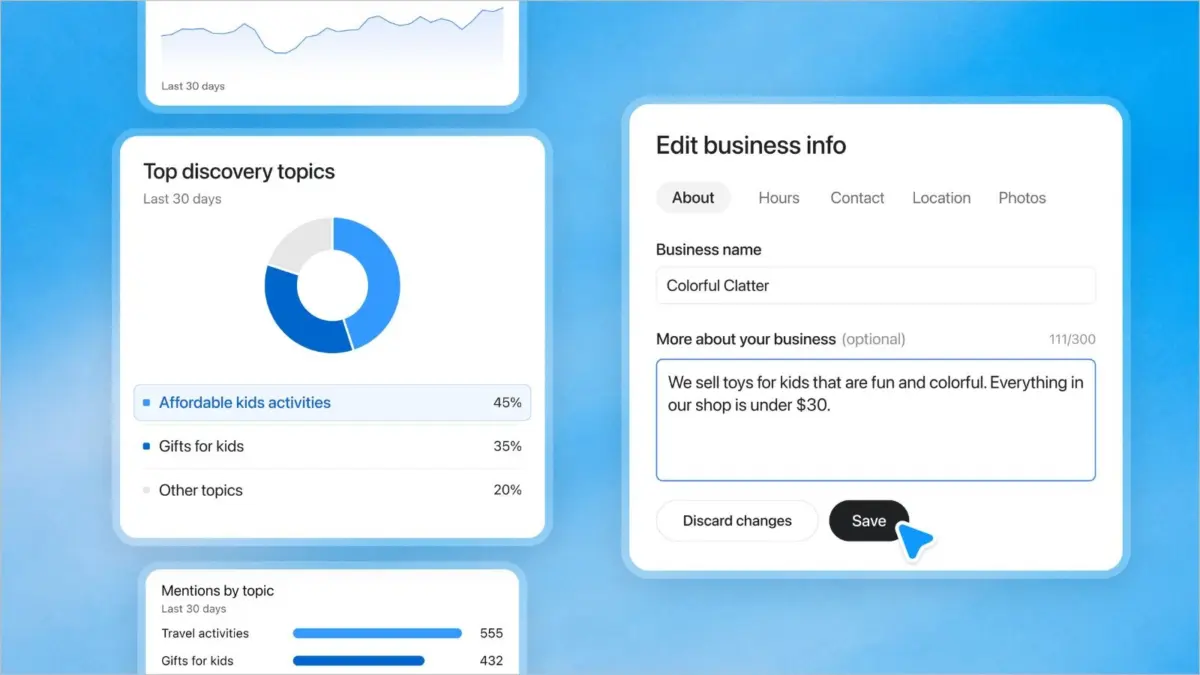
The ChatGPT Business Hub is structured around three primary pillars: verified brand profiling, real-time engagement analytics, and bespoke conversational agent deployment. Each component addresses a specific pain point that enterprises have faced since the dawn of generative AI.
1. Verified Brand Profiles and Direct Data Injection
At the heart of the Business Hub is the self-service verification engine. Much like Google Business Profile or Meta Verified, the system requires organizations to prove ownership of their digital assets through domain validation and administrative credentials.
Once verified, businesses unlock access to a centralized dashboard where they can manage:
- Product Catalogs: Up-to-date specifications, pricing tiers, availability metrics, and SKU details.
- Corporate Messaging: Official brand bios, mission statements, customer support escalation paths, and compliance disclosures.
- Dynamic Updates: Real-time adjustments to operating hours, seasonal offerings, or policy changes that immediately reflect in model outputs without waiting for a fresh web crawl cycle.
According to platform disclosures, while businesses are currently required to establish a foundational profile before deploying advanced tools, OpenAI has structured the onboarding to be lightweight, catering to lean marketing teams as well as complex enterprise IT departments.
2. Comprehensive Engagement Analytics
For enterprise leadership, adopting a new marketing or customer touchpoint requires rigorous attribution and performance tracking. Historically, brands utilizing ChatGPT as a referral channel operated in a data vacuum; they knew users were talking about them, but they lacked macro-level insights into how those conversations were evolving.
The Business Hub introduces robust analytics suites that allow companies to monitor:
- Query Volume & Sentiment: The frequency with which their brand, products, or services are invoked in user prompts, alongside natural language sentiment analysis.
- Contextual Engagement: The types of questions users ask regarding their offerings, illuminating unmet consumer needs or recurring friction points.
- Conversion Funnel Metrics: Click-through rates, referral traffic metrics to external web properties, and the efficacy of embedded calls-to-action within the chat interface.
These insights provide digital marketing executives with unprecedented visibility into the intent-driven queries of high-value consumers, bridging the gap between conversational AI and traditional CRM data.
3. Dedicated Business Agents
Beyond static profiles and analytics, the Business Hub enables companies to construct and deploy bespoke, sandboxed conversational agents tailored specifically to their brand ecosystem.
Unlike general-purpose ChatGPT instances, these dedicated agents can be imbued with proprietary institutional knowledge, customized system prompts, and strict guardrails. A customer interacting with a brand’s dedicated agent within ChatGPT experiences an interface optimized for that specific enterprise—whether that involves troubleshooting complex hardware, guiding a user through an intricate software onboarding flow, or executing secure e-commerce transactions directly within the chat window.
Supporting Context & Metrics: The Macroeconomics of Conversational Commerce
To fully grasp the strategic necessity of the Business Hub, one must analyze the broader structural shifts occurring in global search and digital marketing budgets.
The Decline of Traditional Search and the Rise of Answer Engines
For over two decades, the digital advertising economy was built on the foundation of the blue-link search engine results page (SERP). Brands invested billions of dollars into Search Engine Optimization (SEO) and Pay-Per-Click (PPC) campaigns designed to capture high-intent traffic.
However, consumer behavior is undergoing a seismic migration. Industry analysts estimate that hundreds of millions of active users now bypass traditional search engines entirely, turning instead to conversational AI platforms like ChatGPT, Microsoft Copilot, and Google Gemini to research products, compare services, and synthesize reviews.
- The Zero-Click Threat: In traditional SEO, even if a user found their answer on a search page, brands relied on organic impressions and site visits. In generative AI interfaces, the user receives a definitive, synthesized answer directly from the model. If the model provides incorrect or incomplete information, the brand loses the customer before the journey even begins.
- The ROI Imperative: According to recent digital marketing benchmarks, consumer trust in AI-generated recommendations is exceptionally high, rivaling traditional peer reviews. Consequently, controlling the underlying data that feeds these recommendations has transitioned from a technical nice-to-have to a critical board-level imperative.
Monetization Realities for OpenAI
As OpenAI scales its infrastructure to support billions of daily interactions, the imperative to diversify revenue beyond subscription fees ($20/month ChatGPT Plus tiers and enterprise licensing) has intensified.
The introduction of the Business Hub lays the groundwork for a sophisticated, value-added monetization model. While basic brand profiling may remain accessible to foster ecosystem health, advanced analytics, priority agent placement, and transactional integrations within ChatGPT represent multi-billion-dollar enterprise revenue streams. By aligning its commercial interests with those of global brands, OpenAI is effectively constructing a new digital advertising and commerce infrastructure—one built entirely around conversational intent rather than banner ads.
Official Statements and Industry Perspectives
The announcement of the Business Hub beta has generated intense commentary across the technology and media sectors. At the center of this rollout is Benji Shomair, Vice President of Monetization at OpenAI, whose insights shed light on the company’s long-term product roadmap.
The Vision According to OpenAI
In statements detailing the rollout, Shomair emphasized that the Business Hub is designed to solve a foundational friction point between commercial entities and artificial intelligence models.
"Businesses have spent decades optimizing how they appear to search engines and social media algorithms," industry insiders note of OpenAI’s strategic stance. "As conversational AI becomes the primary interface through which consumers discover the world, companies need a secure, reliable, and transparent mechanism to manage their brand narrative. The Business Hub is our commitment to building that bridge."
Addressing the phased rollout, Shomair highlighted the company’s commitment to scalability, noting that specialized features tailored to complex organizational structures—such as multi-unit franchises, global conglomerates, and decentralized retail networks—will be systematically integrated into the platform over successive update cycles.
Corporate and Agency Reactions
Early reactions from enterprise marketing executives and digital agencies have been largely enthusiastic, tempered by a healthy dose of operational caution.
- The Brand Safety Perspective: Chief Marketing Officers (CMOs) have universally praised the shift toward verification. The ability to purge AI hallucinations regarding product pricing and feature availability is viewed as a massive win for brand equity protection.
- The Resource Allocation Challenge: Conversely, enterprise IT and digital marketing departments are already grappling with the resource implications. Managing a ChatGPT Business Profile represents an entirely new workflow—requiring specialized talent, continuous data synchronization, and dedicated prompt-engineering oversight for custom agents.
As one Fortune 500 digital transformation director remarked off the record: "We spent ten years mastering Google’s algorithm, and another five mastering social media feeds. Now, we are entering the era of LLM governance. The Business Hub isn’t just a new tool; it’s the birth of an entirely new department within enterprise marketing."
Future Outlook: What Lies Ahead for the Business Hub and Conversational AI
As the ChatGPT Business Hub progresses through its initial beta phase and barrels toward general availability, several critical trends will dictate its evolution and long-term impact on the global economy.
1. The Standardization of "LLMO" (Large Language Model Optimization)
Just as SEO spawned an entire industry of optimization agencies, the launch of the Business Hub will formally institutionalize LLMO. We can expect the rapid emergence of specialized software-as-a-service (SaaS) platforms and digital agencies dedicated entirely to managing brand profiles, optimizing custom agents, and analyzing engagement metrics across OpenAI and competing AI ecosystems. Brands that fail to professionalize their conversational AI presence risk vanishing from the consideration sets of modern consumers.
2. Transactional Integration and In-Chat Commerce
Today, the Business Hub focuses heavily on profiling, information syndication, and analytics. However, the logical endpoint of conversational commerce is frictionless, end-to-end transactions executed entirely within the chat interface.
Future iterations of the Business Hub are widely expected to integrate secure payment gateways, inventory reservation APIs, and native checkout protocols. Imagine a consumer asking ChatGPT to recommend the best ergonomic office chair, verifying the product details via the brand’s official Business Hub profile, purchasing the item directly through an embedded agent, and receiving tracking updates—all without ever leaving the chat window. This capability would collapse the traditional e-commerce conversion funnel from multiple clicks to a single conversational command.
3. Multi-Platform Interoperability and Industry Standards
As OpenAI establishes the blueprint for verified business profiles in LLMs, competitive pressure will mount on rival AI developers—including Google, Anthropic, Microsoft, and Meta—to adopt interoperable standards. Enterprises will fiercely resist managing dozens of proprietary business hubs for every distinct AI model on the market. Consequently, industry coalitions may eventually form to establish universal protocols for corporate data syndication within generative artificial intelligence.
4. Regulatory Scrutiny and Data Governance
As conversational AI engines increasingly dictate commercial outcomes, regulatory bodies will inevitably turn their attention to how AI platforms curate, prioritize, and display business information. Questions surrounding anti-trust practices, algorithmic bias, data privacy, and preferential treatment within business hubs will take center stage. OpenAI’s governance frameworks, data security protocols, and verification standards will face intense scrutiny from global regulators eager to ensure fair competition in the burgeoning AI economy.
Conclusion
The launch of the ChatGPT Business Hub represents a watershed moment in the maturation of artificial intelligence. By moving beyond the speculative wild west of web scraping and establishing a structured, verified ecosystem for corporate identity, OpenAI has fundamentally altered the mechanics of digital discovery and commerce.
For enterprises, the message is unequivocal: conversational AI is no longer a peripheral technology to be observed from a distance. It is the primary storefront of the twenty-first century. Organizations that embrace the Business Hub early—leveraging verified profiles, rich analytics, and custom conversational agents—will secure a formidable competitive advantage in an increasingly AI-driven marketplace. Those that hesitate risk leaving their corporate reputation in the hands of probabilistic algorithms, detached from the realities of modern consumer intent.
