

Executive Overview
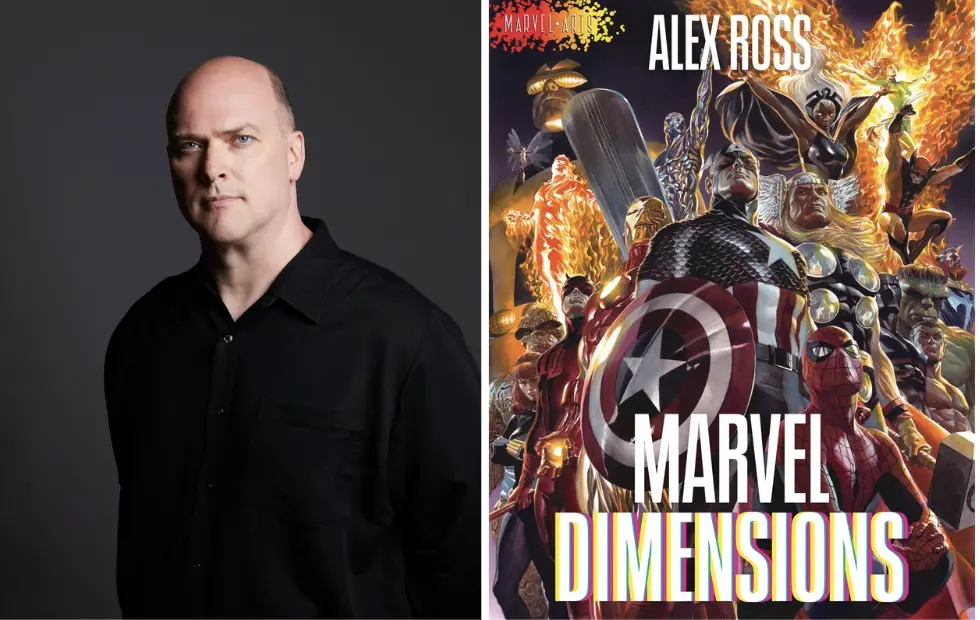
Renowned comic book artist and writer Alex Ross is set to launch his next landmark graphic novel, Marvel Dimensions, continuing his high-profile collaboration with Abrams ComicArts under the MarvelArts imprint. Following the commercial and critical success of 2022’s Fantastic Four: Full Circle, Ross’s upcoming release represents both a visual departure and a thematic critique of contemporary comic book storytelling.
Published outside Marvel Comics’ traditional monthly distribution pipeline by Abrams ComicArts, Marvel Dimensions merges two distinct artistic mediums and narrative frameworks. The publication features an expansive series of painted two-page origin spreads alongside a bound-in, 32-page pen-and-ink narrative comic insert. Beyond its architectural novelties, the graphic novel serves as a deliberate pushback against decades of corporate continuity revisions and adaptations driven by the Marvel Cinematic Universe (MCU). By returning foundational heroes to their original Atomic Age roots, Ross and Abrams Editorial Director Charles Kochman are challenging industry standards regarding visual format, canon, and corporate publishing models.
Detailed Chronology
[2022] ------------------------> [Development Phase] ------------------------> [September Release]
*Fantastic Four: Full Circle*    *Marvel Dimensions* Concept Formulated        *Marvel Dimensions* Published
Inaugurates MarvelArts Imprint   Integration of Painted Spreads & Ink Insert   via Abrams ComicArts
The Genesis of MarvelArts (2022)
In 2022, Abrams ComicArts launched the MarvelArts imprint in direct partnership with Marvel Entertainment. The initiative was designed to grant world-class creators the freedom to execute prestige graphic novels in non-standard physical formats. The flagship release, Fantastic Four: Full Circle, written and illustrated by Alex Ross, demonstrated the viability of high-end graphic albums outside mainstream single-issue monthly serialization.
Conceptualization of Marvel Dimensions
Following Full Circle, Ross found himself grappling with a series of unresolved narrative and visual concepts that did not fit standard comic formats. Rather than abandoning these ideas, Ross began synthesizing two separate artistic impulses: a visual encyclopedia of early Marvel superhero origins and an experimental, uninhibited narrative sequence.
Structural Refinement and Design Innovations
During early planning sessions, Ross and Editorial Director Charles Kochman re-evaluated how the graphic novel could physically house two radically different artistic styles. Initially envisioned as a single continuous book, the team decided to physically bind a separate 32-page comic book insert directly into the hardcover casing. Drawing inspiration from classic Mad magazine "Super Specials," this mechanical design choice allowed Ross to pivot seamlessly from fully painted, hyper-realistic art spreads to traditional black-and-white pen-and-ink line work.
Supporting Context & Metrics
Comparative Breakdown: Traditional Marvel Canon vs. Marvel Dimensions
| Character | Standard Modern / MCU Continuity | Ross’s Marvel Dimensions Continuity | Artistic Style / Format |
|---|---|---|---|
| Bruce Banner / The Hulk | Genetic serum modification, gamma-radiation exposure, childhood trauma retcons | Pure Atomic Age nuclear bomb fallout; personal accountability for weapon creation | Fine-art painted two-page spread |
| Silver Surfer | Unified origin as the tragic, noble alien humanoid Norrin Radd | Dual-origin representation: Kirby’s unfeeling alien vs. Lee’s tragic Norrin Radd | Fine-art painted two-page spread |
| Jean Grey (Phoenix) | Multi-decade cosmic retcons, cosmic entity substitution | Original Silver Age evolution into cosmic powerhouse | Horizontal landscape two-page spread |
| Narrative Insert | Modern digital line work and digital color grading | Classic black-and-white pen-and-ink drawing | 32-page bound-in physical comic insert |
Visual Methodology and Technical Shift
Alex Ross built his industry reputation on hyper-realistic gouache and watercolor paintings, pioneered in groundbreaking 1990s works such as Marvels and Kingdom Come. Marvel Dimensions represents a major technical shift in his bibliography.
+-----------------------------------------------------------------------------+
|                               MARVEL DIMENSIONS                             |
+------------------------------------+----------------------------------------+
|           PART ONE                 |               PART TWO                 |
|  Traditional Painted Spreads       |       Bound-In Comic Insert            |
|                                    |                                        |
|  * Style: Gouache/Watercolor       |  * Style: Pen & Ink Line Work          |
|  * Theme: Atomic Age Origins       |  * Theme: Subversive Canon Inversion   |
|  * Format: Large-scale Spreads     |  * Format: 32-Page Physical Insert     |
+------------------------------------+----------------------------------------+- Part One (Painted Origins): Utilizes Ross’s signature painted style across expansive two-page spreads. The sequence traces Marvel’s chronological evolution, beginning with the original 1939 android Human Torch created by Carl Burgos and concluding with Jean Grey’s transformation into Phoenix.
- Part Two (Pen-and-Ink Insert): A 32-page story executed exclusively in classical pen and ink. This shift allows Ross to experiment with raw line art, stark shadowing, and fluid sequential pacing—a medium he has long sought to integrate into his primary body of work.
Ideological Purism vs. Cinematic Retconning
A driving force behind Marvel Dimensions is Ross’s resistance toward corporate retcons—specifically those propagated by movie adaptations and modern comic revamps. Over the past two decades, media franchises have routinely altered comic backstories to match screenplays or contemporary sensibilities.
A clear example of this dynamic is the origin of the Incredible Hulk:
- The Retconned Narrative: Modern adaptations frequently attribute Bruce Banner’s transformation to serum experiments, genetic engineering, or deep-seated childhood trauma.
- Ross’s Restorative View: Ross insists on returning Banner to his 1962 roots as a weapons engineer whose monster is the direct, tragic consequence of his own scientific ambition during the Cold War nuclear race. Banner is not merely a victim of external circumstances; he is directly accountable for creating the weapon that cursed him.
Similarly, Ross addresses historic creative friction between Marvel’s original architects, Stan Lee and Jack Kirby. For the Silver Surfer, Kirby initially drew an eerie, detached alien entity with no human emotions, whereas Lee scripted him as a melancholy, romantic figure named Norrin Radd. Rather than picking one version over the other, Ross presents both interpretations simultaneously, honoring the creative tensions that originally birthed the character.
Official Statements
Alex Ross on Architectural Construction and Historical Integrity
Reflecting on the mechanical and thematic assembly of the project, Ross highlighted the spontaneous synthesis of leftover concepts:
"In the case of Marvel Dimensions, my urge was having leftover ideas that I wanted to find a place for. I was basically taking two ideas and jerry-rigging them together."
Addressing the choice to execute a portion of the project in black-and-ink line art, Ross explained:
"I’ve always wanted to do pen-and-ink for something, but finding the logic of where it would fit within my body of work has always been a challenge. So we shift context halfway through Marvel Dimensions, and hopefully it feels organic."
On his deliberate decision to bypass modern cinematic revisions in favor of original Atomic Age texts, Ross was candid about his ideological stance:
"Between the MCU and a lot of the updates that have happened over time with new creators, there’s a seditious endeavor on my part to push back against all those other things where they revise history. I’m going back to what things had been established in these characters’ early histories. I’m getting to write the history as I’ve known it."
Elaborating on the specific thematic weight of Bruce Banner’s origin, Ross stated:
"Bruce Banner was a bomb maker, and so everything that happened to him is a side product of his own invention. When people want to talk about how he was an abused child and had a bad relationship with his father, that’s beside the point. He was a person doing a thing that led to a certain suffering, and that’s his own burden to carry. Hold the person accountable, which is the whole original crux of the story of the Hulk that’s gotten lost over time. He’s a product of the nuclear age, which is frankly true of a lot of the original Marvel characters."
Charles Kochman on Publication Design and Structural Freedom
Abrams ComicArts Editorial Director Charles Kochman elaborated on the unique publishing niche that the MarvelArts imprint occupies within the graphic novel market:
"MarvelArts allows Abrams to take on projects that Marvel may not have the bandwidth to do, and in formats that aren’t Marvel’s forte… I like to think that with all of Abrams’ books, the content will always dictate the format. This one has a storytelling reason."
Kochman detailed the historical inspiration behind including a physically distinct comic book insert inside a hardcover volume:
"When Alex was first conceptualizing this whole story, I remember the comic was something that he was going to have inside the book, but not as a separate object. But then at one point we threw out the idea, ‘what if we did it as a separate comic?’ Having worked at Mad magazine, I share with Alex a love of those Super Specials where they would bind in a comic."
Regarding Ross’s decision to alter the book’s orientation for the Jean Grey spread—forcing readers to turn the physical volume horizontally—Kochman noted with a laugh:
"That’s an inside joke for Alex and I, because I always have this thing about not turning a book sideways, so of course he had to make one of them like that. But I will say, Alex’s instincts almost always work. Even with my predilection against those kinds of pages, in that particular instance it really works because it’s part of the whole aesthetic of this book, which is unpredictable."
Future Outlook
The Evolution of Boutique Imprint Publishing
The launch of Marvel Dimensions signals a growing trend in the graphic novel industry: the divergence between mass-market, serialized pamphlet comics and high-end, archival art books. By utilizing Abrams ComicArts’ specialized production capabilities, Marvel can monetize its intellectual property in prestige formats without disrupting its ongoing monthly single-issue continuity.
This model provides several distinct long-term advantages:
- Format Experimentation: Independent book publishers like Abrams are equipped to produce bespoke graphic objects—incorporating varied paper stocks, bound-in inserts, and non-standard print dimensions.
- Creator-Driven Autonomy: Elite creators are granted freedom from corporate crossover events, allowing them to produce evergreen stories tailored for bookstore distribution rather than direct-market comic shops alone.
Preserving Comic Book History in the MCU Era
As multi-billion-dollar film adaptations continue to reshape public perception of comic book characters, Marvel Dimensions sets an important precedent for historical preservation. Ross’s refusal to adjust original lore to align with film narratives highlights a growing movement among classic comic preservationists.
By grounding characters in the socio-political context of their creation—such as Cold War anxieties and Atomic Age existentialism—Marvel Dimensions reassesses the core themes that made these characters enduring American icons. As the book releases this September, it stands as both an artistic experiment and a firm defense of comic book heritage.