


Executive Overview
In the hyper-competitive landscape of the digital economy, thousands of aspiring freelance writers enter the market every month, armed with raw talent, newly minted portfolios, and ambitious revenue targets—often aiming to secure their first $1,000 within 30 days. Yet, despite putting in the rigorous hours required to craft compelling prose, a staggering percentage of these professionals fail to land sustainable client rosters. The root cause of this widespread failure is rarely a lack of writing ability; rather, it is a fatal breakdown in business development execution: the abandonment of the cold email follow-up.
Industry data confirms that the vast majority of independent professionals rely on a passive, single-touch outreach model. They compile a directory of prospects, dispatch a batch of introductory emails, and, upon receiving radio silence, retreat under the assumption that the lead is dead. This conventional wisdom is profoundly flawed. Sales intelligence and outreach metrics repeatedly demonstrate that the lion’s share of commercial transactions and client conversions do not occur on the first impression. Instead, they happen deep within a disciplined, prolonged sequence of strategic touchpoints.
This report investigates the mechanics of modern freelance outreach, dissecting the psychological barriers to following up, the tactical cadence required to capture prospect attention without crossing into harassment, and the technological systems—ranging from lightweight CRM plugins to advanced AI assistants—that transform erratic pitching into a predictable client-acquisition engine. By analyzing insights from seasoned industry veterans like Sean Ogle, founder of Location Rebel, we explore how transforming your follow-up strategy can bridge the gap between obscurity and a thriving freelance enterprise.
Detailed Chronology: The Evolution of Freelance Outreach and the Single-Touch Trap
To understand why contemporary freelancers struggle with client acquisition, one must examine the evolution of digital prospecting over the past decade. Ten years ago, the internet was a significantly less crowded marketplace. Inbox volumes were lower, attention spans were broader, and a well-crafted letter of introduction (LOI) sent to a digital marketing manager or blog editor had a reasonable statistical chance of receiving an immediate reply on the first pass.
As barriers to entry lowered and the global remote workforce expanded exponentially, corporate inboxes transformed into battlegrounds. Today, decision-makers at agencies, SaaS companies, and media outlets are inundated daily with dozens of unsolicited pitches. In this high-noise environment, the traditional single-touch cold email has become virtually obsolete.
The Phased Breakdown of a Prospect’s Journey
- The Initial Influx (Day 0): A freelancer sends a personalized cold email. At this stage, the prospect’s inbox is likely overflowing with urgent operational demands. Even if the email is opened, the immediate need for a freelance writer may be zero. The recipient registers the message, files it away mentally (or archives it), and moves on.
- The Silence Gap (Days 1–4): The novice freelancer checks their inbox, sees no reply, and experiences an internal crisis of confidence. They interpret the silence as rejection, assuming the pitch was poorly written or unwanted.
- The Abandonment Phase (Day 5 and Beyond): Believing that persistence equates to annoyance, the freelancer ceases all communication. In reality, this is precisely the moment when the commercial window opens for proactive professionals.
- The Strategic Intervention (Day 5+): A well-timed, polite follow-up lands in the prospect’s inbox. This time, the timing aligns with a sudden content bottleneck, a writer quitting unexpectedly, or a new marketing campaign kicking off. The follow-up acts as a cognitive trigger, surfacing the freelancer’s initial value proposition right when the pain point materializes.
This chronological reality highlights a hard truth: pitching is not a singular event; it is an endurance-based communication strategy designed to intersect with the unpredictable timing of business needs.
Supporting Context & Metrics: The Mathematics of Persistence
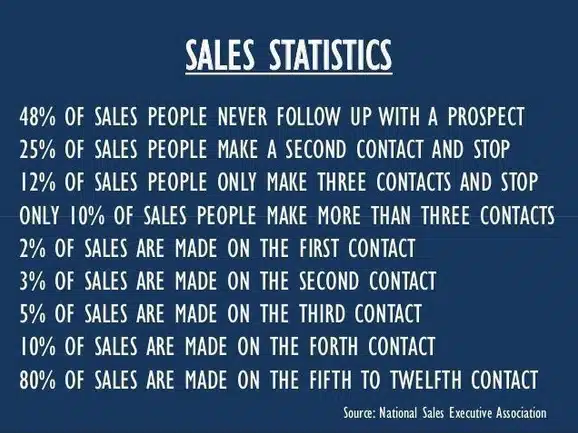
The reluctance of freelancers to follow up often stems from an emotional fear of being perceived as a nuisance. However, empirical sales data starkly contradicts this emotional bias. Sales acceleration studies consistently reveal a massive disconnect between how often salespeople attempt to contact prospects and how many touches it actually takes to close a deal.
Key Sales Statistics on Persistence
- The 2% Fallacy: Historical sales metrics show that 80% of sales are made between the fifth and twelfth contact. Yet, a staggering 44% of salespeople give up after just one follow-up email.
- The Noise Factor: In a typical business environment, decision-makers miss or ignore up to 50% of inbound communications simply due to triage velocity. A single email is statistically insignificant; a sequence forms a recognizable pattern of professional dedication.
- The Temporal Misfit: At the exact moment your first cold email arrives, the probability that a prospect requires a content overhaul or blog expansion is minuscule—often under 5%. However, over a 3-to-6-month horizon, budget cycles shift, team members depart, and content demands spike. Regular follow-ups ensure you remain the path of least resistance when those shifts occur.
The Anatomy of an Effective Cadence
Establishing a cadence requires balancing persistence with professional courtesy. Sending follow-ups too rapidly risks irritating the prospect, while waiting too long allows them to completely forget your initial interaction. Industry experts recommend a structured timeline:

- Initial Follow-Up: Wait 2 to 5 days after the first email. This interval is long enough to respect their busy schedule, yet short enough that your original message is still retrievable in their short-term memory or archived messages.
- The Subsequent Cadence: Space out subsequent check-ins over the ensuing weeks and months. Rather than aggressive sales pitches, these touchpoints should offer evolving value, such as sharing a newly published case study, noting a recent pivot in their company strategy, or aligning with seasonal calendar milestones (e.g., year-end content crunches or Q1 strategic planning).
Official Perspectives and Expert Insights
To gain a deeper understanding of how successful freelancers navigate the delicate balance between aggressive marketing and respectful relationship-building, industry leaders emphasize the philosophy of adding value over spamming.
Sean Ogle, founder of Location Rebel and a veteran educator who has spent over a decade helping students build sustainable online businesses, is unequivocal about the primacy of outreach discipline.
"The whole point of this post was just to say: follow up," Ogle emphasizes. "You’ve done all the hard work building your portfolio and writing samples. You’ve got a lead, researched the person, and spent time crafting a thoughtful email. Don’t let all that effort go to waste. Spend the extra few minutes to write a follow-up and create a schedule to send more."
According to Ogle, the democratization of content creation tools has introduced a plague of low-effort, automated, and AI-generated spam into corporate inboxes. This dynamic creates both a challenge and an opportunity for serious freelance writers.
"I get so many crappy emails," Ogle notes. "They’re not personalized. Perhaps they were written by AI, and then you get follow-ups every day that are also not personalized, and it drives me crazy. Those people give a bad rap to the people who do it properly. Everyone hates getting cold emails, and those people are why. If I get an email where I see someone has taken the time to learn about me and the site, I’m way more likely to respond."
Crucially, Ogle points out that personalization does not require exhaustive, hours-long research dossiers on every single prospect.
"That doesn’t mean you have to spend hours personalizing," he advises. "Just customize the first sentence. That’s honestly all you need. So many people send out bad, generic emails that even a tiny bit of effort helps you rise to the top."
Furthermore, Ogle advocates for the inclusion of what he calls the "easy out"—a non-intrusive closing line that lowers the psychological pressure on the recipient, preserves mutual respect, and keeps communication channels wide open for future collaboration. When executed correctly, a follow-up is not an interruption; it is a welcome service to a busy manager who would otherwise have to waste hours hunting down reliable talent.
Technological Integration: Scaling Your Outreach Without Losing Your Mind
As a freelance writing business scales, managing dozens—or hundreds—of active outreach campaigns manually becomes mathematically impossible using basic email clients alone. Without a system, leads slip through the cracks, follow-up dates are missed, and momentum grinds to a halt. Fortunately, modern software solutions allow freelancers to operationalize their follow-up processes with surgical precision.
1. Gmail-Integrated CRMs (e.g., Streak)
For freelancers operating primarily out of Google Workspace, lightweight CRM tools like Streak offer an elegant solution by transforming a standard Gmail inbox into a fully functional sales pipeline.
- Open Tracking: Instantly see when a prospect opens your cold email, providing real-time data on when to time your next interaction.
- Stage Management: Categorize leads visually—from "Initial Pitch Sent" to "Follow-Up Scheduled" and "Discovery Call Booked."
- Automated Reminders: Set custom intervals so the software prompts you precisely when a follow-up is due, eliminating memory-dependent errors.
2. Generative AI as an Outreach Assistant
For practitioners who find traditional spreadsheets tedious or uninspiring, modern large language models—such as Anthropic’s Claude or OpenAI’s ChatGPT—serve as highly capable virtual marketing assistants.
- Data Tracking: Maintain a running log within an AI chat interface detailing outreach dates, target names, company verticals, and email variants used.
- Performance Analytics: Prompt the AI periodically to analyze your pipeline data: “How many cold emails have I sent this month? What is my conversion rate from initial touch to discovery call?”
- Contextual Recall: Leverage the AI to brainstorm tailored follow-up angles based on previous interactions, ensuring that every touchpoint feels fresh, contextual, and deeply relevant to the client’s current business trajectory.
Future Outlook
The freelance writing economy of tomorrow will not reward those who write the most generic pitches, nor will it be kind to those who abandon their pipeline after a single unanswered email. As artificial intelligence continues to accelerate the generation of commodity text, clients are placing an unprecedented premium on genuine human expertise, strategic reliability, and professional persistence.
The trajectory of successful freelance careers will increasingly depend on process engineering. Writers who view client acquisition as an administrative system rather than an emotional hurdle will consistently outperform their peers. By implementing disciplined follow-up cadences, leveraging lightweight CRM technologies to eliminate human error, and respecting the unpredictable timelines of corporate decision-makers, independent writers can insulate themselves against market volatility.
Ultimately, mastering the follow-up is the definitive rite of passage for any freelance writer aspiring to cross the $1,000 threshold in 30 days or less—and to build a resilient, high-income micro-business that withstands the test of time.