

Executive Overview
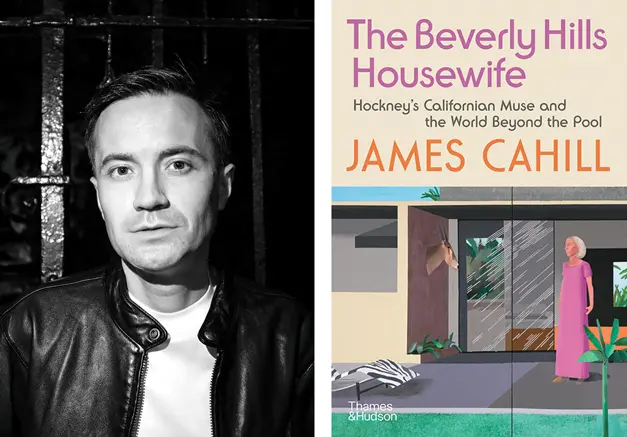
In 1966, a young British painter named David Hockney completed a monumental twelve-foot-wide acrylic painting that would become one of the defining visual artifacts of mid-century Southern California. Titled Beverly Hills Housewife, the work presents a poised, enigmatic woman standing within a sun-drenched, hyper-modernist living space framed by manicured foliage and pristine mid-century architecture. The subject of this massive double-canvas portrait was Betty Freeman—a woman who would go on to become one of North America’s most influential patrons of avant-garde music and contemporary art, but who, at the time of the painting’s creation, was a figure navigating profound personal transition.
In a comprehensive critical re-examination, art historian and critic James Cahill explores the layers of ambiguity, biography, and cultural geography embedded within Hockney’s masterpiece. Moving beyond the flat, glossy surfaces that defined popular perceptions of 1960s California, Cahill argues that Beverly Hills Housewife operates as a pivot point in modern art history. It marks the precise intersection where the traditional canons of European portraiture collided with the uncharted, unformed terrain of Los Angeles.
By framing Hockney as a "charmed outsider"—a British artist detached from East Coast visual traditions—and Freeman as a complex muse turning away from a dissolving domestic life toward an uncertain future, Cahill’s analysis sheds light on the socio-spatial mechanics of 1960s Los Angeles. The painting does not merely capture a wealthy patron in her domestic sanctuary; it documents the birth of a new visual language for a city that, prior to Hockney’s arrival, lacked a dedicated artistic mythos.
Detailed Chronology
[1964] -------------------> [1966–1967] -------------------> [2009] -------------------> [2026]
Hockney arrives in L.A.;    *Beverly Hills Housewife*        Painting sold at auction    James Cahill publishes
identifies city's lack      painted; captures Freeman        for record $7.9M following  critical re-evaluation
of artistic precedents.     during personal transition.      Betty Freeman's passing.    of the work & context.
1. 1964: The Outsider’s Arrival
David Hockney, having recently graduated from London’s Royal College of Art, arrived in Los Angeles for the first time in January 1964. Fascinated by photographs in physique magazines, the bright sunlight, and the sprawling suburban grid, Hockney perceived a metropolis devoid of traditional artistic ghosts. Unlike London or Paris, where centuries of canonical painting weighed heavily on young artists, Los Angeles presented a blank slate—an uncharted landscape waiting for its definitive visual chronicler.
2. 1966–1967: Creation of Beverly Hills Housewife
Commissioned by Betty Freeman’s husband, property developer Stanley Freeman, the portrait was executed over several months between 1966 and 1967. Hockney worked on two joined canvases measuring 72 by 144 inches. During this period, Freeman’s marriage was unravelling, and her transformative career as a philanthropist of radical contemporary composers (including John Cage, Philip Glass, and Steve Reich) was just beginning to take shape. Hockney captured her in a moment of quiet, liminal poise—clad in a hot-pink dress, standing amidst her modernist furniture and art collection.
3. Post-1967: The Evolution of Patronage and Provenance
Following the completion of the portrait, Freeman’s residence in Beverly Hills became a central salon for the global avant-garde. The painting hung prominently in her home for more than four decades, serving as both a personal landmark and an emblem of West Coast modernism. Following Freeman’s death in 2009, Beverly Hills Housewife was offered at Christie’s New York, where it realized $7.9 million, solidifying its status as a cornerstone of Hockney’s middle-period oeuvre.
4. 2026: Critical Re-evaluation by James Cahill
Decades after its creation, art critic James Cahill returned to the painting to re-examine its historical, spatial, and psychological dimensions. Cahill’s scholarship re-contextualizes the work within broader histories of queer aestheticism, mid-century architectural theory, and the unique socio-cultural fluidity of 1960s Southern California.
Supporting Context & Metrics
The Spatial and Aesthetic Metrics of the Canvas
Beverly Hills Housewife is characterized by its rigorous geometric structure and synthetic material choices, reflecting the physical environment of 1960s Los Angeles:
- Dimensions: 72 × 144 inches (182.9 × 365.8 cm), painted across two adjoined linen panels, establishing a panoramic, architectural scale.
- Medium: Acrylic on canvas. Hockney deliberately favored fast-drying acrylic over oil during this period to achieve hard edges, flat color planes, and a sense of "crystalline light" unique to Southern California.
- Compositional Balance: The canvas is divided into distinct spatial zones—the interior domestic salon containing modernist furniture (including a Corbusier lounge chair and an animalistic sculpture) and the exterior patio, split by clean glass partitions.
| Metric / Dimension | Detail / Historical Significance |
|---|---|
| Creation Period | 1966–1967 (Beverly Hills, CA) |
| Canvas Scale | 6 ft × 12 ft (Two joined panels) |
| Primary Medium | Acrylic on canvas (emphasizing speed, flat planes, and bright light) |
| Art Historical Paradigm | Origin of Hockney’s iconic L.A. double-portrait & environment series |
| Sociological Context | Mid-century West Coast elite; emerging avant-garde patronage networks |
+-------------------------------------------------------------------------+
|                              BACKGROUND                                 |
|                   [Manicured Palm / Exterior Patio]                     |
+-------------------------------------------------------------------------+
|                                FOREGROUND                               |
|   [Modernist Couch]   |   [Betty Freeman in Pink]   |  [Sculpture/Chair]|
|   (Architectonic)     |   (Poised / Semiformal)     |  (Modernist Decor)|
+-------------------------------------------------------------------------+
The Spatial Geography of 1960s Los Angeles
To understand why Hockney’s painting resonated so deeply, art historians analyze the physical and social structures of 1960s Los Angeles compared to established East Coast and European cultural centers:
[Traditional Cultural Hubs: Boston / London]
 ──> Verticality, rigid social hierarchies, historical weight ("Ghosts")

[1960s Los Angeles]
 ──> Horizontality, open urban grid, fluid social circles, absence of artistic precedents
Unlike Boston—where Betty Freeman was raised amid entrenched social codes and historic architecture—Los Angeles was built on horizontal expansion and modernist experimentation. The city lacked an established hierarchy of taste, allowing young artists and collectors to forge new modes of living and art-making.
Official Statements
Critical Insights from James Cahill
In his exhaustive analysis of the painting and its historical milieu, art critic James Cahill offers several key perspectives on Hockney’s technique, motivation, and relationship with his subject:
On the Atmosphere and Title
"I found the stillness and crystalline light, combined with that poised, semiformal figure in the middle, very captivating. And the title, Beverly Hills Housewife, simultaneously defines its subject and leaves you with many questions about who she was. When was this? What was her relationship to Hockney?"
On Hockney as the "Piranesi of Los Angeles"
"The force of those early L.A. pictures has to do with Hockney being a charmed outsider. The city was radically new, different, and uncharted. In Hockney’s view there were no real precedents for representations of L.A. in art and, as he put it, no ghosts. He noticed how everything seemed like it was still semi-formed and thought he could be the city’s Piranesi, which was this incredible statement of ambition, but he did live up to it."
           [Giovanni Battista Piranesi]
    Renders 18th-century Rome's majestic, grand architecture
                         │
                         ▼
             [David Hockney (1960s)]
    Renders mid-century L.A.'s light, glass, and modernism
On the Queer Aesthetic and Patron-Artist Dynamics
"Freeman was still very glamorous, though in a quiet, hard to read sort of way. In that moment, 1966–1967, she was still coming into herself. None of her dreams had come to fruition and her marriage was unravelling. She’s turning towards her future, literally in the portrait, and that appealed to Hockney because he was himself at a very important moment of becoming… I’m interested in the pattern of younger gay men’s fascination with older, assured, beautiful women, but in this case, it had so much to do with what they meant to each other individually."
On the Openness of the 1960s L.A. Art Scene
"One has to be careful as a writer to not romanticize L.A., but back in the 1960s there was this real sense that the city itself was young and the contemporary art scene was relatively unformed. People moved about, and interacted with relative ease because the artistic circle was small. The lack of precedence, rules, or tradition—unlike in Boston, where Betty grew up—made such a friendship possible. One of the people I interviewed described how in L.A. everything tends towards the horizontal."
Future Outlook
James Cahill’s re-evaluation of Beverly Hills Housewife signals a broader shift in how modern art history approaches mid-century West Coast art. Long viewed through the lens of casual leisure or superficial pop sensibility, Hockney’s early California output is increasingly recognized as a sophisticated project of urban myth-making and psychological portraiture.
1. Re-Evaluating Mid-Century Modernism
Future scholarship is expected to focus heavily on the intersectional dynamics within Hockney’s work—specifically how queer identity, outsider perspectives, and female patronage shaped the visual identity of Los Angeles. Scholars are moving past simple biographical readings to examine how domestic spaces served as stages for personal re-invention.
2. Institutional and Market Re-assessment
As institutions re-examine post-war American art, works like Beverly Hills Housewife are serving as key case studies in the structural transition from East Coast formalist abstraction to West Coast representational clarity. Curators anticipate expanded retrospectives that pair Hockney’s mid-century paintings with the architectural and musical archives of the figures he depicted, such as Freeman.
3. The Enduring Myth of the Horizontal City
Ultimately, Cahill’s analysis demonstrates that the light, openness, and social fluidity that drew Hockney to Los Angeles in 1964 remain central to the city’s artistic identity. By acting as a modern-day Piranesi, Hockney did not merely depict Los Angeles; he constructed its enduring visual identity—a legacy anchored by the stillness, ambition, and quiet complexity of Beverly Hills Housewife.