

Executive Overview
The return of 84-year-old Senator Mitch McConnell to the U.S. Capitol in September 2026, following a mysterious and heavily guarded three-month absence, has reignited intense debate surrounding aging leadership, political transparency, and accountability in American governance. McConnell, the longest-serving Senate party leader in U.S. history, vanished from public view in June 2026 following what was officially described as a "bad fall" that required hospitalization.
For more than 90 days, constituents, political analysts, and the media were left in the dark. The near-total lack of video or audio updates during his recuperation sparked a flurry of viral conspiracy theories, particularly across social media and MAGA circles. When McConnell finally reappeared on September 14, 2026, wheeled into the Capitol building for a key legislative vote ahead of the midterm sprint, the initial shock quickly gave way to rigorous public scrutiny.
While extended footage showed the veteran Kentucky Republican offering a muted wave and a thumbs-up before departing, critics—ranging from online commentators to state-level officials—argued that the episode exposes glaring vulnerabilities in how Congress handles extended incapacitation among its members. Kentucky Governor Andy Beshear publicly stated that McConnell owes his constituents definitive proof of his day-to-day fitness to serve. Beyond the immediate health speculation, McConnell’s return forces a broader reckoning: Is it time to institute congressional term and age limits, and how does the opaque handling of a powerful lawmaker’s health undermine the public trust?
Detailed Chronology: From the June Hospitalization to the September Return
The June Fall and the Wall of Silence
The timeline of McConnell’s latest medical crisis began in June 2026, when the senator suffered a severe fall that resulted in hospitalization. In recent years, McConnell’s physical health has been a frequent subject of public concern. Notably, in 2023, he experienced two separate incidents where he abruptly froze mid-sentence during press conferences—episodes that medical teams and aides similarly attributed to post-concussion recovery from falls.
However, the June 2026 incident differed sharply in its handling. Unlike previous health scares where McConnell quickly returned to the microphones to reassure the public, the summer of 2026 brought a virtual news blackout. Aside from a few static photographs released by his office, no video or audio footage emerged for nearly three months to confirm whether the senator could speak, comprehend, or execute his senatorial duties. Despite his complete absence from Washington and his inability to attend committee hearings or legislative sessions, McConnell continued to collect his taxpayer-funded salary, fueling growing frustration across the political spectrum.
The September 14 Reappearance
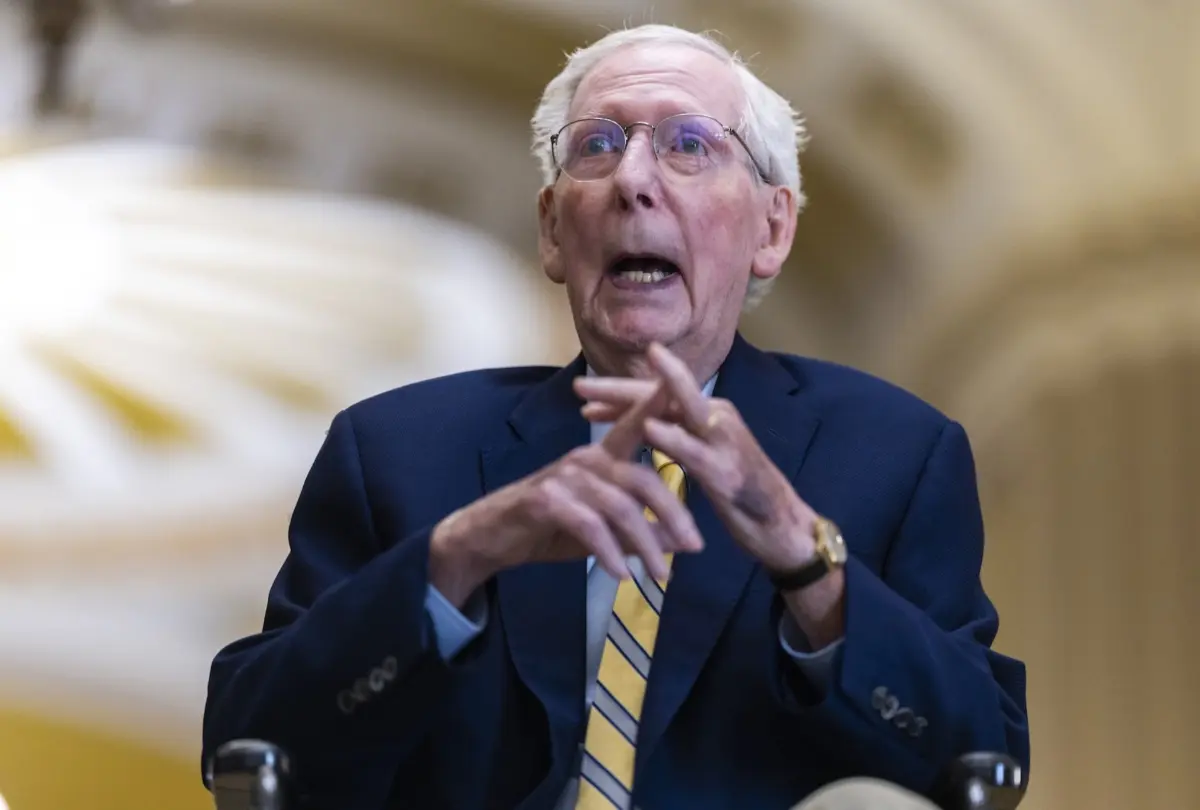
On Monday, September 14, 2026, the Senate returned to Washington for its final legislative push ahead of the midterm elections. To the surprise of reporters and colleagues alike, McConnell was wheeled onto the Capitol grounds.
Visual documentation of his return painted a mixed picture. A widely circulated 10-second viral clip showed journalists shouting questions and demanding a response, while McConnell stared straight ahead with a fixed smile, appearing unresponsive. The video quickly ignited a firestorm online. Right-wing figures, including commentator Laura Loomer, seized on the footage to draw comparisons to past political controversies, claiming the senator looked entirely incapacitated and comparing the situation unfavorably to criticisms leveled against aging Democrats.
However, extended footage published by outlets like TMZ provided a more nuanced look at the senator’s physical state. In the longer clip, McConnell offered a subtle wave and a thumbs-up to onlookers before being assisted into a waiting van. While the video confirmed retained motor skills, it did little to clarify his cognitive capacity or his readiness to engage in demanding legislative work, as he maintained complete silence throughout the encounter.
Supporting Context & Metrics: A History of Health Scares and Political Legacy
Mitch McConnell’s political career is etched deeply into the architecture of modern American governance. Having stepped down from his historic post as Senate Republican Leader last year, he remains an influential figure within the GOP apparatus. Yet, his longevity has increasingly intersected with serious medical frailties.
- Age and Tenure: At 84 years old, McConnell’s tenure spans decades, making him a primary target for critics of an increasingly gerontocratic American legislature.
- The "Freezing" Episodes: The 2023 press conference freezes—where McConnell stood motionless for roughly 30 seconds before aides intervened—raised foundational questions about neurological health among octogenarian lawmakers.
- The Polio Explanation: In a statement posted to X (formerly Twitter) following his return, McConnell addressed his slow recovery by pointing to the "lingering effects of childhood polio," a condition he contracted in his youth that has occasionally impacted his physical mobility throughout his life.
- Economic Disconnect: Critics have continually pointed out the irony of lawmakers like McConnell relying on comprehensive, taxpayer-funded medical care while actively working to shape or dismantle healthcare policies affecting everyday Americans, many of whom face stringent coverage restrictions.
Official Statements and Public Reactions
The public and political reaction to McConnell’s reappearance has exposed deep-seated anxieties regarding transparency in government.
State-Level Pushback
Kentucky Governor Andy Beshear, a Democrat, voiced moderate support for the senator’s return while forcefully demanding greater accountability. In an interview with LEX News, Beshear articulated a sentiment shared by many voters regardless of party affiliation:
"I still think he has an obligation to prove to the people of Kentucky that he has the capacity to represent us and represent us well. That means being able to come day after day, to serve on committees."
Congressional Silence and Social Media Furor
While Senate leadership welcomed McConnell back to the floor with standard procedural courtesy, the broader political ecosystem erupted. Social media algorithms were flooded with internet memes, political attacks, and diagnostic speculations from non-medical professionals. Pundits and partisan commentators utilized the moment to underscore wider systemic issues, drawing parallels to debates over executive branch fitness and calling attention to the absolute lack of institutional rules requiring transparency when a senator is medically sidelined for an entire quarter of a year.
Future Outlook: The Imperative for Reform
The return of Mitch McConnell—whether viewed as a triumphant recovery by his allies or an untenable display of political persistence by his detractors—serves as a case study for the structural flaws in the U.S. legislative branch.
- The Transparency Deficit: The reality that a powerful federal legislator can vanish for three months without providing substantive medical updates highlights a dangerous lack of institutional oversight. Future legislative reforms may need to establish mandatory reporting thresholds for lawmakers experiencing extended medical leaves.
- The Age and Term Limits Debate: Incidents like this invariably accelerate bipartisan discussions regarding age limits and term limits in Congress. As the median age of American lawmakers continues to hover near historic highs, voters are increasingly fatigued by a system that permits lifetime tenures regardless of physical or cognitive decline.
- Legacy and Policy Direction: Beyond the medical lens, McConnell’s enduring footprint on the judiciary, campaign finance deregulation, and national security policy remains potent. Whether he quietly serves out the remainder of his term or faces renewed calls for resignation, his return ensures that the debate over who truly wields power when elected officials are incapacitated will remain at the forefront of American politics.