


Executive Overview
The landscape of content marketing is undergoing its most disruptive transformation since the inception of the search engine. The rapid proliferation of generative artificial intelligence, search engine algorithm overhauls, and the hyper-fragmentation of digital channels have rendered traditional marketing playbooks obsolete. Today, content marketing is no longer merely about drafting search-engine-optimized blog posts; it is an integrated ecosystem spanning social media personal branding, multi-tier email funnels, and high-conversion copywriting.
Despite this rapid evolution, the market for digital marketing education remains saturated with static, outdated courses. To separate high-value programs from legacy offerings, this investigative analysis evaluates eight of the industry’s most prominent content marketing courses. Utilizing a rigorous framework—measuring instructor credibility, format coverage, advice recency, feedback loops, community access, and pricing structures—we analyze which programs prepare modern professionals for the contemporary marketing landscape and which fall short.
Detailed Chronology: The Evolution of Content Marketing Pedagogy
Historically, content marketing education followed a predictable trajectory. In the early 2010s, platforms like HubSpot pioneered inbound marketing methodology, establishing standardized, self-paced certification courses focused on top-of-funnel blog creation. These free educational models served as highly effective lead-generation tools for software-as-a-service (SaaS) providers.
However, as organic search became more competitive and algorithm updates prioritized deep user intent and authoritativeness (E-E-A-T), a second wave of educational platforms emerged. Between 2018 and 2022, agency owners and specialized practitioners began launching premium, high-ticket courses. These programs shifted the focus from raw traffic metrics to direct-response conversions and revenue attribution.
By 2023, the launch of advanced generative AI models fundamentally altered the economics of content production. The cost of generating baseline text plummeted to zero, causing an over-saturation of search engine results pages (SERPs). Consequently, the industry witnessed a rapid shift toward personal branding, proprietary email lists, and community-led growth.

This chronological shift has created a stark divide in educational offerings:
- Legacy Static Courses: Pre-recorded, self-paced programs that teach foundational, historical SEO and blogging methodologies.
- Dynamic Cohorts and Communities: Real-time, practitioner-led academies that continuously update their curricula to address algorithmic shifts and AI integrations.
Supporting Context & Metrics: Evaluating the Top Eight Programs
To provide a comprehensive assessment for marketing executives, entrepreneurs, and career-driven professionals, we evaluated eight leading content marketing programs against six core criteria.
1. Copyblogger Academy
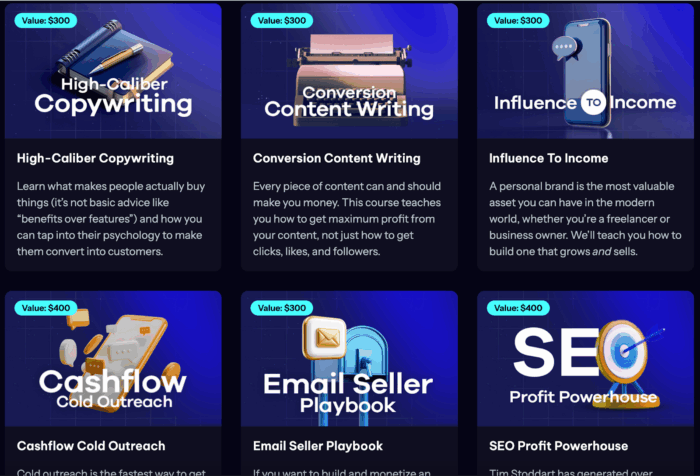
Copyblogger Academy represents the modern, community-centric model of professional education. Directed by seven-figure digital entrepreneurs Tim Stoddart and Charles Miller, the academy positions itself as a dynamic sandbox rather than a static archive of videos.
- Instructor Credibility: Highly robust. Tim Stoddart is the CEO of Copyblogger and Quantum Leads, having scaled multiple seven-figure agencies. Charles Miller has cultivated a combined audience of over 320,000 followers on LinkedIn and X (formerly Twitter), managing personal brands for high-profile founders.
- Content Formats Covered: Comprehensive. The curriculum spans copywriting, advanced SEO, email marketing, personal branding, and sales strategy.
- Advice Recency: Highly current. Because both instructors actively run marketing-dependent businesses, the strategies address real-time shifts in AI-assisted content generation and search engine dynamics.
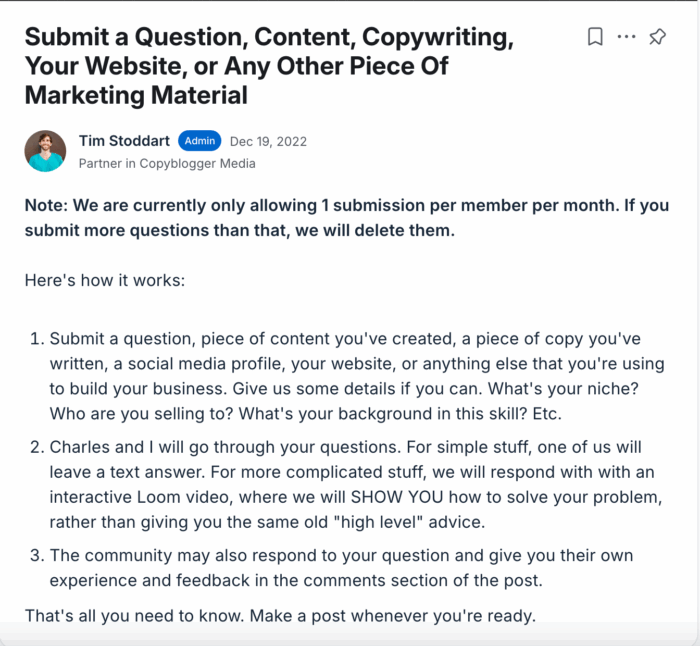
- Feedback & Support: Exceptional. Members submit their actual copy, landing pages, or strategies directly within the community platform to receive personalized feedback from Stoddart and Miller.
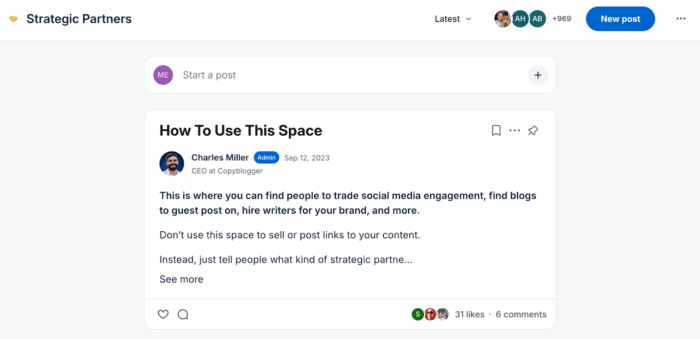
- Community: Active peer-to-peer network facilitating collaboration, engagement groups, and strategic alliances.
- Pricing: Accessible entry point with a $1 trial, transitioning into a recurring monthly membership.
2. HubSpot Content Marketing Certification
As one of the oldest free certifications in the digital space, HubSpot’s 8.5-hour program remains a default entry point for entry-level marketers.
- Instructor Credibility: Solid institutional authority. Led by Justin Champion (HubSpot’s Global Head of Surround Sound Growth) alongside prominent guest experts like Andy Crestodina.
- Content Formats Covered: Primarily traditional blogging, guest posting, and basic video content strategy. It lacks coverage of modern personal branding, social media distribution, and direct-response email marketing.
- Advice Recency: Moderate to outdated. The foundational concepts remain valid, but the curriculum lacks actionable guidance on navigating the post-AI search landscape.
- Feedback & Support: None. The course is entirely self-paced and automated.
- Community: No built-in interactive peer community.
- Pricing: Free.
3. Grow and Convert: Customers From Content
Created by agency founders Benji Hyam and Devesh Khanal, this premium course is tailored specifically for B2B and high-value B2C companies seeking direct conversion attribution.
- Instructor Credibility: Exceptional. The instructors run the Grow and Convert agency, which has managed content operations for brands like Patreon, Leadfeeder, and CrazyEgg.
- Content Formats Covered: Deep-dive SEO, search intent mapping, conversion-focused copywriting, content promotion, and ROI tracking.
- Advice Recency: High. The program is updated continuously as the founders test new methodologies across their active client roster.
- Feedback & Support: High. Instructors actively respond to student queries within a private discussion forum and host monthly live calls.
- Community: Active, specialized forum of high-level B2B practitioners.
- Pricing: $699 one-time fee or six monthly installments of $135.
4. Superpath
Superpath, founded by veteran content strategist Jimmy Daly (formerly of Animalz), operates as a hybrid career-acceleration community and educational resource for SaaS professionals.
- Instructor Credibility: Excellent. Daly is a respected voice in B2B SaaS marketing, backed by a network of content leaders from Shopify, HubSpot, and Intercom.
- Content Formats Covered: Focuses heavily on high-level content strategy, career negotiation, team management, and SaaS-specific SEO. It does not prioritize consumer copywriting or social media personal branding.
- Advice Recency: Real-time. The core value of Superpath lies in its active peer-to-peer exchange, where current industry challenges (such as AI policies) are discussed daily.
- Feedback & Support: Strong peer-to-peer feedback loop with occasional direct access to Daly and guest experts.
- Community: Exceptional. Over 400 active professionals, making it one of the premier networking hubs in the B2B marketing space.
- Pricing: Free basic tier; Pro tier starts at $50/month ($500/annually); Advanced tier is priced at $1,000/year.
5. Ahrefs: Blogging for Business
Ahrefs’ free course, taught by Chief Marketing Officer Tim Soulo, is designed to teach users how to scale a business blog to over 100,000 monthly visitors.
- Instructor Credibility: World-class. Tim Soulo is the primary architect of Ahrefs’ organic growth strategy, which built the SaaS brand into an industry giant.
- Content Formats Covered: Highly specialized and limited to blog SEO, keyword research, link building, and organic search acquisition.
- Advice Recency: Outdated. Recorded in 2020, the technical mechanics of the course do not account for recent search generative experiences (SGE) or generative AI tools.
- Feedback & Support: None.
- Community: No dedicated platform outside of YouTube comment sections.
- Pricing: Free.
6. Semrush Academy: Content Marketing Courses
Semrush offers several educational tracks, notably those led by SEO influencer Brian Dean (founder of Backlinko and Exploding Topics).
- Instructor Credibility: Extremely high. Brian Dean is widely recognized as one of the most successful SEO practitioners in the history of the medium.
- Content Formats Covered: Advanced blogging frameworks, content promotion, link building, and conversion optimization.
- Advice Recency: Moderate. The courses were recorded in 2022. While highly strategic, they predate the massive operational shifts caused by OpenAI and Google’s recent search updates.
- Feedback & Support: None.
- Community: None.
- Pricing: Free.
7. CXL: Content Marketing Research Course
CXL is renowned for its highly technical, rigorous marketing certification programs. This specific module is led by Derek Gleason, SEO and Content Lead at Shopify.
- Instructor Credibility: Outstanding. Gleason manages a massive content portfolio for one of the world’s largest e-commerce enablement platforms.
- Content Formats Covered: Strategic content research, competitor analysis, distribution frameworks, and high-level strategy. It does not cover the mechanics of execution or copywriting.
- Advice Recency: High. Published in 2024.
- Feedback & Support: None.
- Community: None included with the single course purchase.
- Pricing: $299 for the single course, or via CXL’s broader institutional subscription ($289–$599/month).
8. Udemy: Content Marketing Masterclass (Brad Merrill)
This broad-spectrum course aims to provide a comprehensive, all-in-one overview of digital marketing fundamentals.
- Instructor Credibility: Solid. Brad Merrill is an experienced media entrepreneur and founder of Merrill Media.
- Content Formats Covered: Broad and generalized. Covers basic copywriting, email marketing, SEO, social media, and web design fundamentals.
- Advice Recency: Moderate. Last updated in mid-2023, it lacks critical insights into modern AI workflows.
- Feedback & Support: Minimal, limited to automated Q&A boards.
- Community: None.
- Pricing: $109.99 (frequently discounted via Udemy’s pricing algorithm).
Comparative Assessment Matrix
| Course Name | Primary Target Audience | Core Strengths | Key Limitations | Cost |
|---|---|---|---|---|
| Copyblogger Academy | Entrepreneurs, Freelancers, Modern Marketers | Active community, personalized feedback, multi-channel approach (Social + SEO + Email) | Requires active participation to maximize value | $1 trial, then monthly membership |
| HubSpot Academy | Entry-level Marketers, Generalists | Free certification, solid foundational frameworks | No feedback, outdated SEO/AI guidance | Free |
| Grow and Convert | B2B Marketers, Agency Owners | Advanced conversion tracking, real agency systems | Narrow focus on B2B search acquisition | $699 (Lifetime) |
| Superpath | SaaS Professionals, Content Directors | Premier networking, SaaS-specific templates | Expensive, limited focus outside of B2B SaaS | $50 to $100/month |
| Ahrefs Blogging | SEO Specialists, Bloggers | Exceptional keyword research and link building tactics | Outdated (2020), no community or feedback | Free |
| Semrush Academy | SEOs, Growth Marketers | High production value, taught by Brian Dean | No real-time updates, lack of direct support | Free |
| CXL Research | Senior Strategists, Enterprise Marketers | High-level strategy and competitive intelligence | Short duration (1 hour), no execution training | $299 (Single Course) |
| Udemy Masterclass | Beginners, Small Business Owners | Broad overview of foundational concepts | Lacks advanced, channel-specific execution | $109.99 |
Official Statements and Pedagogical Philosophies
The divergence in these programs reflects competing educational philosophies within the marketing industry.
When evaluating the institutional, free-to-access models (HubSpot, Ahrefs, Semrush), the overarching objective is product-led education. As Justin Champion of HubSpot and Tim Soulo of Ahrefs have demonstrated in their respective curricula, these courses are designed to show how to execute marketing strategies using their proprietary software tools. While the educational value is high, the strategic scope is naturally aligned with the capabilities of the host platform.
Conversely, practitioner-led, paid models (Copyblogger Academy, Grow and Convert, Superpath) argue that effective marketing cannot be taught through static, automated courses. Tim Stoddart of Copyblogger has frequently noted that writing in a vacuum is the primary reason content marketing campaigns fail. The philosophy behind Copyblogger Academy is rooted in the belief that real-time feedback and peer critique are critical to developing a marketable skill set.
Similarly, Grow and Convert’s Benji Hyam has argued that traffic is a vanity metric; their pedagogy focuses strictly on conversion attribution, reflecting a trend where businesses demand measurable financial returns on their educational investments.
Future Outlook: The Death of Static Marketing Education
The content marketing landscape of 2025 and beyond will be defined by rapid adaptation. As search engines integrate AI-generated answers directly into search results, the traditional model of writing standard informational articles to capture search traffic will continue to yield diminishing returns.
Consequently, digital marketing education is moving toward a hybrid model characterized by:
- The Integration of AI Workflows: Future-proof programs must teach students how to use AI as an editorial assistant, researcher, and data analyst, rather than viewing it as a shortcut for content generation.
- Multi-Channel Diversification: Courses focused exclusively on written blogs are losing relevance. The market is demanding education on video scriptwriting, newsletter growth, and personal brand monetization across social ecosystems.
- The Rise of Micro-Credentials and Communities: Static, 40-hour video archives are being replaced by continuous learning communities. Professionals are opting for memberships that offer real-time updates, peer networking, and direct access to active practitioners.
Ultimately, the choice of a content marketing course depends on career stage and business objectives. For those seeking basic definitions and resume credentials, free institutional courses remain a viable starting point. However, for entrepreneurs, agency owners, and advanced marketers aiming to build a resilient, multi-channel growth engine in the AI era, dynamic, community-driven platforms like Copyblogger Academy and premium, conversion-focused programs like Grow and Convert offer the highest return on investment.