In the rapidly evolving digital ecosystem of 2025, search engine optimization (SEO) has long outgrown the era of static, manually updated spreadsheets. Modern organic search strategies require agility, precision, and the ability to process vast quantities of data in real-time. As search engine results pages (SERPs) become increasingly dynamic—dominated by AI Overviews, localized map packs, rich snippets, and personalized algorithms—relying on weekly or manual ranking updates is no longer an option for serious marketers and enterprises.
SERP tracking software has become the backbone of modern digital marketing attribution. By automating the monitoring of keywords, competitors, and advanced search features across multiple devices, locations, and search engines, these platforms empower organizations to bridge the gap between keyword movements and actual business revenue.
This comprehensive review examines the current state of rank tracking, highlights the nine critical features to look for when evaluating software, and provides an in-depth analysis of the seven best SERP tracking tools available in 2025. Whether you are managing a boutique digital agency or steering organic growth for a multinational enterprise, understanding how to select and utilize the right SERP tracker is vital for maintaining a competitive edge.
Detailed Chronology: The Evolution of Rank Tracking
To fully appreciate the sophistication of today’s SERP tracking software, it is essential to understand how the industry has transformed over the past decade.
The Manual Era (Pre-2015): SEO professionals relied heavily on local browser checks, manual proxy setups, and complex Excel spreadsheets. Data was sporadic, prone to human error, and heavily distorted by local personalization and browser history.
The Rise of Automated Trackers (2015–2018): Dedicated SaaS solutions emerged to automate daily data scraping. These tools allowed users to input keyword lists and receive automated daily updates, though they were largely limited to desktop tracking on Google and Bing.
The Multi-Device and Feature Explosion (2019–2022): The massive shift toward mobile-first indexing forced tracking tools to separate mobile and desktop rankings. Simultaneously, search engines cluttered SERPs with rich snippets, People Also Ask (PAA) boxes, and video carousels, necessitating advanced SERP feature monitoring capabilities.
The AI and Hyper-Localization Era (2023–2025): Today, the integration of generative AI (such as Google’s AI Overviews) has fundamentally altered click-through rate dynamics. Modern SERP trackers must now process hyper-local data down to the zip-code level, integrate seamlessly with advanced visualization platforms like Google Looker Studio, and correlate ranking fluctuations directly with web analytics and revenue data.
Supporting Context & Metrics: Why Invest in SERP Tracking?
Investing in enterprise-grade SERP tracking software is not merely about vanity metrics or celebrating a jump from position #5 to position #2. It is about validation, accountability, and strategic forecasting.
Key Business Drivers for SERP Tracking
Validating SEO Investment: Stakeholders and executive boards demand proof of ROI. Granular tracking software allows marketing teams to demonstrate consistent progress and tie organic visibility directly to key performance indicators (KPIs).
Uncovering Traffic and Revenue Correlations: Advanced trackers do more than display rankings; they integrate with analytics suites (like Google Analytics and Adobe Analytics) to map specific landing pages and keyword groups to conversions, bounce rates, and bottom-line revenue.
Defending Market Share via Share of Voice (SoV): Tracking individual keyword positions in isolation can be misleading. Modern tools measure Share of Voice, giving a holistic view of how much total market visibility your brand commands relative to your competitors.
Mitigating Algorithm Volatility: Search engine algorithms update constantly. Real-time monitoring allows teams to identify sudden drops immediately, diagnose algorithmic impacts versus technical site errors, and pivot their optimization strategies accordingly.
9 Essential Features to Look for in SERP Tracking Software
When evaluating the market for the best SERP tracking software, buyers must look beyond basic keyword lists. A truly robust platform should incorporate the following nine essential features:
1. Access Accurate On-Demand Ranking Updates
SERP positions fluctuate rapidly throughout the day. Waiting days for scheduled batch updates is unacceptable when reacting to algorithm shifts or launching time-sensitive campaigns. Leading platforms automatically update keyword sets every 24 hours while offering on-demand, single-click manual refreshes for instant data verification.
2. Monitor Performance Across SERP Features
Securing the traditional #1 spot is only half the battle. Modern SERPs are packed with AI Overviews, featured snippets, knowledge cards, and local packs. Top-tier trackers allow you to monitor 50+ distinct SERP features, identifying which keywords trigger them and providing actionable insights on how to steal "Position #0" from competitors.
3. Track SERP Movement Across All Major Search Engines
While Google commands the lion’s share of global search traffic, international campaigns often require multi-engine tracking. Comprehensive software should support monitoring across alternative search engines—including Bing, Yahoo, Baidu, Yandex, and YouTube—ensuring complete visibility across diverse geographic markets.
4. Granular Tracking (By Location and Device)
Local SEO campaigns require hyper-localized data down to the city, neighborhood, or zip-code level. Furthermore, because mobile and desktop search algorithms yield drastically different results, software must offer clear segmentation and comparative analysis between device types.
5. Map SERP Movements to Traffic and Revenue
The ultimate goal of SEO is business growth. Enterprise-grade tools bridge the gap between rankings and revenue by integrating with web analytics platforms, combining keyword positions, search volumes, and SoV metrics with visitor behavior, bounce rates, and conversion goals.
6. View Historical Rank Performance
Point-in-time data provides limited strategic value. Comprehensive historical archives enable SEO professionals to analyze long-term trends, evaluate the impact of past site migrations or content updates, and benchmark performance against competitors over multi-year periods.
7. Run Competitor Comparisons
Understanding your own ranking is only half the equation. Effective platforms group keywords into buckets (e.g., positions 1–3, 4–10, 11–50) and track competitor movement, allowing you to quickly spot emerging threats and capitalize on rival weaknesses.
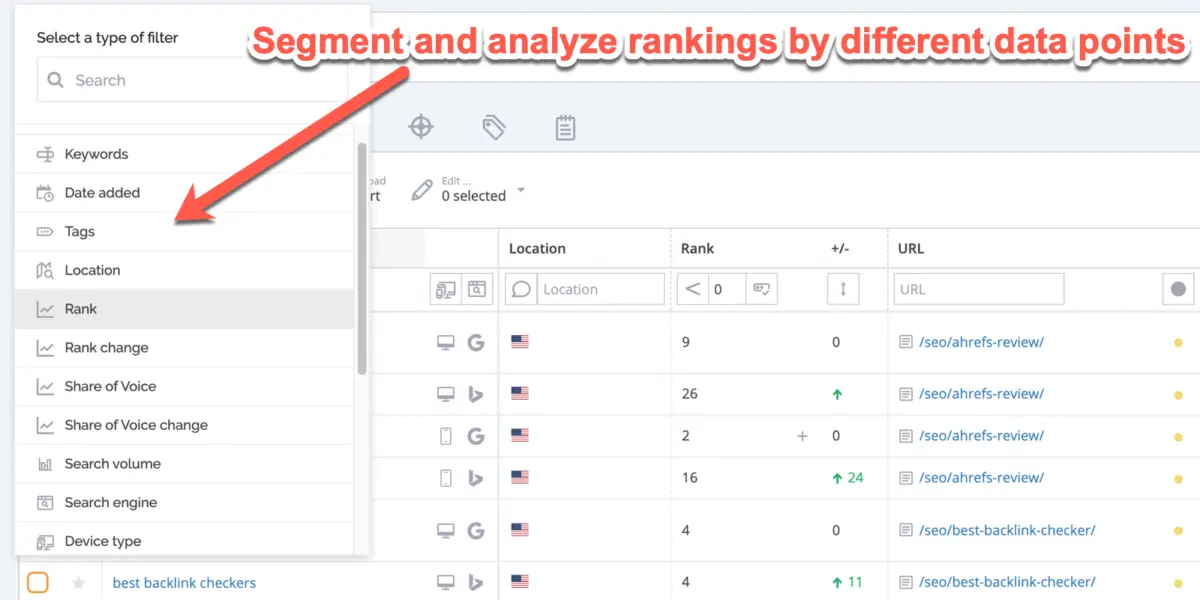
8. Tag and Segment Rankings Data
Large enterprise sites manage tens of thousands of keywords. Advanced tagging functionality allows teams to slice and dice data by topic, funnel stage, content format, or brand versus non-brand queries, ensuring targeted and actionable reporting.
9. Generate White-Label Reports
For agencies and enterprise consultants, client-facing communication is paramount. The ability to generate pristine, white-label PDF reports or integrate seamlessly with visualization tools like Google Looker Studio (formerly Data Studio) and Databox ensures that performance data is always digestible and professional.
Official Statements & Industry Expert Perspectives
To gauge how industry leaders utilize these tools, we turn to prominent voices in the SEO community:
"It’s by far the best keyword ranking tracker in the market and has a ton of great reporting functions. If you want visibility on large volumes of keywords housed within a nice dashboard — this is for you."
— Matthew Howells-Barby, Co-Founder, TrafficThinkTank
"The thing that really got me using them heavily in the last month or two is their Looker Studio connector. Combining the tag feature, as well as the Share of Voice metric… has been a big help in making these reports immediately digestible."
— Ian Howells, Co-Founder, Traffic Think Tank
7 Best SERP Tracking Tools to Consider in 2025
The market features countless options, split generally into two categories: dedicated standalone trackers and SERP tracking modules within all-in-one SEO suites. Below is our curated shortlist for 2025.
1. AccuRanker
Type: Standalone SERP Tracker
Best For: Agencies, enterprise brands, and professionals demanding ultra-fast, on-demand data updates.
Overview: Trusted by over 32,000 companies—including global brands like HubSpot, IKEA, and Kinsta—AccuRanker is widely considered the gold standard for dedicated rank tracking. It delivers lightning-fast daily updates alongside manual on-demand refreshes, deep SERP feature analysis, and robust analytics integrations.
Pricing: Starts at $116/month for up to 1,000 tracked keywords.
2. Semrush (Position Tracker & SERP Gap Analyzer)
Type: All-in-One SEO Suite Component
Best For: Marketers seeking a comprehensive digital marketing suite with enterprise-grade rank tracking.
Overview: Serving over 10 million users globally (including Samsung, Vodafone, and Booking.com), Semrush offers a Position Tracker that rivals the accuracy of any standalone tool. Its extensive feature set is further amplified by specialized add-ons like the SERP Gap Analyzer available in the Semrush App Center, which scans search results to uncover under-optimized content and integrates directly with Google Search Console.
Pricing: Subscription plans start at $139.95/month.
3. ProRankTracker
Type: Standalone SERP Tracker
Best For: E-commerce brands, international companies, and video marketers seeking cost-effective scalability.
Overview: Trusted by over 60,000 customers, ProRankTracker offers a robust, highly accurate tracking and reporting ecosystem across multiple languages, devices, and global locations without breaking the bank.
Pricing: Plans start at $39/month.
4. Advanced Web Ranking (AWR)
Type: Standalone SERP Tracker
Best For: In-house teams and enterprise agencies requiring deep customization and white-label reporting.
Overview: A veteran player in the SEO space trusted by enterprise brands like Microsoft, AWR excels in flexibility, multi-device tracking, location granularity, and comprehensive executive reporting.
Pricing: Plans start at $99/month.
5. SERPWatcher (by Mangools)
Type: All-in-One Suite Component (Mangools)
Best For: Small businesses, startups, and freelancers looking for simplicity and affordability.
Overview: Known for its user-friendly interface, SERPWatcher introduces a unique "Performance Index" metric that calculates organic traffic potential across all tracked keywords. Backed by the broader Mangools toolset, it delivers a streamlined experience without sacrificing core data accuracy.
Pricing: Mangools plans start at $29.90/month.
6. SE Ranking
Type: All-in-One SEO Suite
Best For: Small-to-medium agencies and growing businesses.
Overview: SE Ranking simulates user behavior across precise geographical locations to capture highly accurate ranking data. Its position-tracking module supports all major search engines across desktop and mobile devices.
Pricing: Plans start at $52/month.
7. Nightwatch
Type: Standalone SERP Tracker
Best For: Brands and agencies requiring hyper-local data across tens of thousands of global locations.
Overview: Trusted by enterprise giants like Shopify, Scotiabank, and Coinbase, Nightwatch provides exceptionally accurate daily rank tracking across more than 107,000 locations worldwide, paired with robust segmentation and visualization features.
Pricing: Free trial available; paid plans start at $32/month for up to 250 keywords.
Future Outlook: What Lies Ahead for SERP Tracking?
As we look deeper into the back half of the 2020s, the landscape of search engine optimization will continue to be reshaped by artificial intelligence, voice search integration, and hyper-personalized user experiences.
SERP tracking software is evolving rapidly to meet these challenges. Future iterations of these tools will likely incorporate advanced predictive analytics—using machine learning models to forecast how upcoming algorithm adjustments or competitor content updates might impact your rankings before they occur. Furthermore, the decoupling of traditional blue links in favor of conversational AI interfaces means that rank trackers will increasingly measure "brand presence" within AI-generated summaries rather than just static numeric positions.
Choosing the right tool today is an investment in your organization’s future adaptability. Whether you select a specialized standalone powerhouse like AccuRanker or a multifaceted ecosystem like Semrush, ensuring your tech stack is equipped with real-time data, granular geographic segmentation, and robust revenue attribution will be the defining factor in your organic search success throughout 2025 and beyond.