

Executive Overview
The ongoing hostility between the Trump administration and mainstream news organizations has entered a volatile new phase, underscoring a deepening constitutional clash over the boundaries of executive power and freedom of the press. Just forty-eight hours after a federal judge ordered the White House to reinstate the press credentials of several targeted media outlets, the administration engineered a targeted workaround. On Saturday, September 26, 2026, CNN was barred from traveling aboard Air Force One, effectively bypassing a federal injunction by drawing a technical distinction between stationary White House grounds and mobile presidential transit.
The latest escalation stems from a sweeping administrative ban implemented earlier in the month, which initially sought to strip CNN, MS NOW, and Politico of their "hard passes" to the White House complex. While a federal court temporarily halted that directive, citing fundamental violations of due process under the Fifth Amendment, the administration’s swift maneuver to exclude CNN from a presidential trip to Knoxville, Tennessee, demonstrates the administration’s resolve to exert unilateral control over its press corps. By replacing the network with a non-pool, conservative-leaning outlet—Real America’s Voice News—the administration has once again thrown the mechanics of presidential reporting into chaos, reigniting debates over institutional transparency, First Amendment protections, and the integrity of the collective press pool system.
Detailed Chronology: A Week of Legal Wins and Mid-Air Reversals
The friction between the executive branch and the press corps reached a boiling point in mid-September 2026, when President Donald Trump announced that CNN, MS NOW, and Politico would be immediately barred from the White House complex. Accusing the organizations of broadcasting "fiction and lies" and propagating "fake news," the administration attempted to sever their access without prior notice or administrative hearings.
The targeted organizations responded swiftly, mounting a joint legal challenge that argued the bans violated both their First Amendment rights—guaranteeing freedom of the press—and their Fifth Amendment rights to due process.
The Judicial Intervention
On Thursday, September 24, U.S. District Judge Timothy Kelly, a Trump appointee from the president’s first term, delivered a temporary restraining order against the White House. Judge Kelly ruled that the administration had acted unlawfully by revoking the outlets’ hard passes without offering fundamental due process. Reporters from CNN, MS NOW, and Politico promptly returned to their posts on White House grounds by Friday.
Concurrently, the legal battle exposed deep solidarity within the broader White House press corps. When CNN was initially stripped of its press privileges, the other four members of the traditional five-network television pool—ABC, CBS, NBC, and Fox News—refused to participate in rotating coverage schedules. This unprecedented boycott left several official presidential events entirely without standard network video and audio feeds, illustrating the interdependent nature of the modern press apparatus.
The Return and Immediate Retaliation
Normal operations appeared to edge back toward stability on Friday, September 25, when CNN resumed its standard television pool duties. The network provided vital coverage as President Trump met with Chinese President Xi Jinping during a high-profile visit to the National Archives.
However, the fragile truce dissolved by Saturday morning. President Trump took to Truth Social to air his grievances, writing: "Why should perpetrators of FAKE NEWS, like CNN and MSDNC, be allowed access to a very sacred place, the White House?"
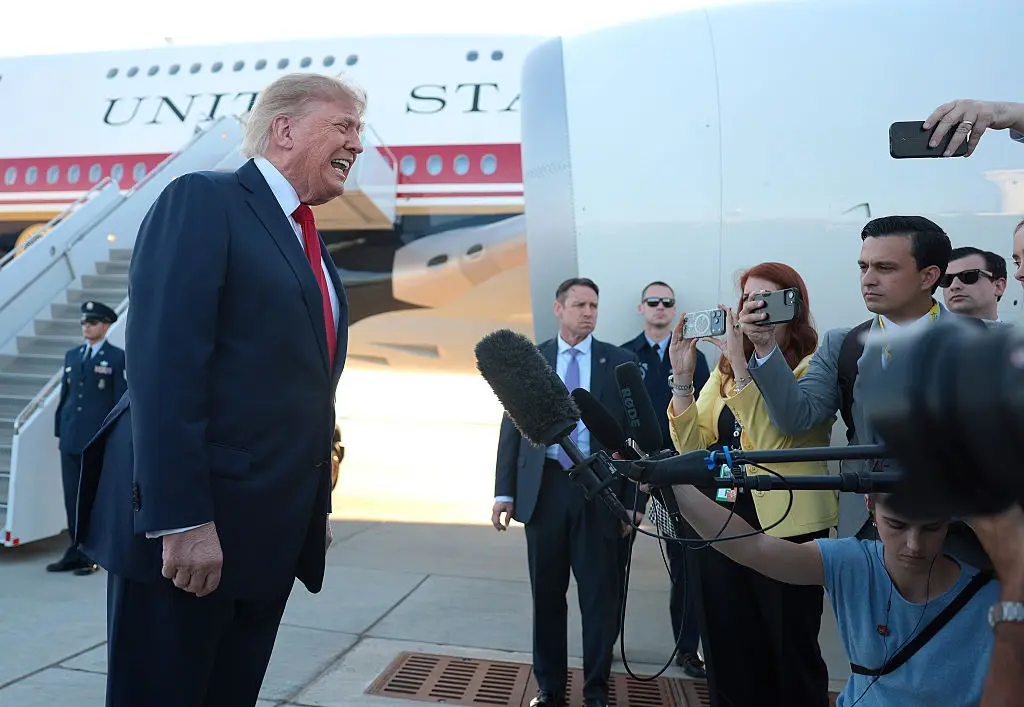
Hours later, the administration executed its latest restriction. CNN was formally dropped from the travel manifest for Air Force One ahead of the president’s weekend trip to Knoxville, Tennessee, where he was scheduled to attend a high-profile college football matchup between the University of Tennessee and the University of Texas. In a move that stunned media analysts, White House travel guidance replaced CNN with Real America’s Voice News—an organization operating outside the traditional, accredited five-network television pool rotation responsible for documenting and distributing footage of executive branch activities.
Supporting Context & Metrics: The Mechanics of the Press Pool
To fully understand the gravity of the administration’s actions, one must examine the operational framework of the White House press corps, which relies on a meticulously calibrated system of shared access and collective trust.
The Five-Network Television Pool
For decades, the White House television pool has functioned as a vital logistical bridge between the executive branch and the American public. Comprising five major networks—ABC, CBS, CNN, Fox News, and NBC—the pool operates on a rotating schedule. The designated network on duty is responsible for recording presidential movements, press gaggles, and official remarks, subsequently distributing that footage to all other domestic and international news organizations.
This cooperative model is designed to ensure that the movements of the leader of the free world are continuously and reliably documented, regardless of political tensions. When the administration disrupted this system by barring CNN, it did not merely punish a single network; it compromised the infrastructure through which historical events are recorded. The solidarity displayed by ABC, CBS, NBC, and Fox News in initially declining to provide substitute crews demonstrated an industry-wide recognition that unilateral exclusions threaten the integrity of the pool as a whole.
The Legal Gray Area: Hard Passes vs. Transit Access
Judge Timothy Kelly’s Thursday ruling explicitly addressed the revocation of the outlets’ "hard passes"—the credentials that grant journalists daily entry to the West Wing and working press areas of the White House complex. However, the order did not explicitly mandate inclusion on mobile transport vessels like Air Force One or assign specific seats within the rotating television pool rotation.
The administration’s legal strategy has leaned heavily on this distinction. By arguing that access to the President’s personal aircraft and domestic travel itineraries falls under discretionary executive privilege rather than public forum doctrine, administration attorneys have sought to circumvent the spirit of Judge Kelly’s injunction while adhering to its literal boundaries. Media lawyers, conversely, contend that manipulating travel manifests and pool rotations to penalize specific editorial viewpoints is a retaliatory practice that violates constitutional protections against viewpoint discrimination.
Official Statements and Rhetorical Escalation
The war of words between the executive branch and targeted journalists has intensified, shifting from policy disputes to direct personal confrontations.
The White House Perspective
The administration maintains that access to the White House is a revocable privilege rather than an absolute right, framing its actions as a necessary response to what it characterizes as pervasive journalistic bias. President Trump has repeatedly defended the bans by accusing the targeted outlets of manufacturing false narratives and failing to provide fair coverage of his administration’s accomplishments.
In his Saturday morning statement on Truth Social, the president questioned the basic premise of allowing critical news organizations access to federal facilities, signaling that the administration views adversarial reporting not as a cornerstone of democracy, but as a breach of institutional decorum.
The Media Response
Journalists and media executives have pushed back vigorously against these assertions. The tension was recently crystallized during a fiery exchange at the United Nations General Assembly in New York, where White House officials lacked jurisdiction over press credentials. When President Trump publicly upbraided CNN anchor and correspondent Kaitlan Collins for alleged failures in coverage, Collins stood her ground.
"We never said we were never going to cover the president," Collins retorted, refuting the administration’s claims that CNN intended to boycott presidential events entirely.
Legal representatives for CNN, MS NOW, and Politico have echoed this sentiment in court filings, emphasizing that a government cannot selectively punish news outlets simply because it dislikes their editorial output. The substitution of accredited pool members with fringe or non-traditional outlets like Real America’s Voice News—which lacks formal integration into the multi-network pool sharing agreement—has further inflamed concerns that the White House is attempting to curate a compliant, partisan media environment rather than engaging with an independent press.
Future Outlook: Constitutional Showdowns Ahead
As the legal teams prepare for subsequent rounds of litigation, the long-term implications for executive-press relations remain deeply uncertain.
The Judicial Horizon
Legal experts anticipate that the current temporary restraining order issued by Judge Kelly will soon face a more rigorous test as the plaintiffs seek a preliminary injunction. If the court expands its definition of unlawful retaliation to encompass travel privileges, pool rotations, and Air Force One manifests, it could establish a landmark precedent limiting an administration’s ability to weaponize logistics against critical reporters. Conversely, should appellate courts rule that presidential transport falls entirely within executive discretion, the White House could effectively neutralize hostile coverage by denying travel access while technically complying with stationary ground-access mandates.
Institutional Resilience and the Road Ahead
Regardless of the legal technicalities, the standoff has permanently altered the working relationship between the executive branch and the journalists assigned to cover it. The willingness of the other major television networks to halt pool operations in defense of a competitor signals a new era of collective defensive strategies within the press corps.
As the Trump administration continues to challenge the established norms of journalistic access, the courts will ultimately decide whether the executive branch can dictate who gets a seat on Air Force One—or if the constitutional guarantees of a free press extend safely into the skies.