

Executive Overview
As Tennessee State Senator Brent Taylor gears up for a high-stakes congressional run in the newly redrawn Ninth District, his legislative legacy tells a starkly different story than his campaign platform suggests. Over his nearly four-year tenure in the state legislature, the white, Republican former funeral home business owner has utilized a powerful GOP supermajority to systematically bypass, defund, and override the will of voters in Memphis—a historically Black, Democratic-leaning city.
Through a succession of aggressive state preemption laws, Taylor has targeted the core pillars of local autonomy: police oversight, criminal justice reform, and prosecutorial discretion. These measures were enacted under the banner of public safety, responding to Memphis’s struggle with high violent crime rates. However, civil rights advocates, criminal justice experts, and local leaders argue that Taylor’s policies function less as public safety initiatives and more as tools of social control. By dismantling local reforms passed in the wake of the 2023 police killing of Tyre Nichols and attempting to oust Shelby County’s first Democratic district attorney in 25 years, Taylor has shaped a political career defined by superseding urban self-governance.
Now, following a controversial redistricting process that transformed Tennessee’s historically majority-Black Ninth Congressional District into a sprawling, majority-white expanse, Taylor is heavily favored to win a seat in Washington, D.C. His primary challenger, 31-year-old Black Democratic state Representative Justin J. Pearson, represents an ideological polar opposite—championing systemic investments in education and economic opportunity over mass incarceration. As Taylor transitions his sights from the Tennessee General Assembly to the halls of Congress, the debate over his record highlights a deepening fracture between rural and suburban white lawmakers and the urban centers they seek to govern from afar.
Detailed Chronology: A Legislative Assault on Local Autonomy
The conflict between state-level preemption and municipal self-determination in Memphis is not abstract; it is anchored in a precise timeline of legislative maneuvers that coincided with local tragedies and political shifts.
January 2023: The Catalyst of Tyre Nichols’ Death
The political landscape of Memphis shifted indelibly in January 2023, the very month Taylor took office. The nation reeled from the release of harrowing video footage showing undercover Memphis police officers repeatedly punching, kicking, and using a baton on 29-year-old Tyre Nichols just blocks from his mother’s home. Nichols died from his injuries three days later.
In response to intense pressure from the Nichols family and community activists, the Memphis City Council unanimously passed a groundbreaking ordinance in April 2023. The law banned police officers from pulling motorists over for minor, non-safety-related traffic infractions—such as a broken taillight—as a pretext for investigating unrelated, more serious crimes. Research has repeatedly demonstrated that these pretextual stops are disproportionately deployed against Black drivers, eroding public trust and generating volatile, unnecessary police encounters.
2024: Stripping Local Authority Over Traffic Stops
Viewing the Memphis ordinance as a threat to public safety enforcement, Taylor and state Representative John Gillespie struck back. They co-sponsored legislation explicitly prohibiting local governments from curbing law enforcement’s ability to conduct traffic stops, effectively nullifying the Memphis ordinance.
Despite impassioned pleas from Tyre Nichols’ mother, RowVaughn Wells, urging lawmakers to reject the bill, Taylor defended the legislation on the Senate floor. Acknowledging his background as a funeral home director, Taylor stated, "We can’t let that empathy, Mr. Speaker, cloud our judgment in protecting 7 million Tenneseans." Governor Bill Lee signed the bill into law, contending that while police need tools, they must be held accountable. Eight months later, a U.S. Department of Justice investigation corroborated local concerns, finding that the Memphis Police Department’s aggressive traffic enforcement unlawfully discriminated against Black residents and routinely enabled excessive force.
2023–2026: The Campaign Against District Attorney Steve Mulroy
Taylor’s preemption strategy extended aggressively into the judicial sphere, targeting Shelby County District Attorney Steve Mulroy. Elected in 2022 as the county’s first Democratic prosecutor in a quarter-century, Mulroy campaigned on rehabilitation, mental health counseling, drug treatment, and deprioritizing low-level offenses like marijuana possession.
Taylor labeled Mulroy a "far-left zealot" whose policies would worsen violent crime. Beginning in 2023, Taylor sponsored a law transferring the power to review death penalty cases from local elected prosecutors to the state attorney general—a move that disproportionately impacted Shelby County, home to half of Tennessee’s death row prisoners.
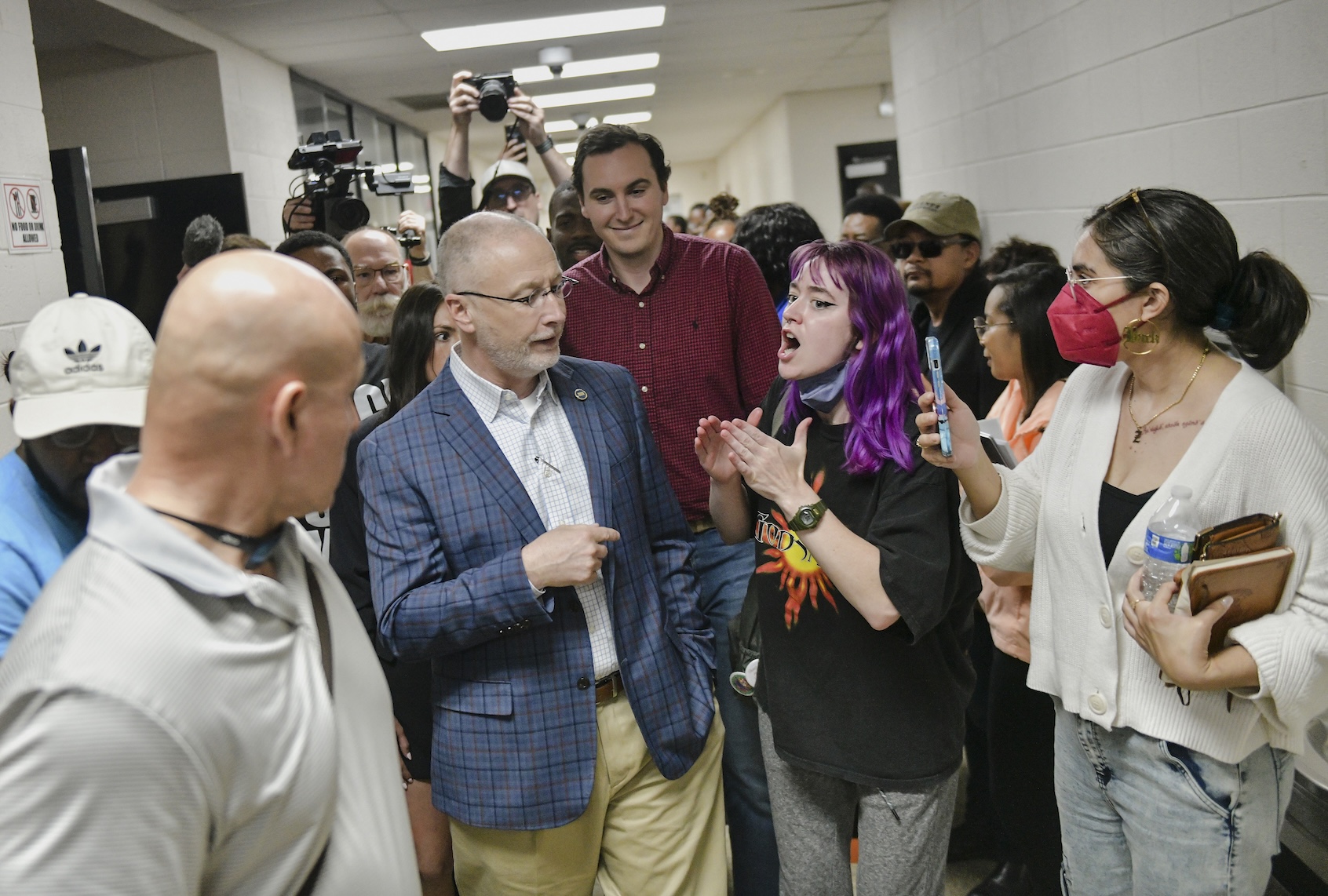
The pressure escalated dramatically following the deployment of a federal-state crime task force by the Trump administration. Taylor co-sponsored legislation authorizing the state attorney general to review every case processed through Mulroy’s office and report dispositions to legislative leaders. Furthermore, the law granted the state Supreme Court the power to install an unelected "shadow district attorney" if Mulroy opted not to prosecute certain categories of crime. Mulroy responded by filing a state lawsuit challenging the oversight laws as unconstitutional overreaches that undermine prosecutorial independence.
2023: Dismantling the Bail "Ability to Pay" Calculator
Among Taylor’s most impactful interventions was his 2023 dismantling of a bipartisan Shelby County bail reform order. Prior to the agreement, hundreds of impoverished defendants—disproportionately Black—were languishing in the overcrowded Shelby County Jail simply because they could not afford cash bail, risking the loss of their jobs and child custody.
In August 2022, local criminal justice advocates, the ACLU, and Republican District Attorney Amy Weirich agreed to a new bail framework that incorporated an "ability to pay" calculator. Taylor immediately moved to dismantle it. Co-sponsoring a preemption bill that passed into law, Taylor banned judges from considering a defendant’s financial condition when setting bail. A 2025 University of Memphis study confirmed that median bail amounts subsequently spiked, driving up jail populations and disproportionately impacting low-income Black residents.
Supporting Context & Metrics: The Mechanics of Preemption
State preemption is not unique to Tennessee. In recent decades, Republican-dominated statehouses across the United States have increasingly leveraged preemption to block progressive or moderate policies enacted by Democratic-led cities concerning civil rights, labor protections, and public health.
However, legal and academic experts emphasize that Tennessee’s application of preemption toward Memphis carries distinct racial dynamics.
- The Shelby County Jail: The facility has faced severe scrutiny, with more than 65 inmate deaths recorded since 2018. Critics argue that Taylor’s elimination of the bail calculator and his push for aggressive incarceration will drive these mortality and overcrowding metrics higher.
- The Ninth Congressional District Shift: Following a U.S. Supreme Court ruling that curtailed challenges to partisan gerrymandering, Tennessee Republicans redrew the map. The Ninth Congressional District, which stood for over 40 years as a majority-Black district rooted in Memphis, now stretches across half the state and possesses a majority-white electorate.
- Campaign Finances: Brent Taylor, who amassed millions through the sale of his family funeral home businesses, has heavily self-funded his congressional campaign, loaning it $1.5 million. Meanwhile, his opponent, state Representative Justin J. Pearson, has successfully leveraged national Democratic networks to slightly outraise Taylor in direct campaign donations.
Official Statements and Expert Perspectives
The philosophical chasm dividing Taylor’s approach from that of Memphis leadership is illuminated by key statements from legal scholars, local officials, and the candidates themselves.
- Brent Taylor (State Senator / Congressional Candidate): Defending his legislative record before the U.S. Senate Judiciary Committee and in public statements, Taylor has maintained that his laws are strictly designed to prioritize public safety and hold local officials accountable. Referring to District Attorney Mulroy during task force operations, Taylor asserted that Memphis residents "deserve confidence that the significant investments being made to combat violent crime are matched with accountability at every level of the justice system."
- John Pfaff (Fordham School of Law Professor): Analyzing the broader architecture of preemption, Pfaff explained that suburban and rural voters, feeling alienated by the social policies of urban centers, leverage their legislative supermajorities to exert control. "If the suburbs and rural areas control the governor’s mansion and the state legislature, they then can use their power there through preemption laws that finally tell Memphis what they want Memphis to do," Pfaff noted, adding that tough-on-crime legislation has historically served as a mechanism of social control over minority communities.
- Bill Anderson (Former Shelby County General Sessions Court Judge): Speaking on the practical fallout of Taylor’s judicial laws, Anderson—who retired early after clashing with Taylor over bail reform—issued a stark warning: "I think he’s very dangerous for Shelby County, and he’s going to be very dangerous for the Ninth District if he gets elected… To those of us in the system, it’s obvious what he’s doing. He called them reform acts, but they’re not reform."
- Justin J. Pearson (State Representative / Congressional Opponent): Positioning himself as an advocate for systemic root-cause solutions, Pearson has emphasized the need to invest in local schools, environmental justice, and economic development rather than relying exclusively on punitive incarceration.
Future Outlook: The Road to Washington and Local Fallout
As the 2026 midterm election approaches, the contest between Brent Taylor and Justin J. Pearson in Tennessee’s redrawn Ninth District stands as a referendum on governance, representation, and the limits of local democracy.
If Taylor secures victory, as polling and the newly engineered district map suggest, it will validate a hardline preemption model wherein state legislators can effectively bypass municipal electorates to implement their preferred criminal justice and social policies from Nashville. For Memphis, this outcome threatens to institutionalize an era of state tutelage, where locally elected officials—from the city council and the school board to the district attorney—operate under the constant shadow of state oversight and legal threats.
Conversely, a victory for Pearson would signal a powerful counter-mobilization by urban voters against legislative gerrymandering and state preemption. Regardless of the electoral outcome, the structural friction between Tennessee’s rural-suburban statehouse majority and its largest urban, majority-Black city has permanently altered the civic landscape of Memphis, establishing a contentious precedent for local self-determination nationwide.