

Executive Overview
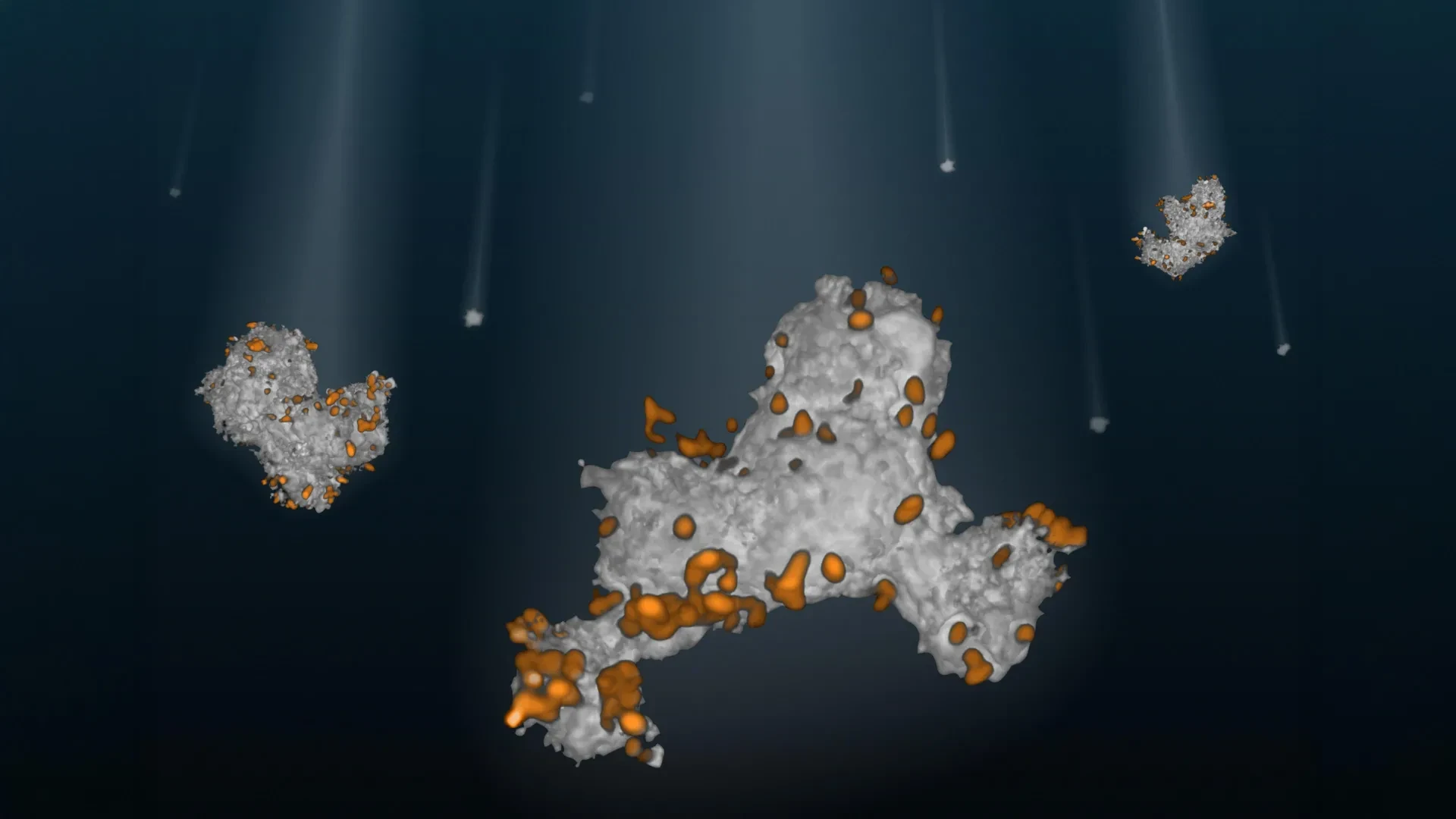
Far beneath the sunlit surface of the open ocean, an eternal, silent blizzard drifts downward into the abyss. Unlike the crystalline water-ice that blankets terrestrial landscapes, this underwater precipitation is composed of organic refuse: discarded animal mucus, microscopic fecal pellets, particulate silt, and the skeletal remains of dead plankton. Known to oceanographers as "marine snow," this aggregate shower is far more than oceanic debris. It serves as Earth’s primary biological elevator, sweeping carbon dioxide absorbed from the atmosphere down toward the twilight and midnight zones of the sea.
Each year, this descending blizzard captures and removes an estimated 10 gigatons of carbon from surface waters. Yet, a longstanding mystery has baffled marine scientists: roughly 80 percent of this carbon dissolves or is metabolized on its downward journey, leaving only about two gigatons to reach the abyssal depths where it can be sequestered for centuries or millennia.
Now, a groundbreaking collaborative study conducted by researchers at UC San Diego’s Scripps Institution of Oceanography and the University of Lincoln has illuminated a critical, previously overlooked variable in this global carbon calculus: the viscosity—or sheer stickiness—of the marine snow itself. Published on October 8 in the journal Science, with a complementary methodological breakdown in Nature Communications, the research reveals that the gooeyness of these microscopic aggregates dictates how effectively hungry ocean bacteria can break them apart.
According to the findings, the stickiest, most viscous marine snow particles can deliver more than six times as much carbon to the deep ocean as their thinner, less cohesive counterparts. By deploying cutting-edge 3D microscopy and custom fluorescent markers after a four-year technical quest, scientists have opened an unprecedented window into the "mucoscape"—a microscopic frontier whose implications stretch far beyond marine carbon cycling, touching human medicine, coral reef conservation, and microbial ecology.
Detailed Chronology: A Four-Year Quest to Visualize the "Mucoscape"
To understand how marine snow operates at a molecular level, researchers first had to overcome a technological barrier that had stymied microbiology for decades: the inability to observe live bacteria interacting with the physical architecture of mucus in real time.
The Genesis in 2021
The journey began in 2021 when Dr. Bryce Inman, then a postdoctoral researcher at Scripps Oceanography, set out to map what he colloquially termed the "mucoscape." For generations, marine scientists understood that bacteria consumed sinking organic matter, but the exact mechanical relationship between bacterial enzymes and the complex polymer networks of marine snow remained a black box.
"Observing individual bacteria interacting with the physical structure of mucus had never been possible," Inman noted, reflecting on the opacity of the medium and the limitations of traditional imaging tools.
Teaming up with veteran microbiologist and Scripps professor emeritus Farooq Azam, Inman embarked on a grueling four-year research and development cycle. Early iterations of their experiments routinely failed. Mucus is notoriously difficult to image; it is structurally heterogeneous, highly hydrated, and sensitive to preparation artifacts. Traditional microscopy flattened these delicate three-dimensional matrices, destroying the very spatial relationships the team sought to measure.
The Breakthrough in 2025
After years of trial and error, the interdisciplinary team finally cracked the observational code in 2025. Their breakthrough relied on a powerful synergy between advanced 3D confocal microscopy and custom-engineered fluorescent molecules.
Confocal microscopy bypasses the limitations of standard light microscopy by using spatial pinholes to block out-of-focus light, capturing crisp optical sections at varying depths within a thick sample. When paired with fluorescent tags designed to bind selectively to specific biochemical components of marine snow, the microscope allowed researchers to digitally reconstruct the particles in three dimensions.
For the very first time, scientists could inspect the rugged topography of an individual flake of marine snow. The resulting imagery revealed an extraordinarily intricate landscape complete with internal bulges, micro-crevasses, density gradients, and structural variations that fundamentally dictate microbial colonization.
Supporting Context & Metrics: The Mechanics of the Marine Carbon Pump
To fully appreciate the weight of this discovery, one must examine the mechanics of the ocean’s biological carbon pump—a cornerstone of Earth’s global carbon cycle.
[Atmospheric CO2]
       │
       ▼ (Photosynthesis by Phytoplankton)
[Surface Waters: Organic Matter & Plankton]
       │
       ▼ (Aggregation into "Marine Snow" ~10 Gigatons/yr)
[Descending Slime Particles] ◄─── Bacterial Attack & Viscosity Resistance
       │
       ├───> ~8 gigatons metabolized/released in upper ocean
       │
       ▼ (~2 Gigatons/yr sequestered for centuries)
[Deep Ocean Floor / Abyssal Storage]
The Global Carbon Equation
The global carbon cycle dictates the continuous exchange of carbon among the atmosphere, terrestrial ecosystems, and the oceans. The oceans act as our planet’s largest active carbon sink, absorbing roughly a quarter of all human-generated carbon emissions.
When microscopic surface-dwelling phytoplankton photosynthesize, they pull carbon dioxide from the atmosphere. When these organisms die, or when they are consumed and excreted by zooplankton, their remnants clump together with ambient silt and mucus, forming marine snow. As these aggregates plummet toward the sea floor, they form the backbone of the biological carbon pump.
The Bacterial Battleground
However, the descent is fraught with peril for the carbon cargo. The water column is teeming with heterotrophic bacteria that view marine snow not as a vehicle for global climate regulation, but as a rich, nutrient-dense floating buffet.
As the particles sink, these bacteria attach themselves to the organic matter, secreting extracellular enzymes to hydrolyze the complex carbohydrates and proteins. If bacteria digest the aggregate too quickly, the particle breaks apart, dissolving its carbon back into dissolved inorganic carbon in the upper ocean, where it can eventually outgas back into the atmosphere.
The Viscosity Factor
The Scripps and University of Lincoln study reveals that the physical consistency of the marine snow dictates the outcome of this microbial siege. Using their new imaging suite, the researchers discovered that bacteria do not—and cannot—attack a marine snow particle uniformly.
Instead, bacteria preferentially colonize the outer margins and peripheral zones of the particles, where the mucus is less viscous, thinner, and more easily penetrable. The dense, highly viscous, hyper-gooey regions located deep within the interior of the aggregate present a formidable physical barrier.
"Bacteria can latch on to less viscous portions of each particle, but cannot reach more viscous regions until they break it down," Inman explained, offering an intuitive analogy: "Think of it like a worm in an apple: the flesh is easy to penetrate, but the core is tough to chew through."
Through a combination of controlled laboratory experiments and advanced computational fluid dynamics simulations, the team quantified this phenomenon. Particles possessing high internal viscosity resisted bacterial degradation and physical fragmentation for drastically longer periods. Consequently, these robust, sticky flakes maintain their structural integrity throughout a much longer descent, ensuring that over six times more carbon reaches the abyssal sediment than is delivered by their watery, low-viscosity counterparts.
Official Statements & Expert Insights
The implications of this study extend well beyond chemical oceanography, prompting re-evaluations across multiple biological disciplines.
Dr. Bryce Inman emphasized the paradigm shift regarding how scientists view biological slime:
"Mucus, slime, whatever you want to call it, has a surprising amount of structure. There are bulges, crevasses, all this sort of structure to it that we really had no idea about at a scale smaller than bacteria. This is the first time we’re really examining this physical habitat."
Dr. Farooq Azam, whose decades of microbiological research laid the groundwork for this inquiry, pointed out that the findings resolve long-standing discrepancies in global carbon export models. For years, models struggled to reconcile why particles of seemingly identical chemical composition yielded vastly different carbon sequestration rates. The missing variable was physical micro-architecture and rheology—the study of the flow and deformation of matter.
Furthermore, independent experts in biogeochemistry have hailed the study as a methodological triumph. By marrying high-resolution optical physics with marine ecology, the research team has provided a blueprint for analyzing micro-scale environmental interactions that were previously relegated to theoretical speculation.
Funding and institutional support for the four-year endeavor were jointly provided by the Simons Foundation and the Engineering and Physical Sciences Research Council (EPSRC), underscoring the cross-disciplinary value of the work to both biological foundations and physical engineering bodies.
Future Outlook: Implications Beyond the Ocean
While the immediate application of this discovery is refining global carbon budgeting and climate change projections, the insights gained from visualizing the "mucoscape" carry profound weight across entirely unrelated fields of science and medicine.
Mucus is ubiquitous in nature. Far from being a simple, inert, slippery lubricant, mucus is a sophisticated biological hydrogel secreted by organisms across the tree of life. The micro-architectural complexities and viscosity gradients uncovered in marine snow are mirrored in numerous other biological systems.
1. Human Digestive Health and Mucosal Immunology
In human medicine, mucosal layers line the respiratory, gastrointestinal, and urogenital tracts, serving as the body’s first line of defense against pathogenic invasion. Understanding how bacteria navigate, colonize, and break down mucus matrices of varying viscosities can yield new insights into microbiome dynamics, inflammatory bowel diseases, and targeted drug delivery systems that must traverse mucosal barriers.
2. Coral Reef Conservation
Coral reefs rely heavily on mucus layers to trap nutrients, shed harmful sediments, and ward off microbial pathogens. As ocean acidification and warming temperatures alter seawater chemistry, the physical properties—including the viscosity—of coral mucus can shift, potentially rendering reefs more susceptible to disease and bleaching events. The microscopy techniques developed in this study offer marine biologists a new tool to assess coral health at the microscopic level.
3. Plant-Soil Interactions and Kelp Forests
Terrestrial plant root systems exude mucilage into the surrounding rhizosphere to facilitate water absorption and nutrient exchange, supported by complex microbial communities. Similarly, giant kelp forests produce vast quantities of mucilaginous exudates that fuel coastal food webs. The principles of viscosity-mediated bacterial degradation discovered in marine snow apply directly to these crucial ecological niches.
The Road Ahead
As climate scientists race to improve predictive models of Earth’s carbon cycle, incorporating micro-scale variables like marine snow viscosity represents a monumental leap forward. What happens in the microscopic crevices of an oceanic speck of dust ultimately determines the chemical composition of our atmosphere and the stability of our global climate.
By proving that something as seemingly mundane as the thickness of underwater slime can exert a planetary-scale influence, this research bridges the gap between the infinitely small and the infinitely vast—transforming our understanding of the deep ocean’s silent snowfall forever.
