

Executive Overview
In what may mark a watershed moment for modern biotechnology, researchers at the Massachusetts Institute of Technology (MIT) have unveiled a groundbreaking technique that transforms immune cells into precision cancer-fighters directly inside the human body. Published in the prestigious journal Nature Biotechnology, this innovative approach bypasses the complex, costly, and time-consuming laboratory manufacturing processes that have historically bottlenecked personalized cell therapies.
For over a decade, revolutionary treatments such as CAR-T cell therapy have offered renewed hope to patients battling stubborn blood cancers. Yet, these therapies remain trapped in a paradigm of logistical nightmares: harvesting a patient’s cells, shipping them to centralized cleanrooms, genetically altering them over weeks, and re-infusing them at exorbitant costs.
The MIT team—led by senior author Daniel Anderson, institute professor Robert Langer, postdoctoral researcher Yuang Chen, and graduate students Julia Monkovic and Haseeb Mughal—has shattered this paradigm. By engineering lipid nanoparticles (LNPs) to deliver messenger RNA (mRNA) instructions directly to natural killer (NK) cells in vivo, the researchers have successfully reprogrammed these immune cells inside living subjects. The resulting "CAR NK cells" have demonstrated a remarkable capacity to hunt down tumors, obliterate aggressive melanomas, and even reverse autoimmune liver damage with startling efficiency.
If successfully translated to human clinical trials, this technology promises to democratize advanced immunotherapy, transforming bespoke, multi-week treatments into off-the-shelf nanoparticle infusions akin to standard vaccinations.
Detailed Chronology: From Lab Bench Breakthrough to In-Vivo Triumph
The genesis of this scientific breakthrough lies in the relentless pursuit of more efficient delivery systems for genetic payloads. For years, the scientific community has recognized the immense potential of CAR (chimeric antigen receptor) technologies. However, the physical reality of executing genetic modifications ex vivo (outside the body) has severely limited patient access and strained healthcare infrastructures.
The Evolution of Cellular Engineering
The journey began with the FDA approval of CAR-T cell therapies, which supercharge a patient’s T cells to hunt down specific cellular markers. While effective against B-cell malignancies like leukemia and lymphoma, CAR-T therapies hit a brick wall when targeted against T-cell cancers or T-cell-driven autoimmune disorders. Because both the therapeutic cells and their targets are T cells, they engage in fratricide—destroying one another before the treatment can take root.
To sidestep this immunological friendly fire, scientists turned their attention to natural killer (NK) cells. Unlike T cells, NK cells operate via distinct activation pathways, making them uniquely suited to hunt down rogue T cells without attacking themselves. However, producing CAR NK cells ex vivo retained many of the same infrastructural hurdles, specialized labor requirements, and financial burdens plaguing CAR-T production.
The Nanoparticle Breakthrough
Recognizing these systemic bottlenecks, the MIT team pivoted to a radical question: What if, instead of taking the immune cells out of the body to be modified, we sent the modification tools directly to the cells inside the body?
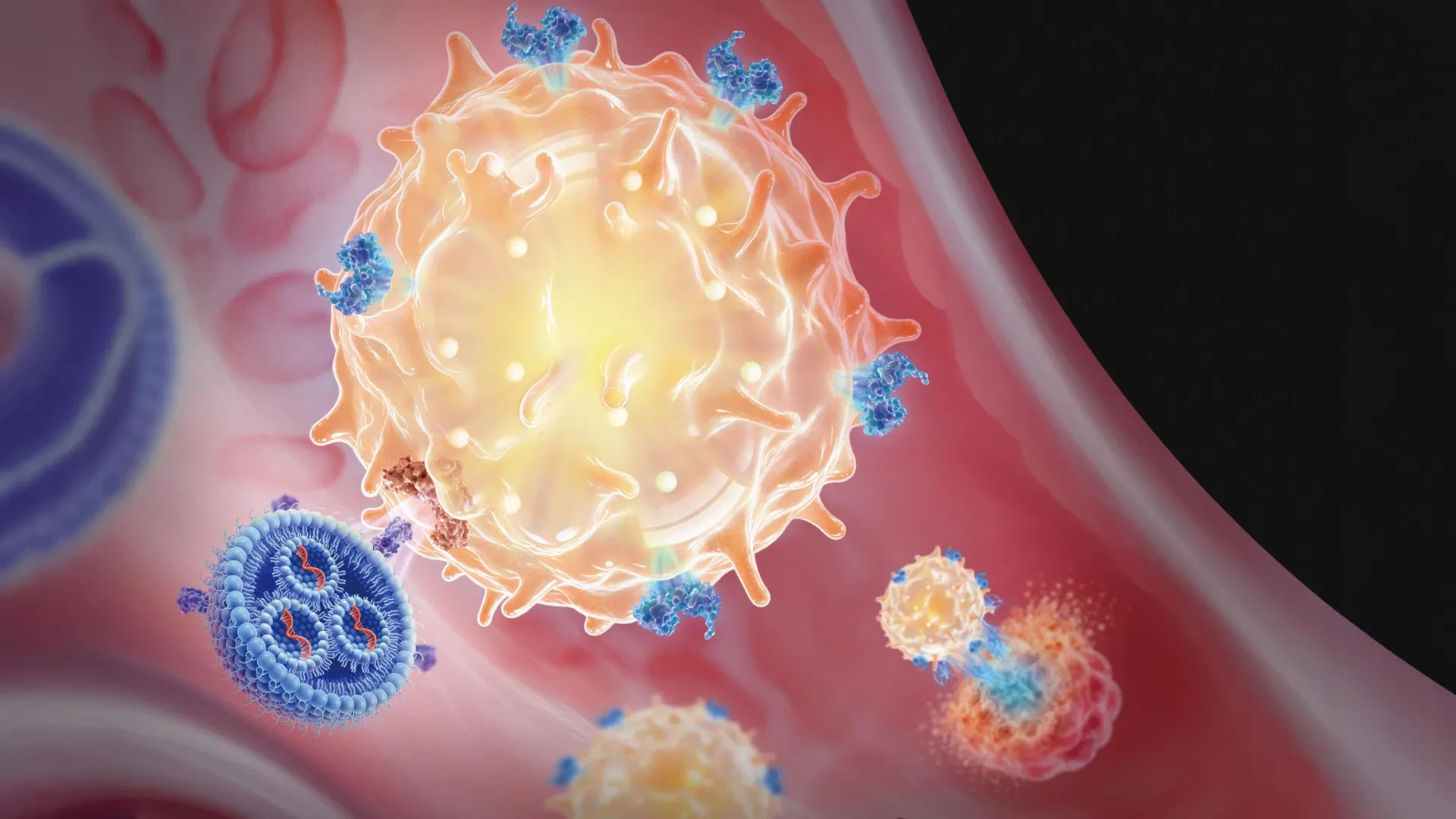
To achieve this, the researchers engineered specialized lipid nanoparticles. These microscopic fatty bubbles were loaded with mRNA blueprints encoding specific chimeric antigen receptors. To ensure these genetic instructions didn’t drift aimlessly through the bloodstream, the team decorated the outer surface of the nanoparticles with targeted antibody fragments. These molecular "address labels" were programmed to recognize and bind exclusively to surface receptors on natural killer cells.
Preclinical Validation: Mice, Melanoma, and Lymphoma
With the delivery mechanism perfected, the MIT team advanced to rigorous animal testing. The results exceeded expectations:
- Cellular Targeting Efficiency: Upon injection into murine models, the nanoparticles successfully located and genetically modified approximately 80 percent of the targeted NK cells in vivo.
- Melanoma Remission: In mice bearing aggressive forms of melanoma, a targeted nanoparticle regimen yielded complete tumor remission in three out of five test subjects.
- T-Cell Lymphoma Eradication: Utilizing humanized mice—animals engineered with functional components of the human immune system—the researchers administered five successive nanoparticle injections. The treatment completely obliterated human T-cell lymphoma tumors, yielding therapeutic outcomes statistically indistinguishable from traditional ex vivo manufactured CAR NK cell infusions.
- Reversing Autoimmune Hepatitis: Expanding the technology beyond oncology, the team targeted autoimmune hepatitis—a debilitating condition where rogue T cells attack healthy liver tissue (hepatocytes). A single nanoparticle injection successfully purged the autoreactive T cells, allowing the damaged liver tissue to regenerate and heal entirely.
Supporting Context & Metrics: The Mathematics of Medical Access
To fully appreciate the gravity of MIT’s in vivo reprogramming technique, one must examine the staggering metrics and logistical realities governing current cellular immunotherapies.
The Scale of Current Immunotherapy Bottlenecks
- Seven and Counting: Over the past decade, the U.S. Food and Drug Administration has greenlit seven autologous CAR-T cell therapies.
- The Cost Barrier: Conventional cell therapies routinely carry price tags ranging from $350,000 to over $500,000 per patient, driven almost entirely by the intricate, labor-intensive manufacturing chain.
- The Time Factor: From leukapheresis (blood collection) to final infusion, the turnaround time for traditional CAR therapies typically spans two to four weeks—a window of time many advanced-stage cancer patients simply do not have.
- The 80% Benchmark: The MIT nanoparticle system achieved an in vivo transfection and modification rate of roughly 80% in targeted NK cells, a conversion efficiency previously thought impossible outside of a controlled, sterile laboratory incubator.
- 100% Clearance: In humanized mouse models of T-cell lymphoma, a localized course of five injections achieved total tumor clearance, matching the efficacy of gold-standard laboratory-engineered cell therapies without requiring a single day of ex-vivo processing.
Official Statements: Perspectives from the MIT Pioneers
The implications of this research extend far beyond academic curiosity, offering a profound glimpse into the future of clinical medicine. The lead architects of the study have emphasized both the technical elegance of the discovery and its expansive therapeutic horizons.
"The manufacturing challenges with CAR NK cells are significant. The idea here is you can deliver a nanoparticle that will modify your own NK cells with a CAR construct and teach them to attack tumor cells."
— Daniel Anderson, Professor in MIT’s Department of Chemical Engineering, Koch Institute Member, and Senior Author of the Study.
Anderson’s vision underscores the democratization of care. By replacing multimillion-dollar cleanroom processing facilities with a scalable, injectable pharmaceutical product, healthcare providers could theoretically administer cell therapies in standard outpatient clinics.
"If a patient can just get an infusion of nanoparticles, it would dramatically simplify the process and reduce costs."
— Daniel Anderson
Co-author Robert Langer, MIT’s David H. Koch Institute Professor and a titan in the field of drug delivery, highlighted the broader pharmacological versatility of the platform:
"This study is an excellent example of the power of nano delivery systems and their ability to potentially treat cancer and other diseases."
— Robert Langer
Lead researcher Yuang Chen elaborated on the unique clinical utility of targeting natural killer cells over conventional T cells, particularly when addressing complex immunological disorders:
"NK cells can treat these T cell malignancies — not only T cell cancer, but also T cell autoimmune diseases."
— Yuang Chen, MIT Postdoctoral Researcher
Future Outlook: Horizons in Oncology, Autoimmunity, and Beyond
While the preclinical results in murine and humanized mouse models are undeniably thrilling, the scientific community maintains a measured, rigorous perspective regarding the road ahead.
Bridging the Preclinical-Clinical Divide
The most critical next phase for the MIT team involves rigorous toxicology and safety evaluations in larger animal models, laying the necessary groundwork for Investigational New Drug (IND) applications with regulatory bodies like the FDA. Ensuring that lipid nanoparticles selectively modify NK cells without triggering systemic inflammatory cascades or off-target genetic alterations will be paramount as trials scale upward.
Expanding the Therapeutic Target Matrix
Beyond melanoma, lymphomas, and autoimmune hepatitis, the foundational architecture of the LNP-mRNA platform opens doors to an expansive array of intractable pathologies:
- Multiple Sclerosis (MS): By deploying nanoparticles that program NK cells to eliminate myelin-autoreactive T cells, researchers hope to halt or reverse neurodegenerative autoimmune damage.
- Rheumatoid Arthritis: Similar precision strikes could neutralize the destructive immune cells responsible for joint degradation.
- Solid Tumors: While blood cancers have been the primary beneficiaries of early immunotherapies, adapting CAR NK cells to infiltrate and dismantle dense solid tumors remains a holy grail of modern oncology.
A New Era of Accessible Medicine
Ultimately, the transition from ex vivo cell engineering to in vivo nanoparticle reprogramming represents more than just a procedural upgrade—it is a philosophical reimagining of how we treat disease. By turning the human body into its own biological manufacturing plant, MIT’s pioneering research points toward a future where advanced, life-saving immunotherapies are no longer rare commodities locked behind walls of prohibitive cost and complexity, but universally accessible therapeutics available at the stroke of a syringe.
Funding for this transformative research was generously provided by Sanofi, the Marble Center for Cancer Nanomedicine, and a Koch Institute Support (core) Grant from the National Cancer Institute.
