

Executive Overview
Trends come and go, but personal style remains entirely eternal. While the beauty industry often fixates on fleeting aesthetics, universal color palettes, and rapid-fire seasonal makeup transformations, nothing is quite as foundational—or as deeply personal—as the architectural structure of your face. Among the diverse spectrum of human facial geometries, one stands out for its innate romance, dramatic contrast, and striking visual balance: the heart-shaped face.
Frequently referred to by beauty professionals and structural stylists as the inverted or reverse triangle, the heart-shaped face is a captivating canvas. Defined by a commanding, wide forehead that gracefully tapers down through pronounced, high cheekbones to settle at a delicate, pointed chin, this facial architecture acts as a natural contour. It is a geometry shared by some of the most enduring icons in cinematic and cultural history, from Reese Witherspoon and Scarlett Johansson to supermodel royalty like Naomi Campbell.
Yet, despite its inherent photogenic quality, styling for a heart-shaped face requires a nuanced understanding of proportion, weight distribution, and visual equilibrium. Because the primary width is concentrated in the upper third of the face—specifically at the temples and forehead—improper haircuts or overly severe styling choices can inadvertently exaggerate this upper dominance, throwing the overall harmony out of alignment. Conversely, mastering the mechanics of this shape allows individuals to harness volume, strategic texturizing, and clever framing to create a breathtaking sense of symmetry.
To demystify the art of styling the heart-shaped face, we sat down exclusively with Eric Marshall Wright, owner of the renowned Eric Marshall Salon in Nashville, Tennessee. Drawing from years of high-end salon experience and structural hair design, Wright breaks down the anatomy of the reverse-triangle visage, offering expert insights on how to achieve salon-quality results at home, which common styling pitfalls to aggressively avoid, and the essential tools and products required to elevate your everyday routine.
Detailed Chronology: The Evolution of Face-Shape Mapping in Modern Hairstyling
To truly understand why certain cuts flatter a heart-shaped face while others falter, it is helpful to examine how the beauty and hairstyling industries arrived at modern face-shape mapping. Long before the era of algorithmic beauty filters, contouring tutorials, and digital face-scanners, classic hairstylists operated on strict geometric principles rooted in classical art and proportion.
The Mid-20th Century: The Birth of Structural Hair Design
During the golden age of Hollywood salon culture in the 1950s and 1960s, master stylists began analyzing the skeletal frameworks of silver screen stars. Figures like Audrey Hepburn and Marilyn Monroe were meticulously styled not merely based on hair texture, but on how their bone structure interacted with light, shadow, and spatial geometry. Stylists realized that the human eye naturally seeks balance—an equilibrium between top and bottom, width and length.
For those with heart-shaped faces, early stylists noted a distinct challenge: the stark contrast between a broad upper half and a narrow lower half. The historical solution during this period relied heavily on chin-length bobs with flipped-out ends, designed explicitly to artificially widen the lower jawline and create a sense of visual squareness where nature had provided a point.
The Late 20th Century: The Rise of Face-Framing Layers
As fashion shifted toward more relaxed, bohemian, and textured looks in the 1970s and 1990s, the rigid geometry of mid-century styling gave way to softer, more organic approaches. Icons like Reese Witherspoon emerged in the late ’90s and early 2000s, bringing the heart-shaped face to the forefront of contemporary pop culture.
During this era, hairstylists pioneered the concept of "soft framing." Rather than attempting to completely reshape the jawline with heavy, structured lines, stylists began utilizing wispy, piecey layers, curtain bangs, and texturized ends. This evolution recognized that the natural contour of a heart-shaped face was actually an asset—something to be accentuated and softened rather than masked or hidden.
The Modern Era: Precision Styling and Smart Tools
Today, face-shape mapping has merged with advanced hair technology. Modern stylists no longer rely solely on heavy shears and basic round brushes. The introduction of ionic hair dryers, thermal hot brushes, precision texturizing sprays, and specialized flexible-hold hairsprays allows individuals to manipulate volume down to the millimeter.
As Eric Marshall Wright notes, contemporary styling for a heart-shaped face is all about intentionality: "To accentuate this face shape, you just repeat the actual face shape in your haircut because width is at the forehead. Heart-shaped faces are especially stunning with bangs, thanks to the balance and softness they bring to the face."
Supporting Context & Metrics: Recognizing and Deconstructing the Heart-Shaped Face
Before investing in specialized styling tools or committing to a dramatic chop, accurate self-assessment is essential. Many individuals misidentify their facial geometry, confusing a round face with an inverted triangle, or mistaking a strong jawline (square) for a tapered chin.
How to Identify a Heart-Shaped Face
According to morphological experts and top salon professionals, the heart-shaped face possesses several distinct anatomical markers:
- The Forehead: The widest point of the face, stretching horizontally across the temples and hairline.
- The Cheekbones: High, defined, and prominent, serving as a transitional bridge between the upper width and lower narrowing.
- The Chin: Tapered, delicate, and visibly pointed, giving the lower third of the face its characteristic heart-like apex.
- The Hairline: Often features a distinct "widow’s peak" at the center of the forehead, though this is not a universal requirement for the classification.
The Psychological and Visual Impact of Facial Proportions
From a visual communication standpoint, the human brain processes faces by assessing symmetry and balance. Because a heart-shaped face concentrates visual weight in the upper region, observers naturally look first at the eyes, brow line, and upper cheekbones.
According to stylistic metrics analyzed across red-carpet trends and editorial beauty publications, softening the upper perimeter while adding subtle width or movement around the chin creates an immediate illusion of oval-like perfection—the historical gold standard of facial symmetry. When executed correctly, the natural contour of the heart-shaped face transforms from a structural challenge into an undeniable stylistic superpower.
Official Expert Insights: Eric Marshall’s Masterclass on At-Home Styling
To achieve red-carpet-ready hair with a heart-shaped face, understanding where to build volume and where to eliminate it is paramount. Eric Marshall Wright breaks down his professional philosophy into actionable, easy-to-follow categories.

1. Mastering the Half-Up, Half-Down Look
Pulling the hair completely back from the face can sometimes expose too much upper width, making the forehead appear disproportionately dominant. However, the half-up, half-down style offers the best of both worlds.
"If you’re pulling your hair half up, which I do recommend, clip it back and keep the length down around your chin or your shoulders to help keep that width," Wright advises. "I love the clips to pull your hair back."
Recommended Tools for the Look:
- RPZL Mini Acetate Hair Clip: Ideal for securing small sections of hair, particularly for shorter styles or fine hair textures.
- Teleties Large Flat Round Hair Clip: Perfect for those with thicker hair or anyone preferring a flat-backed clip that rests comfortably against the head.
- Mason Pearson Pocket Nylon Hair Brush: Engineered to handle thick, coarse hair effortlessly while remaining gentle enough for wet-hair detangling.
2. The Art of Loose Waves from the Chin Down
Waves are currently dominating major red-carpet events, from the Emmy Awards to high-fashion galas. However, applying waves uniformly from root to tip can spell disaster for a heart-shaped face by adding unwanted volume at the temples.
"I would also suggest waves, but starting from the chin down, not all the way up to the root," explains Wright. "Again, you want to be mindful of keeping the root flat. You could do flat waves, or you could just do loose curls at the bottom."
He adds a crucial warning regarding overall proportion: "You want to avoid the severity of your hair pulled back just because of the width at your forehead. I would keep emphasis on where do you want the eye to be drawn to. Because the chin is pointed and the forehead is wider horizontally, where are you wanting to add softness to. If the top of the face is wide, offset by creating width to areas other than forehead and anything that you want to close off."
Recommended Tools for the Look:
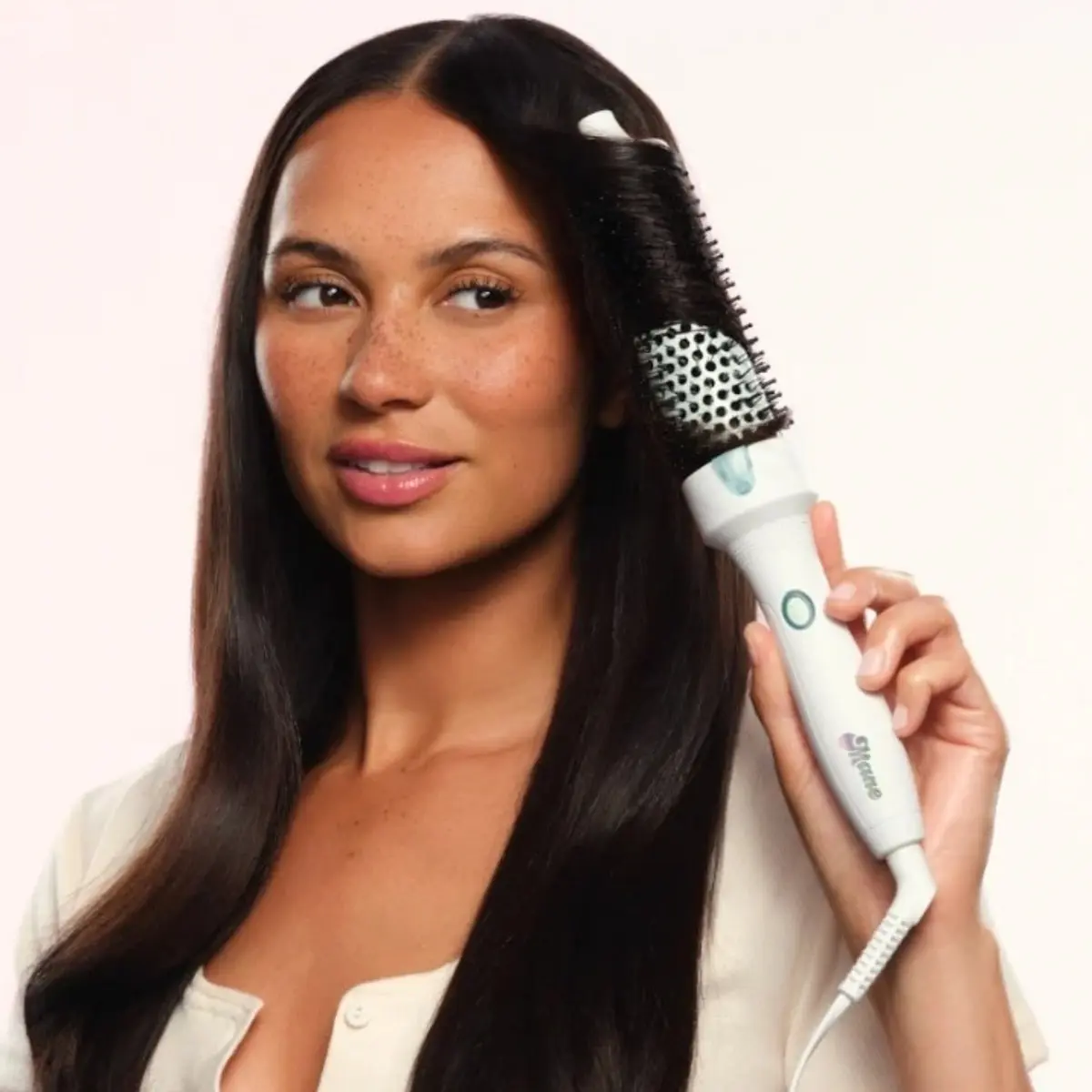
- Mane It’s Giving Body Medium Hot Thermal Round Brush: A versatile hot brush that delivers smooth waves, essential root volume, and beautifully polished bangs simultaneously.
- Davines This Is A Perfecting Hairspray: An ultra-fine mist that locks in waves without stiffness, preserving natural movement and bounce.
- Emi Jay Big Effing Clip: A stylish, heavy-duty claw clip designed to keep long, thick hair completely secure without slipping.
3. Harnessing the Power of Bangs
Bangs are arguably the ultimate secret weapon for anyone blessed with a heart-shaped face. By physically breaking up the expanse of the broad forehead, bangs introduce instant softness and balance.
"I always style bangs first anytime someone has an appointment at the salon with bangs, so make sure you keep that in mind," Wright shares. "I always use a flat brush to get the bangs smooth, and then go back in with either your round brush."
Whether opting for a sweeping side-bang or a textured, straight-across fringe, the goal is to soften the geometric lines of the upper face.
Recommended Tools for the Look:
- Davines MELU Anti-Breakage Hair Shield for Long Hair: A premier thermal protectant that shields fragile strands and delicate bang sections from heat damage while imparting deep hydration and shine.
- Mane This Totally Blows! Ionic Compact Hair Dryer: A powerful, compact dryer utilizing advanced ionic technology to dramatically reduce drying time and eliminate frizz.
Future Outlook: Navigating Common Mistakes and the Next Wave of Hair Care
As the beauty landscape continues to evolve, avoiding common styling errors remains critical for those with heart-shaped faces.
What Mistakes Should Heart-Shaped Faces Avoid?
According to Wright, the biggest misstep isn’t necessarily a catastrophic styling failure, but rather a lack of volume awareness. For those rocking chin-length or shoulder-length cuts, allowing too little volume at the roots can inadvertently exaggerate the sharpness of the jaw and chin, making the upper face look top-heavy. Conversely, for longer hair lengths, failing to incorporate strategic, face-framing layers or bangs misses a vital opportunity to create soft, harmonious movement around the cheekbones.
To lock in your final look and maintain effortless texture throughout the day, professional stylists consistently recommend a high-end finishing product:
- Davines This is a Dry Texturizing Finishing Spray: The ultimate finishing touch, delivering a piecey, defined, yet touchable look that keeps styles dynamic and modern from morning until night.
The Future of Face-Shape Customization
Looking ahead, the intersection of AI-driven hair consultations, hyper-personalized salon treatments, and advanced smart-styling tools points toward an even more customized era of beauty. Stylists predict that consumers will increasingly move away from one-size-fits-all hair trends, favoring precision cuts tailored explicitly to their skeletal architecture. For the heart-shaped face, this means a continued celebration of bespoke fringe designs, chin-enhancing texturizing techniques, and an empowered embrace of nature’s most romantic geometry.