


Executive Overview
The American aviation sector is slowly clawing its way back to normalcy following an unprecedented and deeply disruptive nationwide flight grounding that brought the country’s airspace to a sudden halt for roughly four hours on a Friday. While aviation analytics firms report that the vast majority of commercial flights have resumed schedules, the downstream effects of the freeze continue to reverberate. Hundreds of cancellations, frustrated passengers stranded across thousands of terminals, and sharp political clashes have turned an operational crisis into a major flashpoint for the Trump administration.
Beyond the tarmac, the weekend’s events have triggered intense scrutiny of federal leadership, a bruising round of Sunday morning political talk show appearances by Transportation Secretary Sean Duffy, and high-stakes conversations across the broader media and cultural landscape. From the sudden political alienation of the influential "podcast bros" demographic following the midterm elections to the poignant reflections of veteran journalist Scott Pelley at the Poynter Institute’s Bowtie Ball, the cultural and political currents in the United States are shifting rapidly. This report provides an exhaustive, multi-layered examination of the flight grounding crisis, the subsequent political fallout, structural infrastructure challenges, and the broader media developments shaping the national conversation.
Detailed Chronology: The 4-Hour Freeze and Recovery
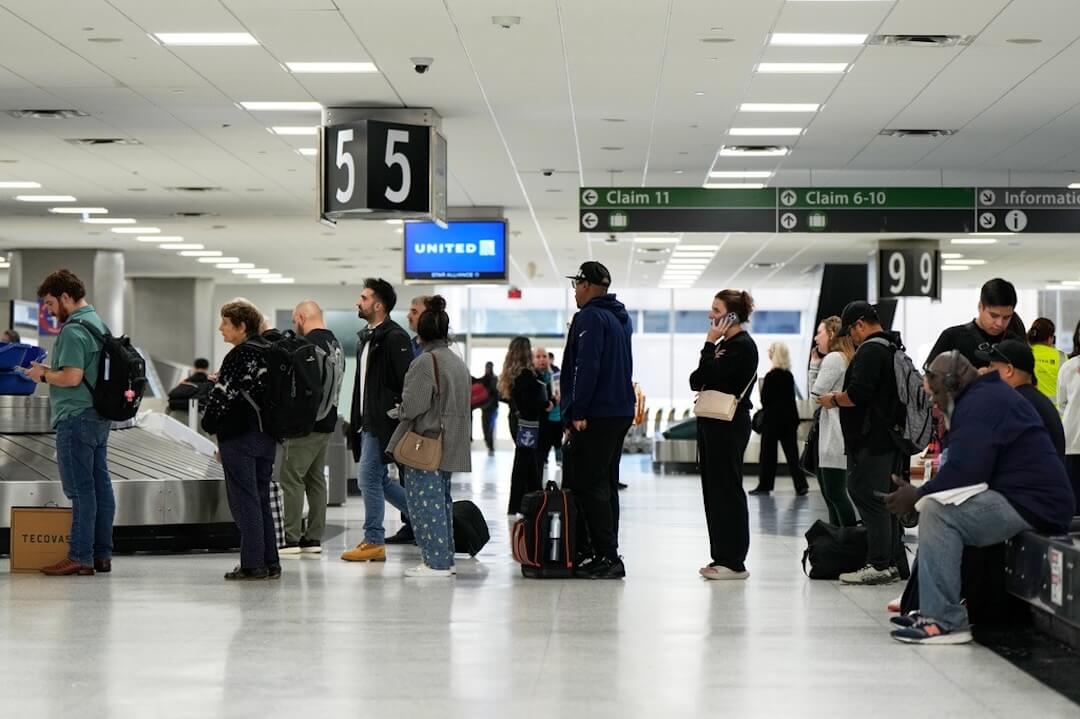
The crisis began without warning on Friday afternoon, plunging the United States transportation network into chaos. Without prior public notice, federal authorities enacted a total nationwide ground stop, halting all departing commercial flights. For approximately four hours, millions of travelers were left stranded inside aircraft on tarmacs, queuing in endless lines at terminal gates, or scrambling for information as departure boards flashed red across the country.
By Sunday afternoon, conditions had improved significantly, though lingering anomalies remained evident. According to data compiled by aviation analytics firm Cirium, nearly 70 percent of all scheduled domestic flights departed within 14 minutes of their scheduled departure time by late Sunday afternoon. However, the system’s fragility was laid bare by cancellation metrics: approximately 7 percent of flights—representing more than 1,900 individual trips—were scrubbed entirely. This cancellation rate was notably higher than that of a typical operating day, serving as a persistent reminder of the systemic bottlenecks triggered by the nationwide flight freeze.
Travelers forced to endure the weekend fallout encountered opaque communications, shifting departure schedules, and a profound lack of real-time updates from federal authorities during the initial hours of the shutdown. The operational chaos served as a stark preview of the political firestorm that would soon engulf the Department of Transportation and the White House.
Supporting Context & Metrics: Infrastructure Realities and the $50 Billion Question
At the heart of the operational breakdown lies a stark and persistent reality: the aging, brittle infrastructure of the United States aviation system. During his weekend media blitz, Homeland Security Secretary Markwayne Mullin offered a candid, if blunt, assessment of the technology underpinning modern American air travel.
"What we were trying to do… is to make an old, 50-year-old system, which is basically an old dial-up system, work with the new technology we have today," Mullin explained during an appearance on Fox News’ The Sunday Briefing. "It’s caused problems."
This technological deficit formed the basis for the Trump administration’s immediate, aggressive push for emergency capital. On Friday evening, as stranded passengers filled terminals nationwide, Transportation Secretary Sean Duffy held a high-profile press conference alongside FAA officials. Rather than offering immediate operational reassurances or a detailed timeline for full recovery, Duffy delivered an urgent financial plea, demanding $50 billion from Congress to overhaul the nation’s air traffic control and aviation systems.
"This is an emergency. This is an emergency. I want Congress to give emergency funding," Duffy insisted, emphasizing that decades of deferred maintenance and bipartisan underinvestment had bequeathed the current administration a critically compromised system.
The Political and Bipartisan Backlash
Duffy’s emergency press conference, delivered while passengers remained stranded in the dark regarding the status of their travel plans, misfired badly with the public and lawmakers alike. The aggressive tone—perceived by many as an inopportune time to lobby for legislative funding rather than provide operational accountability—ignited swift, bipartisan outrage.
Conservative commentators and lawmakers were particularly vocal in their condemnation. Marc Thiessen, a prominent conservative columnist, took to social media to lambistic the strategy, tweeting: "What is Duffy doing? No one cares about political responsibility right now. They want to know what’s happening, when it will be fixed, and when planes will be flying again!"
Former Georgia Representative Marjorie Taylor Greene was even more scathing in an extensive post on X (formerly Twitter). "This press conference is unreal bull[expletive]," Greene wrote. "It’s literally like a shakedown for more money… This is the biggest [expletive] you to the American people. I’ve never seen anything so pathetic in my life!"
Official Statements and the "Full Ginsburg" Accountability Tour
The political damage control reached its peak on Sunday when Transportation Secretary Duffy executed what media insiders call "The Full Ginsburg"—appearing on all five major Sunday morning news programs in a single day. Named after lawyer William Ginsburg, who famously achieved the feat in 1998 while representing Monica Lewinsky, the maneuver is a rare media strategy attempted only a few dozen times in television history.
Navigating the Sunday Circuit
Across NBC’s Meet the Press, CNN’s State of the Union, and other major broadcasts, Duffy faced relentless questioning regarding accountability and presidential prioritization.
On NBC, moderator Kristen Welker pressed Duffy directly, noting that the FAA administrator had apologized to the public during Friday’s briefing. "You are, of course, the transportation secretary. Do you feel you also owe an apology to the American people? This happened on your watch."
Duffy countered by emphasizing his rapid pace of administrative reform while deflecting personal culpability. "Well, listen, it happened on my watch. But we have to be clear," Duffy said. "I am moving at an incredible speed that no one has done at the FAA or the DOT in decades… But I can’t apologize for what was passed on to us. And I can’t blame Republicans or Democrats because it’s all of them. It goes back, 20, 25, 30 years of a lack of investment."
Meanwhile, CNN’s Dana Bash confronted Duffy with a fundamental question concerning executive leadership and legislative prioritization: "President Trump has been in office, complete control of Congress for Republicans for two years. He’s really vocal about his priorities. He got Congress to fund ICE. He’s used his platform to push priorities like election reform, the White House ballroom, the Reflecting Pool. Is it a failure on his part that you haven’t gotten this money?"
Duffy steadfastly defended the president, asserting that modernization of the national airspace has been a quiet yet persistent passion for Donald Trump since before his swearing-in, despite a relative lack of public pronouncements on the topic from the Oval Office itself.
President Trump’s Response and Social Media Silence
President Trump’s personal response to the crisis drew heavy criticism from observers and political opponents. From the moment the skies were shut down on Friday afternoon through Saturday, the president offered no public statements, press conferences, or official White House communiques addressing the nationwide travel paralysis.
Instead, Trump’s digital footprint during the immediate aftermath focused on unrelated topics, including criticisms of California Governor Gavin Newsom, updates on the East Potomac golf course renovation, and commentary on stock market volatility following Democratic gains in the midterm elections.
It was not until Sunday morning that Trump broke his silence via a post on Truth Social. In his message, the president pointed fingers at the preceding Biden administration while issuing an urgent plea to Capitol Hill: "We have the knowledge and plan for the Flight Control Systems, we need Congress to give the money, FAST! Our FAA is doing a great job, and is ready to go."
Broader Media, Cultural, and Political Ripples
The Midterm Fallout and the Defection of the "Podcast Bros"
The aviation crisis unfolded against a backdrop of sweeping political shifts, most notably the Republican setbacks in the recent midterm elections. One of the most compelling sociological stories of the 2024 presidential election had been Donald Trump’s successful cultivation of young male voters—specifically the 18–29 demographic—through high-profile appearances on prominent podcasts hosted by figures like Joe Rogan, Theo Von, and Andrew Schulz.

However, recent voter trends suggest a swift reversal of this political alignment. Initial election data analyzed by The New York Times revealed a profound change of heart among young men. Voters aged 18–29—the prime demographic for "manosphere" media—shifted more than 30 points to the left in subsequent voting trends, while male voters as a whole shifted approximately 17 points leftward.
Weighing in on the midterm results, Joe Rogan offered a rare political observation on Friday. "They didn’t just lose the podcast bros. They lost most of the country," Rogan remarked, reinforcing his general disdain for partisan politics while acknowledging the undeniable political erosion facing the administration.
Scott Pelley Honored at the Poynter Bowtie Ball
Away from the capital’s political theater, the journalism community gathered in Tampa, Florida, for the Poynter Institute’s annual Bowtie Ball. Longtime 60 Minutes correspondent Scott Pelley was honored with the prestigious Poynter Medal for Lifetime Achievement in Journalism.
In a candid onstage conversation with Poynter President Neil Brown, Pelley reflected on his storied career—spanning from his early days reporting in Texas to anchoring the CBS Evening News and anchoring investigations for 60 Minutes. However, the discussion took a sharp turn when Pelley addressed his departure from CBS earlier that summer.
Pelley revealed to the hundreds of attendees that he has not watched 60 Minutes since his firing. "I know what we built there, and I know what they’ve done, and I cannot bring myself to watch it," Pelley stated. He went on to offer a sobering critique of modern broadcast journalism: "We had corporate imperatives and political bias reaching right into our scripts. And once that’s started, the broadcast loses its independence, it loses its credibility, and then at that point, it loses its audience."
The evening also celebrated other industry leaders, including Hearst President and CEO Steven R. Swartz, who was awarded the 2026 Distinguished Service to Journalism Award.
Pop Culture Intersection: Billy Evans Breaks Silence on Theranos Docuseries
In the realm of cultural media, Billy Evans—the longtime partner of disgraced Theranos founder Elizabeth Holmes—broke his media silence following the release of the buzzed-about, three-hour documentary You Can See Everything, directed by Nathan Fielder and Lance Oppenheim.
In a revealing interview with Matt Gutman for CBS Sunday Morning, Evans addressed the documentary’s controversial creative choices, including a widely discussed shower scene for which he stated he did not grant explicit consent. Despite an unflattering portrayal, Evans maintained a philosophical perspective: "I would have preferred for that not to be the case, but it’s entertainment, you know, and I didn’t get to control that edit."
Evans also discussed actress Amanda Seyfried, who won an Emmy for playing Holmes in the 2022 miniseries The Dropout and who appears in You Can See Everything both as herself and recreating scenes as Holmes. Evans expressed appreciation for Seyfried’s participation, noting that it highlighted the stark contrast between theatrical dramatization and real life, even as Seyfried’s on-screen persona openly scrutinized Evans’s actions.
Future Outlook
As the American aviation system normalizes and flight schedules return to baseline predictability, the long-term ramifications of Friday’s grounding remain unresolved. The incident has permanently altered the political calculus surrounding federal infrastructure spending, forcing both parties to confront the vulnerabilities of a 50-year-old air traffic control architecture.
Whether Congress will heed Transportation Secretary Duffy’s urgent call for a $50 billion emergency infusion remains an open question on Capitol Hill, particularly given the tense partisan dynamics following the midterms. Meanwhile, the executive branch faces mounting pressure to demonstrate transparent leadership, avoid communication vacuums during national emergencies, and prove that the nation’s skies are secure against both technical obsolescence and operational failure.
