In the fast-evolving landscape of search engine optimization, the sheer volume of available software can paralyze even the most seasoned digital marketers. A quick search for "best SEO tools" yields hundreds of conflicting listicles, leaving practitioners drowning in feature lists, redundant dashboards, and costly subscriptions. Do you need a dozen disparate platforms to unearth profitable keywords, or can a lean, highly targeted stack deliver superior results?
To cut through the noise and eliminate analysis paralysis, 139 of the world’s leading search marketing experts, enterprise SEO managers, and agency founders were asked a straightforward, high-stakes question:
"If you could only use 3 tools for keyword research, which 3 would you choose?"
By going straight to the source—consulting the practitioners building profitable campaigns for Fortune 500 brands and high-growth startups alike—a definitive leaderboard has emerged. The consensus is clear: modern keyword research is no longer just about raw search volume; it is about mastering search intent, conducting ruthless competitor gap analyses, and leveraging deep semantic insights.
This comprehensive report breaks down the ultimate industry leaderboard, analyzes the standout features of the top-voted platforms, and distills the collective wisdom of nearly 140 industry authorities into an actionable blueprint for your SEO strategy.
The Leader
board: Top Keyword Research Tools by Vote Count
While dozens of niche scrapers, browser extensions, and proprietary data crunchers were mentioned throughout the survey, three heavyweights overwhelmingly dominated the ballots.
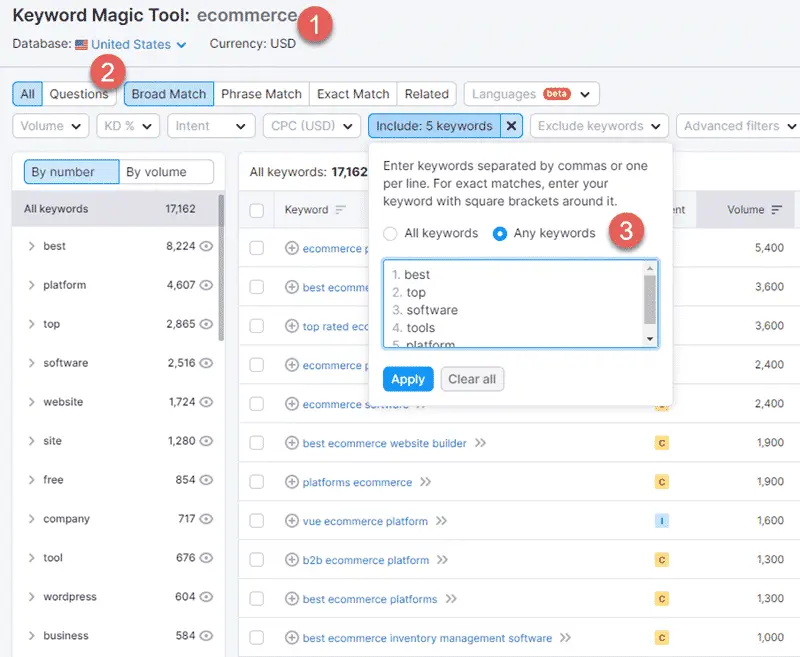
Semrush captured the top spot, cementing its status as the industry-leading, all-in-one SEO and competitive intelligence suite. Boasting one of the largest keyword databases on the market—spanning over 23 billion keywords across 142 international databases—Semrush is favored for its robust versatility across both organic (SEO) and paid (PPC) campaigns.
The Keyword Magic Tool: Praised widely by contributors, this feature allows users to group thousands of keywords into granular topic silos, filter by search intent, question types, and SERP features, and instantly push terms into position-tracking or PPC campaigns.
The Keyword Gap Tool: A favorite for competitive analysis, enabling side-by-side comparisons of up to five competing domains to unearth high-value keyword opportunities that your own site is missing.
2. Google Keyword Planner (57 Votes)
As the native tool straight from the search engine giant, Google Keyword Planner (GKP) remains a foundational staple, despite its limitations.
The Caveat: While historically free and open, GKP now restricts granular search volume data to accounts actively running paid Google Ads campaigns. Non-paying users receive only broad volume ranges. Furthermore, because its data is derived from paid search, SEO purists argue it lacks true organic context and advanced filtering.
The Value Proposition: Despite these drawbacks, GKP remains unmatched for validating high-level traffic baselines, exploring local/geo-targeted search volumes, and uncovering baseline commercial intent through historical CPC (Cost-Per-Click) bid data.
3. Ahrefs Keywords Explorer (55 Votes)
A close runner-up, Ahrefs is revered as a powerhouse all-in-one SEO toolkit, with its Keywords Explorer serving as a gold standard for comprehensive topical research.
The Keyword Ideas Report: Similar to Semrush’s keyword mapper, Ahrefs allows users to feed in a seed term and instantly generate thousands of variations across Google, Bing, Yahoo, YouTube, and Amazon.
Advanced SERP Metrics: Beyond basic volume, Ahrefs provides critical metrics such as Return Rate (RR), Clicks distribution, and deep backlink-driven Keyword Difficulty (KD) scores, giving marketers a realistic assessment of whether they can actually crack the first page.
Expert Insights: The Top 3 Pillars According to the Industry Leaders
While the leaderboard highlights the overall favorites, the individual responses from 139 industry practitioners reveal nuanced strategies. Many experts emphasize that effective keyword research relies on a synergistic stack rather than a single silver bullet.
1. Luke Monaghan (International SEO Manager, lululemon)
"If I had to choose three keyword research tools that I use the most regularly, I’d have to choose Semrush for competitive insight, SISTRIX for historical performance and visibility charts, and Keywordtool.io for long-tail variants. SEO has moved beyond exact-match vanity keywords; you have to build deep context."
2. Geoff Kenyon (Founder, GeoffKenyon.com)
Geoff highlights a hybrid approach combining KeywordTool.io for content theme generation, Semrush for uncovering competitor paid and organic bids, and good old-fashioned Microsoft Excel for keyword mapping, categorization, and programmatic regional scaling using formulas like CONCATENATE.
3. John Doherty (Founder, Credo)
John leans into a specialized trio: Ahrefs for killer topic research, Semrush for deep domain-level competitor analysis, and AnswerThePublic to nail down question-based informational queries that capture top-of-funnel search intent.
4. Paul Shapiro (Technical SEO Lead, Shopify)
Challenging the conventional tool stack, Paul advocates for advanced technical workflows that go beyond the basics:
KNIME: An open-source data analytics platform used for advanced semantic keyword clustering and text mining.
MarketMuse: An AI-driven tool that crawls websites to identify topical authority gaps using sophisticated modeling algorithms.
Seed Keywords: A human-centric micro-survey platform that asks actual target audiences how they search for products, bypassing traditional search tool bias.
5. Chris Dreyer (CEO, Rankings.io)
Chris emphasizes the often-underutilized power of Google Search Console (GSC):
"I believe Search Console is overlooked a lot because it’s a free tool provided by Google. Site owners not using this on a regular basis are short-changing themselves. It shows you the exact queries people are using to find your site, what you rank for, and your true SERP position."
Supporting Context, Data, and Emerging Methodologies
As search engines become smarter through machine learning and natural language processing (NLP), the definition of "keyword research" is undergoing a structural paradigm shift. Several key themes emerged from the broader expert panel:
The Death of Traditional Keyword Stuffing and the Rise of "Search Intent"
Multiple experts—including Brendan Hufford (ActiveCampaign) and Suganthan Mohanadasan (Snippet Digital)—argued that focusing obsessively on single keyword phrases is outdated. Modern SEO requires topic clustering and mapping content to user intent.
As Suganthan notes, modern tools like Keyword Insights utilize state-of-the-art NLP and SERP clustering to determine whether a keyword requires a single dedicated blog post, a comprehensive pillar page, or a transactional e-commerce category page.
The Human Element: Talking to Real Customers
Several seasoned practitioners, such as Kurt Frankenberg and Jay Acunzo, issued a stern reminder that software should never replace direct customer communication.
"Before opening any tool, talk to your actual customers or customer service reps," notes Carrie Hill (Sterling Sky). "The words real people use to describe a product or service often completely mismatch what software assumes they type into search boxes."
Specialized Niche Tools and Chrome Extensions
Beyond the major suites, several auxiliary tools received high praise for specific workflow efficiencies:
Keywords Everywhere: A lightweight browser extension praised by Joe Williams, Saurabh Bisht, and Freddie Chatt for injecting search volume data directly into Google SERPs and auto-suggest boxes on the fly.
AnswerThePublic / alsoasked.com: Universally lauded as the premier visual scrapers for unearthing questions, prepositions, and long-tail informational queries.
BuzzSumo: Widely cited not as a keyword tool per se, but as an essential validator for content ideation, social sharing trends, and headline validation.
Future Outlook: What’s Next for Keyword Research?
As we look toward the future of search marketing, the convergence of artificial intelligence, zero-click searches, and multimodal queries (voice, visual, and AI-driven chat interfaces like Search Generative Experience) will continue to reshape how marketers discover opportunities.
AI-Driven Semantic Modeling Tools: Platforms like MarketMuse, Surfer SEO, and emerging AI clustering tools will transition from optional add-ons to core enterprise requirements, helping brands build comprehensive topical authority rather than chasing isolated keywords.
The Renaissance of First-Party Data: With privacy regulations tightening and traditional keyword databases facing data sampling limitations, savvy marketers will increasingly rely on a combination of Google Search Console API data, internal customer support logs, and programmatic analysis (via tools like Python or KNIME) to uncover proprietary keyword opportunities.
Consolidation of the SEO Tech Stack: While specialized point solutions will always exist for scraping or intent-clustering, the dominance of all-in-one suites like Semrush and Ahrefs remains virtually unassailable. Their ability to bundle keyword research, backlink auditing, site health monitoring, and rank tracking into a single ecosystem provides unmatched ROI for marketing teams.
That’s a Wrap!
A massive thank you to all 139 search marketing experts who contributed their insights, workflows, and toolstacks to this comprehensive industry roundup.
To recap the expert consensus: while native platforms like Google Keyword Planner remain useful for high-level traffic baselines, industry leaders overwhelmingly rely on Semrush for competitive intelligence and Ahrefs for deep topical exploration—supplemented by agile extensions like Keywords Everywhere and intent scrapers like AnswerThePublic.
Which tools are currently anchoring your keyword research stack? Are you leaning into AI-driven clustering, or sticking to the classic data giants? Let us know in the comments below!