In the fast-paced ecosystem of search engine optimization (SEO) and paid media, the myth persists that marketers need a dizzying array of dozens of disparate platforms to build a profitable campaign. Search engine results pages (SERPs) are littered with endless "top 10, 20, 50, or 100" tool lists that often leave practitioners paralyzed by choice, drowning in data, and no closer to selecting the right infrastructure for their specific business needs.
To cut through the noise and eliminate the paralysis of choice, we went straight to the source. We polled 139 leading search marketing experts, enterprise SEO managers, agency founders, and content strategists with a simple, high-stakes question:
"If you could only use 3 tools for keyword research, which 3 would you choose?"
The responses provide an authoritative, battle-tested leaderboard that reveals precisely which platforms the industry’s top operators rely on to drive profitable online marketing campaigns for their own properties and high-profile clients. Crowned by a clear top tier—led by Semrush, Google Keyword Planner, and Ahrefs—this exhaustive review examines the definitive keyword research tools shaping modern digital marketing strategies.
Detailed Chronology and Leaderboard Breakdown
While the digital marketing landscape has evolved significantly over the years, the core tools relied upon by top-tier practitioners have coalesced into a powerful, reliable triad. Based on total expert vote counts, three dominant platforms emerged at the top of the leaderboard:
Semrush (87 votes)
Google Keyword Planner (57 votes)
Ahrefs Keywords Explorer (55 votes)
1. Semrush: The Industry-Leading All-in-One Powerhouse
Securing the top spot with 87 votes, Semrush established itself as the undisputed favorite among search marketing experts. Boasting one of the largest keyword databases in the industry—exceeding 23 billion keywords spanning 142 international databases—Semrush provides deep topical and competitor keyword intelligence for both organic SEO and pay-per-click (PPC) campaigns.
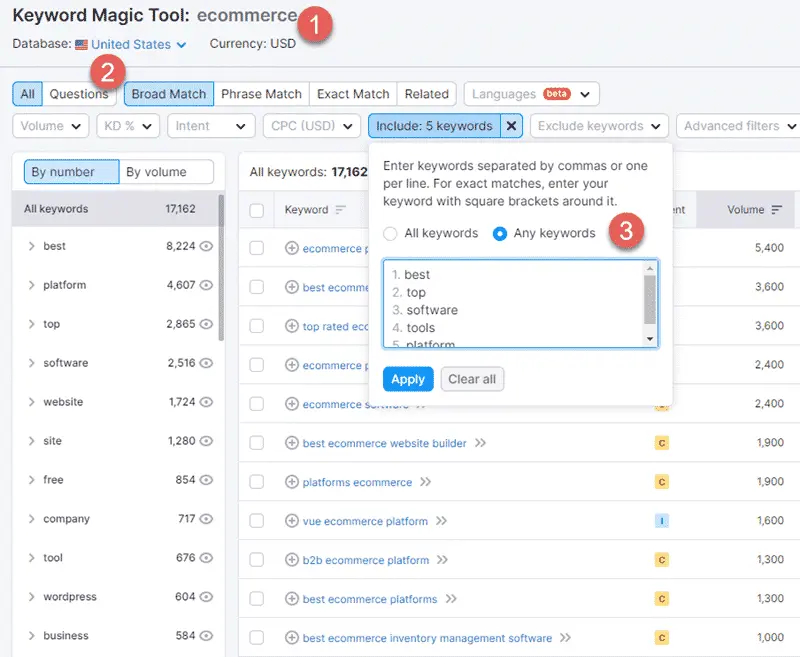
Keyword Magic Tool: Highly praised for its ability to segment keywords by topic, search intent, question type, and SERP features. Users can effortlessly filter by difficulty and competition metrics, saving keywords directly to lists or pushing them into position-tracking and PPC toolkits.
Keyword Gap Tool: A favorite for competitive intelligence, allowing side-by-side comparisons of up to five competing domains to uncover missed keyword opportunities, shared terms, and unique rankings.
2. Google Keyword Planner: The Gold Standard for Raw Data
Ranking second with 57 votes, the Google Keyword Planner remains a staple, though its functionality has shifted. While it is fundamentally built for the Google Ads platform (offering precise search volume data primarily to active advertisers, while providing only rough ranges to non-advertisers), experts continue to value it for baseline traffic numbers, localized geographic targeting, and direct insights from the search engine itself.
3. Ahrefs Keywords Explorer: The SEO Tactician’s Choice
With 55 votes, Ahrefs stands shoulder-to-shoulder with Semrush as an elite all-in-one SEO solution. Its Keywords Explorer report is lauded for multi-engine support (pulling data across Google, Bing, Yahoo, YouTube, and Amazon) and its robust Keyword Ideas Report. Experts rely heavily on Ahrefs for its backlink-informed Keyword Difficulty (KD) scores, traffic potential metrics, and click-through rate (CTR) behavior modeling.
Supporting Context & Metrics: How the Industry Giants Utilize Their Toolkits
A tool is only as powerful as the strategist wielding it. An analysis of the expert responses reveals distinct methodological workflows that separate elite marketers from the rest of the pack.
Moving Beyond Simple Keywords: Search Intent and Topical Clustering
A recurring theme among top practitioners—such as Brendan Hufford of ActiveCampaign and Suganthan Mohanadasan of Snippet Digital—is that traditional keyword research focused strictly on isolated search volumes is effectively dead. Modern SEO requires a focus on search intent and topical authority.
Rather than chasing a single vanity keyword, experts leverage advanced filtering and semantic tools to map out clusters of content. For instance:
Chris Castillo highlights the synergy of combining Ahrefs and Keywords Everywhere for raw data collection, paired with Keyword Cupid for automated semantic clustering into content themes.
Paul Shapiro of Shopify champions advanced tools like KNIME and MarketMuse to execute sophisticated semantic keyword research and topic modeling, ensuring content addresses the complete informational needs of the user.
The Human Element: Customer Interviews and Qualitative Research
Several veterans pointed out that software alone cannot replace direct human interaction.
Kurt Frankenberg notes that his absolute best keyword insights come from old-fashioned customer interviews: asking real, paying clients how they searched for a solution or what exact phrasing they used.
Carrie Hill of Sterling Sky echoes this sentiment, emphasizing that customer service interactions and direct audience conversations reveal nuances, slang, and localized intent ("near me," "recommended," "reviews") that algorithmic tools frequently miss.
Leveraging the Unsung Hero: Google Search Console (GSC)
A massive contingent of surveyed experts—including Chris Dreyer, Charlie Williams, and Emily Yost—stressed that Google Search Console is arguably the most underutilized, yet invaluable, free keyword tool available. By mining GSC data, marketers can uncover:
High-impression, low-CTR queries that represent immediate "low-hanging fruit" optimization targets.
Hidden or brand-obscured terms that real users are typing to find existing content.
Performance data for pages that are already validated by Google as relevant to specific sub-topics.
Official Expert Statements & Perspectives
The 139 contributing experts provided a rich tapestry of tactical advice. Below is a snapshot of how specific industry leaders structure their top three toolkits:
Luke Monaghan (International SEO Manager, lululemon): Relies on Semrush for competitive visibility insights, SISTRIX for historical performance and client-friendly visibility charts, and Keywordtool.io for capturing long-tail variants.
John Doherty (Founder, Credo): Chooses Ahrefs for killer topic research, Semrush for domain-level competitor analysis, and AnswerThePublic for nailing question-based keyword research.
Adam Connell (Founder, Blogging Wizard): Points to Ahrefs for advanced click-through data and backlink metrics, KWFinder for quick autocomplete and question-based research with slick SERP analysis, and AnswerThePublic as a free foundational ideation tool.
Eli Schwartz (SEO Consultant): Combines Ahrefs for historical competitor rankings, Rank Ranger to drill into Google Search Console data, and the Google Keyword Planner as a trusted source for relative traffic data.
Brian Jackson (Co-Founder, Forgemedia): Uses Ahrefs to assess top SERP holders and content viability, Semrush for PPC ad history and accurate difficulty metrics, and KWFinder for rapid long-tail list building and organization.
Future Outlook: The Evolution of Keyword Research
As we look toward the future of search marketing, the definition of keyword research continues to morph. The integration of machine learning, natural language processing (NLP), and AI-driven search experiences (such as Google’s Search Generative Experience) means that marketers must adapt their tool stacks accordingly.
AI and Semantic Clustering: Tools that utilize machine learning to automatically cluster keywords by search intent—such as Keyword Insights or native modules within Semrush and Ahrefs—will transition from "nice-to-have" to mandatory infrastructure. Marketers will spend less time manually grouping spreadsheets and more time engineering comprehensive topical authority maps.
Multi-Platform Search Optimization: With users increasingly bypassing traditional Google searches in favor of platform-specific queries on YouTube, Amazon, TikTok, and Reddit, tools that can aggregate data across these ecosystems (e.g., Keywordtool.io, Ahrefs, and Wordtracker) will see a surge in strategic importance.
First-Party Data Integration: As privacy regulations tighten and third-party data becomes more volatile, enterprise SEOs are following the playbook of leaders like Andrew Shotland (Local SEO Guide), investing in proprietary internal databases and machine learning scripts to process GSC and CRM data at scale.
Conclusion
Ultimately, the consensus from 139 of the world’s best search marketers is clear: you do not need a subscription to every tool on the market. By anchoring your strategy with a robust all-in-one suite like Semrush or Ahrefs, supplementing it with raw data from the Google Keyword Planner or Google Search Console, and grounding your research in real human intent and qualitative customer feedback, you can build a streamlined, high-performance keyword arsenal capable of dominating the SERPs in any vertical.


![139 Experts Reveal Best Keyword Research Tools [Leaderboard]](https://www.robbierichards.com/wp-content/uploads/2021/01/Best-Keyword-Research-Tools-for-SEO.jpg)
![139 Experts Reveal Best Keyword Research Tools [Leaderboard]](https://www.robbierichards.com/wp-content/uploads/2021/10/Semrush-home-page-screenshot.jpg)
![139 Experts Reveal Best Keyword Research Tools [Leaderboard]](https://www.robbierichards.com/wp-content/uploads/2022/05/image12.png)
![139 Experts Reveal Best Keyword Research Tools [Leaderboard]](https://www.robbierichards.com/wp-content/uploads/2022/06/Keyword-Gap-Tool.jpg)
![139 Experts Reveal Best Keyword Research Tools [Leaderboard]](https://www.robbierichards.com/wp-content/uploads/2018/08/rj-employee_Robbie-color-new.png)
![139 Experts Reveal Best Keyword Research Tools [Leaderboard]](https://www.robbierichards.com/wp-content/uploads/2022/06/Google-Keyword-Planner.jpg)
![139 Experts Reveal Best Keyword Research Tools [Leaderboard]](https://www.robbierichards.com/wp-content/uploads/2022/06/Ahrefs-home-page.jpg)
![139 Experts Reveal Best Keyword Research Tools [Leaderboard]](https://www.robbierichards.com/wp-content/uploads/2021/08/Luke-Monaghan-headshot.jpg)
![139 Experts Reveal Best Keyword Research Tools [Leaderboard]](https://www.robbierichards.com/wp-content/uploads/2021/08/Gael-Breton-headshot.jpg)
![139 Experts Reveal Best Keyword Research Tools [Leaderboard]](https://www.robbierichards.com/wp-content/uploads/2015/04/KW-Expert-Roundup.jpg)
![139 Experts Reveal Best Keyword Research Tools [Leaderboard]](https://www.robbierichards.com/wp-content/uploads/2019/05/John-Doherty-150x150.jpg)
![139 Experts Reveal Best Keyword Research Tools [Leaderboard]](https://www.robbierichards.com/wp-content/uploads/2015/04/ana_hoffman.jpg)
![139 Experts Reveal Best Keyword Research Tools [Leaderboard]](https://www.robbierichards.com/wp-content/uploads/2021/08/Paul-Shapiro-headshot.jpg)
![139 Experts Reveal Best Keyword Research Tools [Leaderboard]](https://www.robbierichards.com/wp-content/uploads/2021/08/Chris-Castillo.jpg)
![139 Experts Reveal Best Keyword Research Tools [Leaderboard]](https://www.robbierichards.com/wp-content/uploads/2021/08/Matthew-Barby-headshot.jpg)